Beginner 8 minutes
How marine life is classified: why the name matters
From common names to the system that organizes everything you'll see underwater
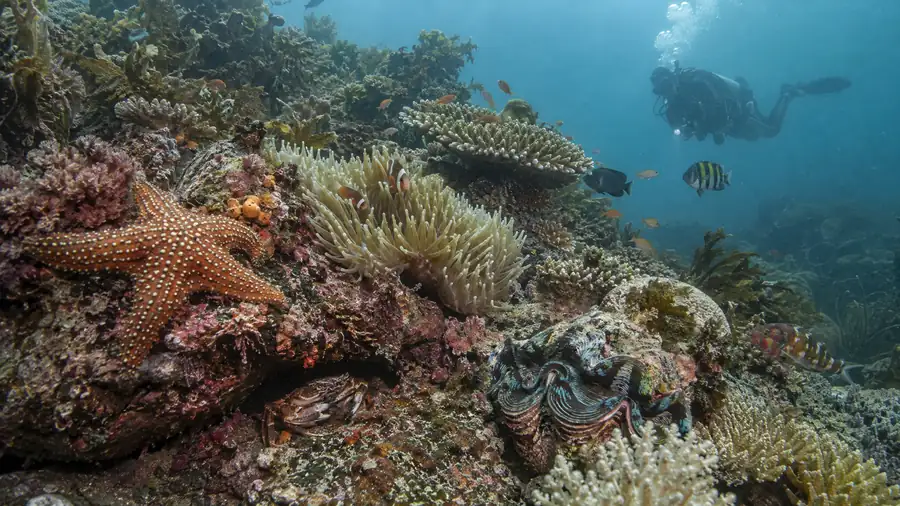
The same fish is called four different things on four islands of the same archipelago, and on the island next door that same name refers to a completely different animal. That's why there's a parallel naming system that no one uses on the boat, and that solves exactly this problem.
In this article you'll see why classification is needed, how the hierarchy that organizes living things works, what scientific names are and how they're written, the major groups a diver encounters, and why that classification changes from time to time.
Identifying by group instead of by individual names multiplies what you get out of a dive: recognizing a family tells you how an animal you've never seen before feeds, where it lives, and how it behaves.
What classification is for
The original motive is practical: talking about the same thing. Common names change from one language to another, from one country to another, and sometimes from one port to the next, and the same name can refer to species that don't look anything alike.
The scientific system solves that by assigning each species a single, universal name made up of two words: the genus and the specific epithet. That name is written in italics, with the genus capitalized and the rest lowercase, and it's the same in the Philippines as it is in Honduras.
But classifying does something more important than putting on labels: it groups things together. Placing a species within a family is a statement that it shares ancestry, and with it, a set of anatomical, physiological, and behavioral traits.
That turns classification into a field tool. If you recognize that an unfamiliar fish is a scorpionfish, you already know it's an ambush predator, that it's probably camouflaged against the substrate, and that you shouldn't rest your hand nearby, as covered in the article on venomous fish. You don't need the exact species to know how to behave.
That's why every diver who's good at identification gives the same advice: learn families before species. There are only a few dozen families that cover almost everything you'll see, and hundreds of species within each one.
The hierarchy
Boxes within boxes, from the most general to the most specific.
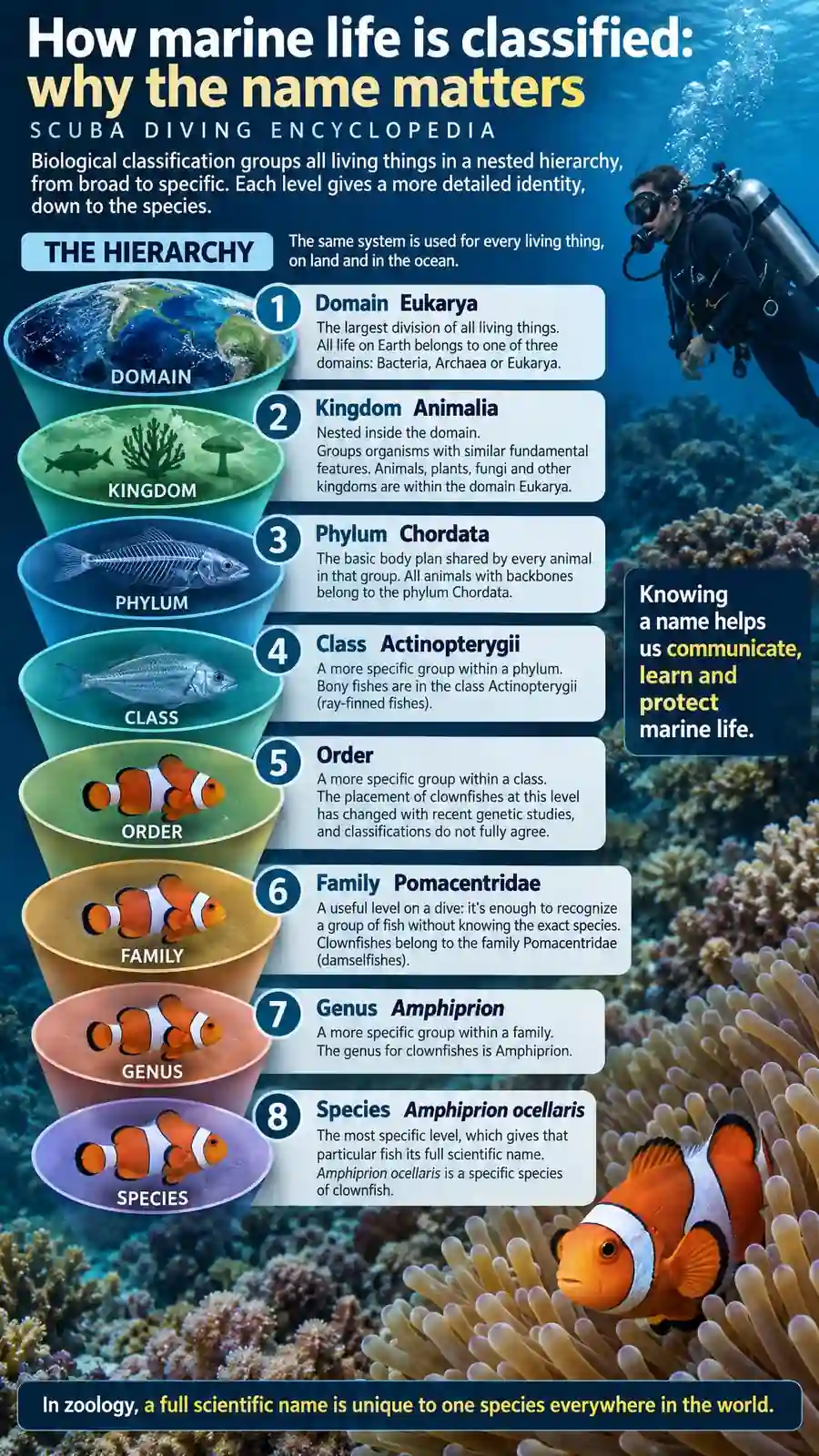
The main levels, from largest to smallest, are domain, kingdom, phylum, class, order, family, genus, and species. Each one groups together the level below it, and the further down you go, the more traits its members share.
The high levels: domain, kingdom, and phylum
At the very top there are three domains: two of organisms without a cell nucleus (bacteria and archaea, both with enormous presence and importance in the sea) and one that groups together everything else, from phytoplankton to whales.
Within that last domain are the kingdoms you'd recognize: animals, plants, fungi, and several groups of single-celled organisms and algae that don't fit neatly into any of the others.
Phylum is the level that pays off most in the sea, because it groups together completely different body plans: cnidarians, mollusks, arthropods, echinoderms, and chordates are all different phyla, and their differences are far greater than those between a shark and a human being.
The useful levels: class, order, and family
Class separates out groups a diver recognizes at a glance: within mollusks, gastropods, bivalves, and cephalopods are different classes; within chordates, cartilaginous fish, bony fish, reptiles, and mammals.
Order, and above all family, are the real working level underwater. Butterflyfish, angelfish, damselfish, wrasses, scorpionfish, moray eels: these are families, and each one has a recognizable body shape, swimming style, and behavior.
Learning to see the family is what lets you identify without a guide: body shape, fin position, mouth type, and swimming style are usually enough.
Genus and species
Genus groups together very closely related species, and species is the basic unit: populations that breed with each other and produce fertile offspring. In the sea that definition has its cracks, because there are hybrids and there are separated populations still considered the same species.
The full scientific name is the combination of both, and that's why species within the same genus share the first word: it's the fastest way to know that two animals are close relatives.
When a guide shows a name followed by the initials indicating an undetermined species, that's exactly what it means: the genus is known but not the specific species, something extremely common in poorly studied groups.
The major groups you'll encounter
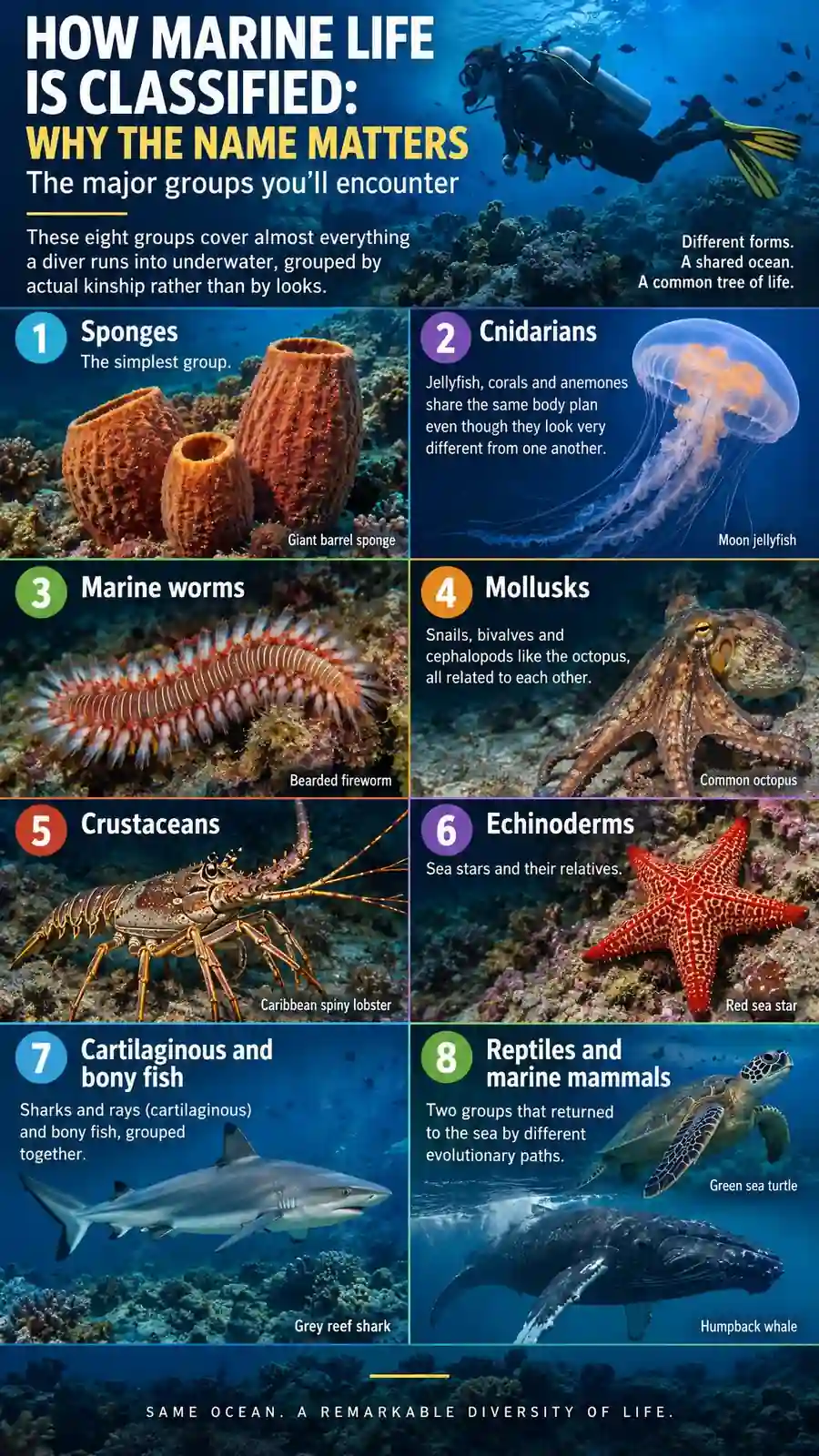
A quick map of what's on a reef, organized by relatedness rather than appearance.
Sponges are animals without tissues or organs, fixed filter feeders, and among the oldest animal lineages. Cnidarians (jellyfish, corals, anemones, hydrozoans) share the stinging weapon described in the article on jellyfish and are the reef builders.
Marine worms span several distinct phyla that everyday language lumps together, from polychaetes with their bristles to brightly colored flatworms that get mistaken for nudibranchs.
Mollusks include sea snails and nudibranchs, bivalves, and cephalopods, and arthropods include the huge group of crustaceans. Echinoderms (sea stars, urchins, sea cucumbers, crinoids) are an exclusively marine phylum with radial symmetry, a body plan that doesn't exist on land.
All of these are invertebrates and have their own article. Among vertebrates, cartilaginous and bony fish are covered in theirs, and marine reptiles and mammals in their respective ones: they're land lineages that returned to the sea.
And outside the animal kingdom is what sustains everything else: phytoplankton, algae, and marine seagrasses, plus bacteria and archaea whose role in nutrient cycles is enormous and almost invisible.
Why classification changes
Because it isn't a catalog of appearances, it's a tree of relatedness.
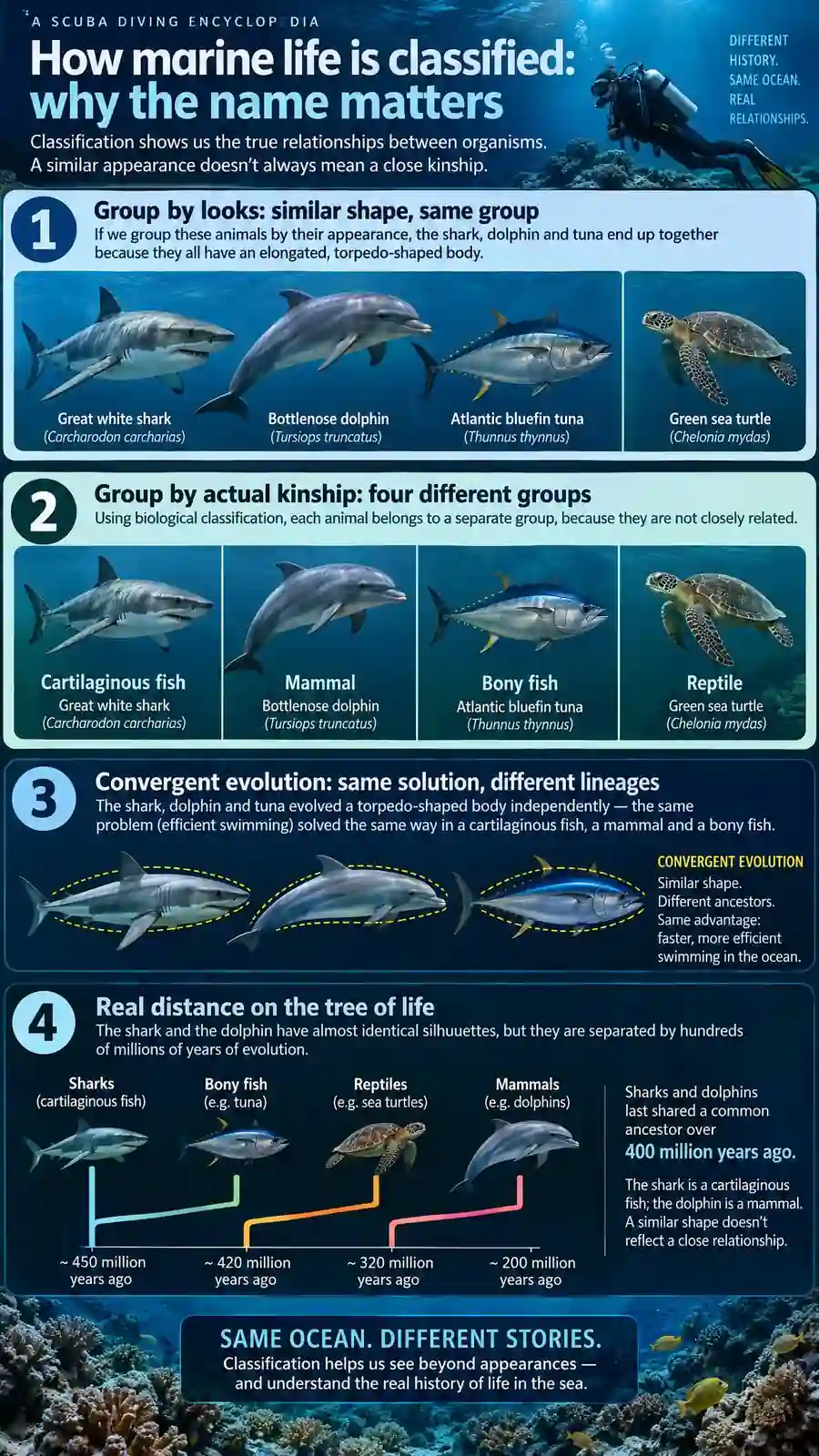
For centuries, classification was based on physical resemblance, which is the only tool available when there's nothing else. The problem is that resemblance is misleading: organisms with no close relation develop similar shapes when solving the same problem, something especially common in the sea.
Since genetic analysis became available, classification has been continually reordered to reflect real relatedness. Groups that seemed solid have dissolved, and species that were thought to be one have turned out to be several very similar ones.
The most illustrative case for a diver is the word fish. It doesn't name a natural group: a tuna is more closely related to a human being than to a shark, because bony fish and cartilaginous fish split apart an extremely long time ago. It's a useful, ecologically sensible term, but it isn't a category of relatedness.
The opposite also happens. Populations once thought to be a single species turn out to be several once their genetics are examined, something that has happened in very visible groups and that carries direct conservation consequences: if one species turns out to be three, each one has populations much smaller than previously believed.
For an enthusiast, the practical conclusion is reassuring: a guide being ten years old doesn't invalidate it, but it's worth knowing that names shift, and that what matters for observing well is recognizing the group, not memorizing the label.
Diving application
Learn about twenty fish families and about ten invertebrate groups first: with that alone you can place a good part of what you'll see in any sea in the world.
Pay attention to body shape, fin position and shape, mouth type, and swimming style. Those four traits identify the family long before color does.
Don't trust color as a criterion: it changes with age, sex, region, and the animal's condition, and it's what leads to the most errors.
Note down or photograph anything you don't recognize with a complete reference shot, following the approach in the article on identification through photography, and work it out later at your own pace.
And use scientific names when you look up information: it's the only way to make sure you're reading about the animal you actually saw.
Common mistakes
"Fish are a natural group."
It isn't, in terms of relatedness: bony fish and cartilaginous fish split apart an extremely long time ago, and a tuna is more closely related to a human being than to a shark.
"To identify animals you have to learn species."
Learning families pays off far more: a few dozen cover almost everything you'll see, and knowing the family already tells you how the animal feeds and behaves.
"Color is the best identification clue."
It's the worst one. It changes with age, sex, region, and the animal's condition. Body shape, fins, mouth, and swimming style are far more reliable.
Did you know…?
- Echinoderms (sea stars, urchins, sea cucumbers, and crinoids) are an exclusively marine phylum with a radially symmetric body plan that doesn't exist on land.
- When a guide writes a genus followed by an abbreviation for an undetermined species, it's saying that the relatedness is known but not the specific species.
- Genetic analysis has turned single species into several very similar ones, which sharply reduces the estimated size of their populations.
Key takeaways
- Classification lets you talk about the same thing and, above all, group by relatedness and infer behavior.
- The hierarchy runs from domain to species, and the scientific name combines genus and epithet.
- Learning families pays off far more than memorizing individual species.
- Classification is reordered by genetic analysis because it reflects relatedness, not resemblance.
- "Fish" is a useful term but not a natural group: resemblance is often misleading in the sea.