Beginner 8 minutes
What does it mean to be certified?: what the card certifies and what it doesn't
What that card actually certifies, what it doesn't, and why it never expires even though your ability does

The card you're handed at the end of a course isn't a permit issued by the state, no public body issues it, and no one is going to ask for it if you walk into the water from a beach. And yet, without it, no dive center in the world will fill a tank for you.
In this article you'll see exactly what a diving certification certifies, who issues it and with what authority, why it doesn't have an expiration date even though your actual ability does deteriorate, and how the document differs from the competence it's supposed to represent.
Almost every misunderstanding about training (believing your level qualifies you for anything, or that after ten years of inactivity you're still the diver you used to be) comes from not understanding what that document is and isn't.
A training certificate, not a license
The difference isn't a technicality: it changes who's accountable for you.
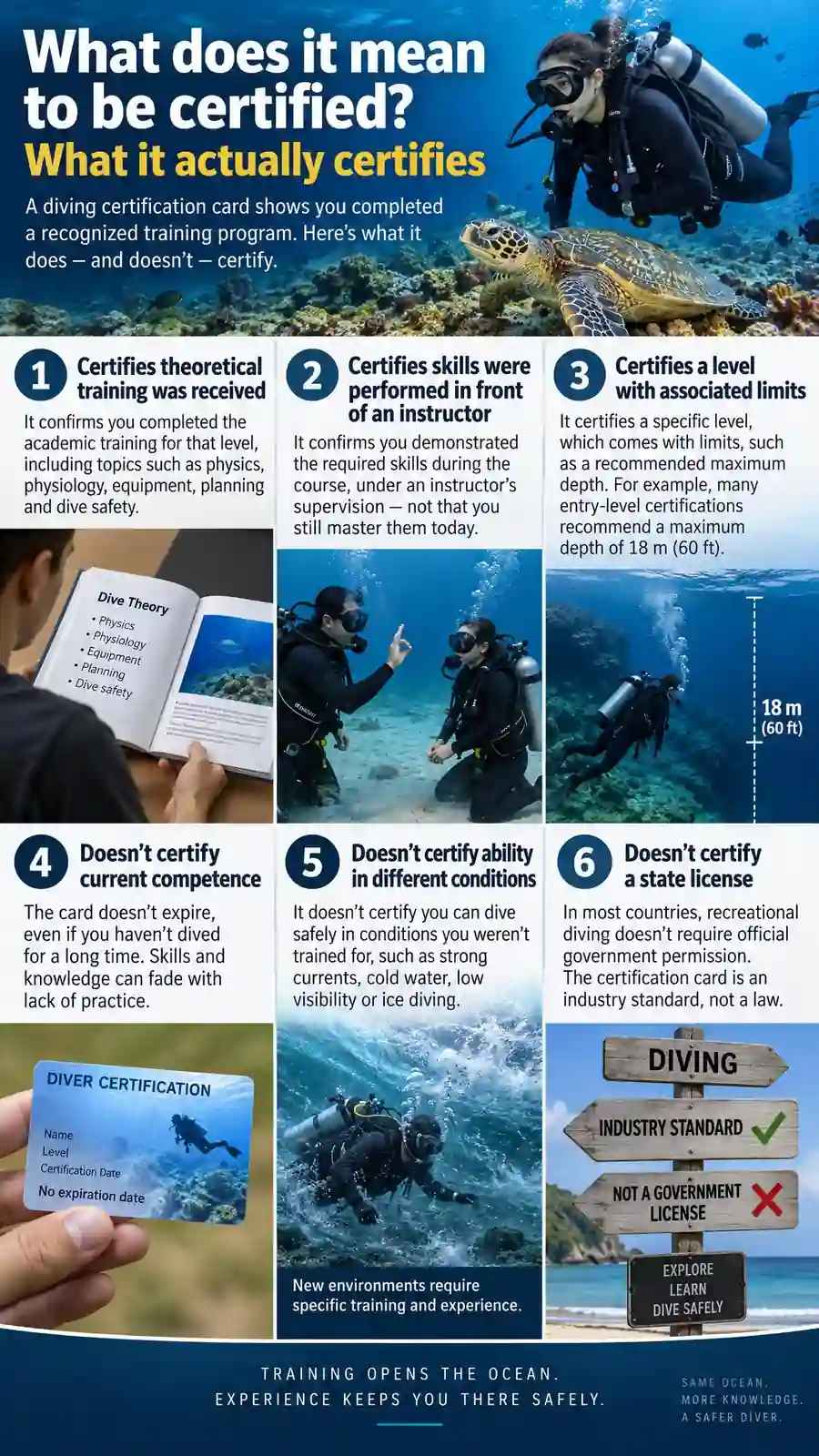
A recreational diving certification is proof that you completed a training program with an instructor accredited by an agency, and that you demonstrated specific skills at a given moment. That's all it says. It isn't a state license like a driver's license, it isn't issued by a public authority in most countries, and it doesn't legally permit or forbid anything on its own.
The issuer is a training agency: a private organization that defines a program, trains instructors, publishes standards, and issues credentials. Its authority doesn't come from a law, it comes from industry recognition: dive centers around the world accept its cards, and that tacit agreement is what makes it hold value.
In practice it works as an access key. The dive center that's going to rent you equipment, fill a tank, or take you out on a boat needs some criterion for deciding whether you're someone they can take into the water without direct supervision, and the card is that criterion. Not because it's infallible, but because it's the only standardized thing that exists.
There are local exceptions worth knowing about: some countries do regulate the activity administratively, requiring mandatory insurance, a valid medical certificate, or registration with a national park. That's added on top of the certification, it never replaces it.
What it actually certifies
Three things, and none of them is that you're a good diver today.
What the certification actually claims can be summed up in three points, and it's worth reading them carefully because they're narrower than people assume.
That you received a certain amount of theoretical training
Basic physics, physiology, planning, equipment use, and emergency procedures, at the scope appropriate to the level. It doesn't guarantee you remember it: it guarantees that at the time, you passed an assessment on it.
It's the part that gets forgotten the fastest and is the easiest to recover. Rereading the course material before getting back in the water after a long break is one of the most cost-effective things you can do.
That you performed certain skills in front of an instructor
Flooding and clearing a mask, recovering a regulator, sharing air, controlling buoyancy, ascending in a controlled manner. You performed these in confined water and then in open water, with an instructor watching and under generally mild conditions.
Having done them then doesn't mean they'll come out today under stress, in the cold, in current, or after years without practicing them. That's exactly the gap between certification and real competence, and it's the subject of the article on certification versus experience.
That you're recognized at a level with associated limits
Each level comes with a recommended maximum depth and a type of dive you're considered trained for: no physical overhead, within limits that don't require mandatory stops, and in conditions similar to or better than those you trained in.
That last nuance, conditions similar to those of your training, is the most ignored and the most important. Getting certified in a warm pool and a calm sea doesn't prepare you for cold water, current, or low visibility, even if the number on the card is the same.
Why it never expires (and why that shouldn't reassure you)
Recreational diving certifications don't have an expiration date. The card you earned twenty years ago is still valid, and no dive center will reject it for being old. The reason is simple: it certifies a past fact, you completed that training, and that fact doesn't stop being true over time.
The problem is that ability does expire, and fairly fast. Fine motor skills, buoyancy control, and above all the automatic response to a problem degrade with inactivity. A diver with fifty dives who hasn't been in the water for five years isn't the same diver they used to be, even though their document says exactly the same thing.
Agencies know this, which is why they all offer some kind of refresher or review program, under different names depending on the agency, for people who've been out of the water for a while. It isn't a legal requirement, nor is it usually one imposed by the dive center, but the industry's usual recommendation puts the threshold at around six to twelve months of inactivity before considering a refresher before you go back in.
Many dive centers also apply their own filter, regardless of what the card says: they ask when your last dive was, how many you have logged, and what kind of diving you did. If the answer doesn't convince them, they may ask for a check-out dive with a guide before letting you go on your own. That's good practice, not personal distrust.
There's one important exception: professional credentials work differently. A Divemaster's or instructor's certification and their current authorization to guide or teach are two different things. Agencies require annual membership renewal to keep active or teaching status, and insurance requirements depend on the agency, the country and local rules. A professional who doesn't renew is not authorized to work as an agency member until they regain active status, even though the certification itself remains. That's covered in the article on the professional career path.
The document and what's behind it
The physical card has been fading out in favor of the digital version in each agency's app, with a verifiable code. For practical purposes they're equivalent, and carrying the digital one saves you the classic problem of having left it at home on the day of your trip.
Behind it there's a record in the database of the agency that issued it, and that record is what lets you recover it if you lose it. Keeping track of the number and the agency is more useful than keeping the plastic.
The logbook is a separate, complementary document. The certification says what training you have; the logbook says what you've actually done. A dive center that's unsure about your level looks at the logbook, not the card, because that's where the information that really matters is: how many dives, at what depth, in what conditions, and how long ago.
That's why it's worth keeping up, even though it can feel like paperwork. It isn't a scrapbook: it's the only evidence of your real experience, and there are courses and destinations that explicitly require it as a condition of entry.
Did you know…?
- Recreational diving certifications don't expire, but professionals need current active status to teach or guide: that means renewing their agency membership each year and, where the agency or local rules require it, keeping professional insurance in force.
- In most countries, diving doesn't require any state license. The card is an industry agreement, not a public permit.
- Many dive centers decide based on the logbook, not the card: the date of your last dive carries more weight than the level printed on the plastic.
Key takeaways
- A certification certifies completed training, not a state license or your current competence.
- It claims three things: you received a theory course, you performed certain skills in front of an instructor, and you're recognized at a level with limits.
- It doesn't expire because it describes a past fact, but real ability does degrade with inactivity.
- The level's limits include a nuance almost no one remembers: conditions similar to those you trained in.
- The logbook documents your real experience and usually carries more weight than the card when a dive center evaluates you.