Intermediate 9 minutes
Climate change in the ocean: heat, acidity, and sea level
The ocean absorbed most of the problem, and that has consequences
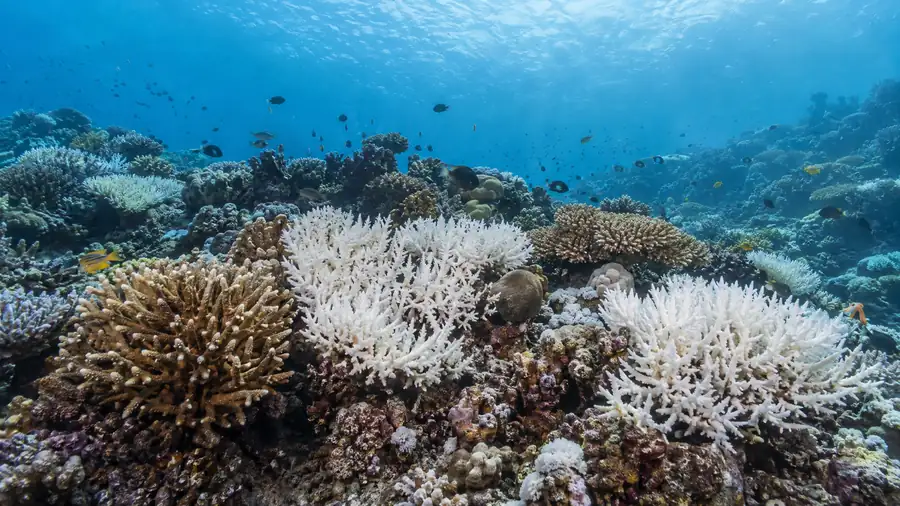
If the ocean didn't exist, the warming we feel on land would be much greater. The sea has absorbed most of the extra heat trapped by the atmosphere and a substantial fraction of the carbon dioxide emitted. It has been protecting us, and the bill for that service is paid underwater.
In this article you'll see what excess CO₂ does to the ocean through two simultaneous pathways, warming and acidification, what each one means for the organisms that build reefs, what other effects add to them, and what all of that looks like from a dive.
This is the threat that acts on every dive site on the planet at once, including those perfectly protected from fishing and tourism. No local measure fully offsets a change of this scale, and that conditions everything else that gets discussed in conservation.
Two effects of the same cause
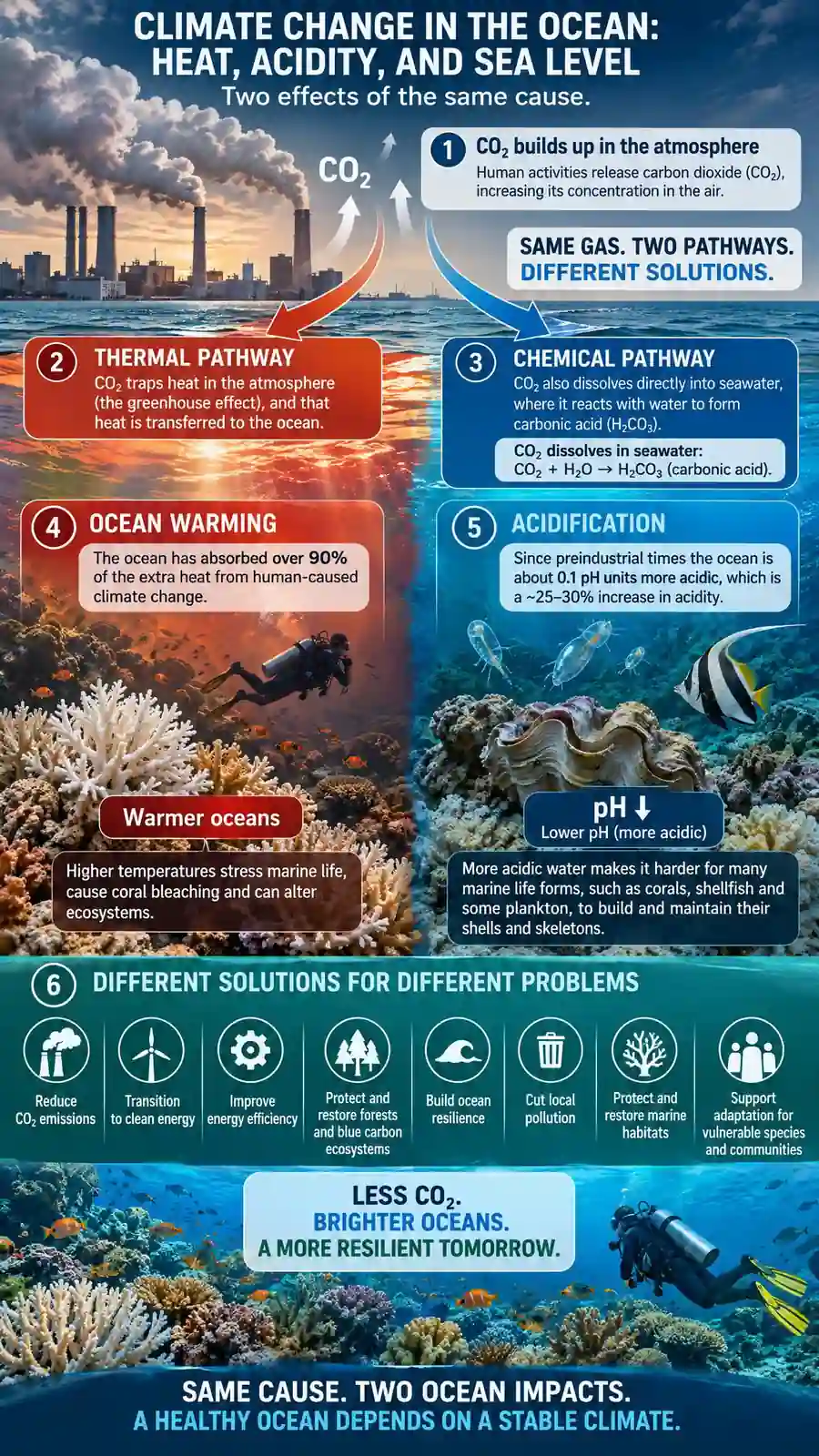
Atmospheric CO₂ reaches the sea by two different paths and produces two independent problems.
The first path is thermal. Carbon dioxide and other gases trap heat in the atmosphere, and the ocean absorbs the vast majority of that excess, because water has an extraordinary heat capacity, as you saw in the article on temperature and heat transfer. That heat accumulates mostly in the surface layer, which is exactly where the reef lives.
The second path is chemical and less well known. Part of the CO₂ emitted dissolves directly in the water, where it reacts to form carbonic acid and release hydrogen ions. The result is a drop in ocean pH: that's acidification, and it doesn't depend on heat at all.
The magnitude is measurable and significant: the average pH of the ocean surface has dropped by about a tenth of a unit since preindustrial times, which on a logarithmic scale equals an increase of roughly 25 to 30 percent in hydrogen ion concentration.
Both effects advance at the same time and on the same organisms, and neither is solved locally. A perfectly protected reef, with no fishing, no tourism, and no discharge, receives exactly the same heat and the same chemistry as a degraded one.
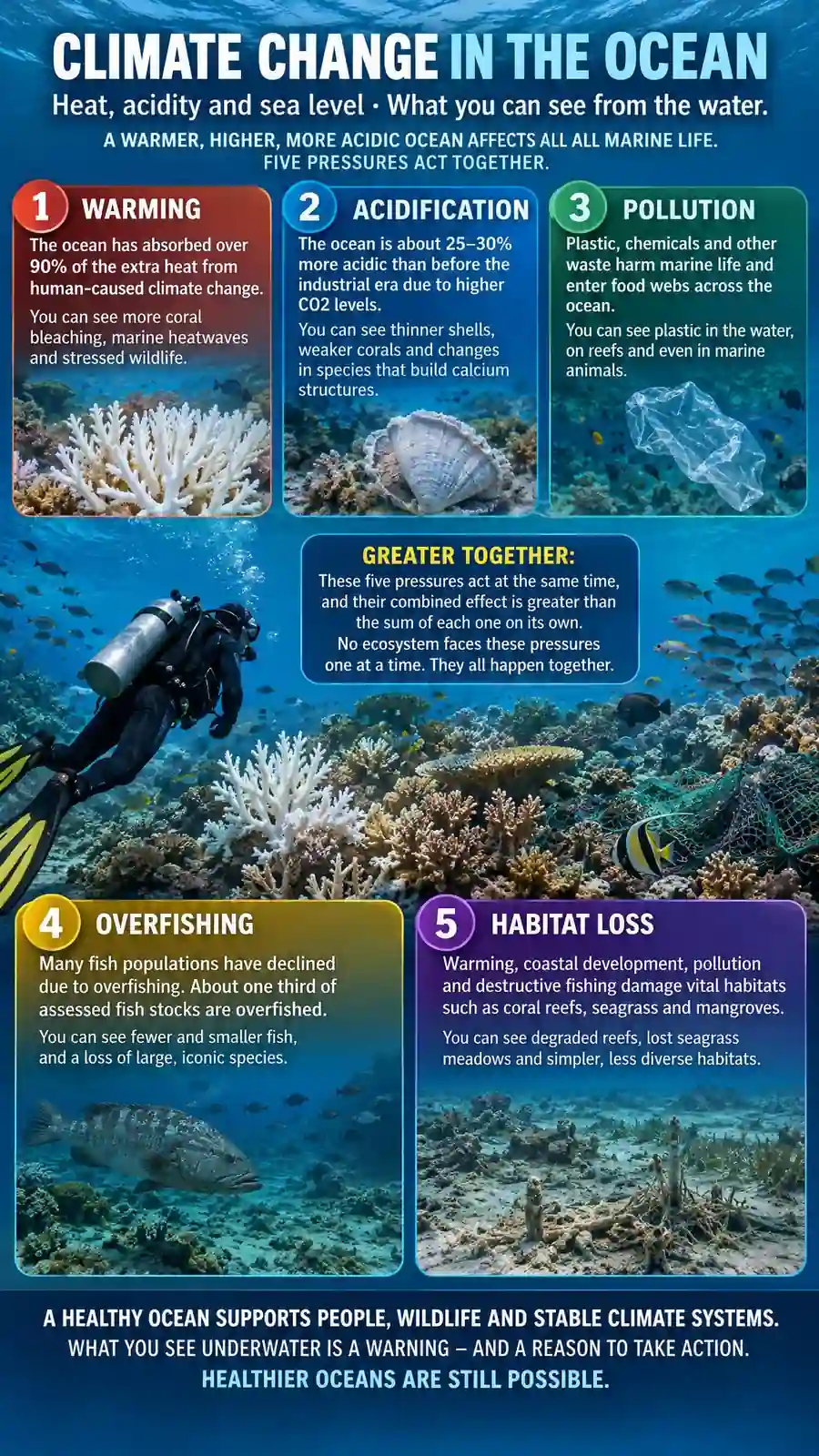
Added to those two are other derived effects: sea-level rise, loss of dissolved oxygen, increased stratification that reduces nutrient mixing, and the geographic shift of many species toward colder latitudes.
Heat: bleaching and marine heatwaves
The most visible effect for a diver is coral bleaching, covered in its own article: when water temperature exceeds the area's usual range for weeks, the coral expels the symbiotic algae it gets most of its food from, loses its color, and is left exposed to dying if the situation persists.
The important detail is that it doesn't take much: a sustained excess of one or two degrees above the usual seasonal maximum is enough to trigger the process. It doesn't need to be a spectacular warming, it needs to last.
Recent decades have seen bleaching episodes on a global scale, increasingly frequent and with less recovery time between one and the next. That shortening interval is probably the most worrying data point: a reef can recover from an episode if it has a decade ahead of it, but not if the next one arrives in three years.
The associated phenomenon is marine heatwaves: prolonged periods of anomalously high temperature in a region, affecting not only corals but kelp forests, seagrass meadows, and entire populations of fish and invertebrates.
And there's a silent effect that accumulates: species shifting. Many organisms are moving toward colder latitudes following their thermal range, which disrupts entire communities both in the place they're leaving and in the one they arrive at.
Acidity: building costs more
Countless marine organisms build calcium carbonate structures: corals, mollusks, sea urchins, calcareous algae, foraminifera, and a significant part of plankton. All of them depend on the availability of the ions needed for that construction.
Acidification reduces that availability. The result isn't that shells dissolve overnight, but that building them requires more energy, and that energy comes out of other functions: growth, reproduction, disease resistance.
In corals, the consequence is a skeleton that grows more slowly and is less dense, which means reefs that rebuild worse after a storm and that lose the race against erosion and against the organisms that bore into the structure.
In calcifying plankton the effect is more troubling because of its position: they're the base of the food chains discussed in the corresponding article, and any disruption at that level propagates upward.
And there's a temporal aggravating factor: acidification is a slow process to reverse. Even if emissions stopped, pH would take a very long time to return to previous values, because it depends on ocean mixing processes that operate on century-long timescales.
What you can see from the water
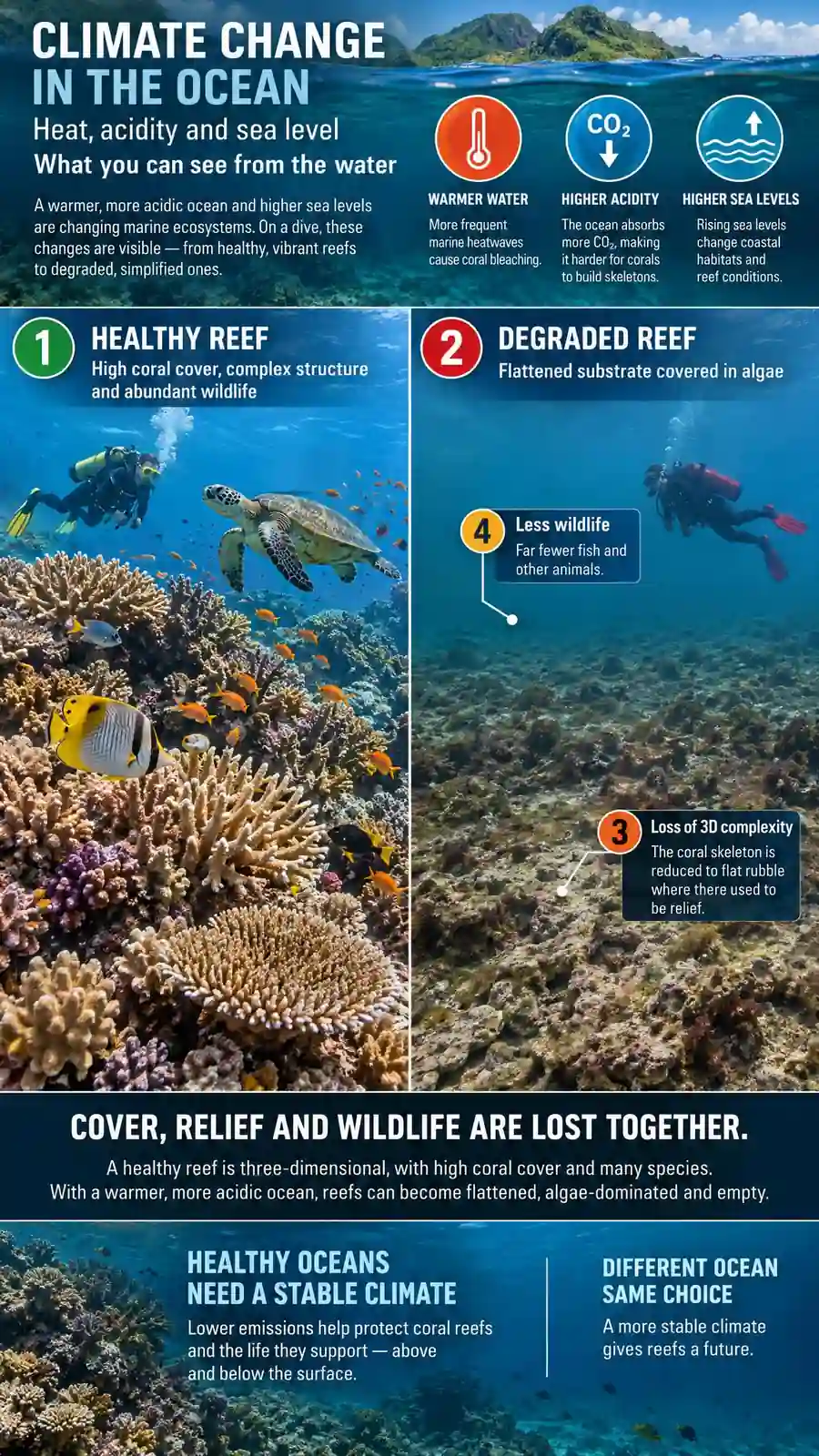
Bleached coral, at different stages: colonies completely white, colonies with pale patches, and colonies that died recently and are freshly covered by a film of algae. Recognizing those three states (living but bleached, recently dead, and long dead) tells you a lot about when the episode occurred.
Structural changes: reefs losing three-dimensional complexity because branching colonies die and collapse, leaving a flatter relief. It's a second-order effect and, as you saw in the article on biodiversity, it has enormous consequences for the number of available niches.
Species appearing where they weren't before and others no longer being seen. Local guides with many years at a site are the best source on this, and they usually have very precise observations.
And there's something that isn't visible and is worth keeping in mind: most of the change happens on a timescale we don't perceive in a week's vacation. Comparing photos of the same site twenty years apart is more revealing than any dive.
The honest conclusion is uncomfortable: this is the factor a diver has the least direct influence over, and the one that most determines the future of the sites they care about. What is within their power (reducing the rest of the pressures so that systems retain the capacity to recover) is the content of the rest of this category.
Diving application
Document. Photographing the same sites systematically, with a date, is a real contribution: most long time series of reefs exist thanks to consistent amateurs.
Participate in bleaching and temperature monitoring programs, covered in the citizen science article, which accept data from recreational divers.
Reduce the pressures you actually have local control over: don't touch, maintain impeccable buoyancy, don't anchor on coral, choose operators who work responsibly.
And consider the weight of your own travel decisions, without deceiving yourself in either direction: dive trips have a real footprint, and at the same time well-managed dive tourism is one of the strongest economic arguments for conserving a reef.
Above all, get informed: the difference between a diver who understands what they're seeing and one who doesn't is, in the medium term, the difference between an informed voter and consumer and one who isn't.
Common mistakes
"A bleached coral is dead."
A bleached coral is alive but without its symbiotic algae: it can recover if conditions return to normal within weeks. It dies if the episode drags on.
"Acidification is the same as warming."
They're two independent processes with the same cause: one is thermal and the other chemical. Acidification would happen even if the water didn't warm by a single degree.
"If a reef is protected, it's safe."
Local protection doesn't filter out heat or ocean chemistry. What it does do is preserve the system's capacity to recover between episodes.
Did you know…?
- The ocean has absorbed the vast majority of the extra heat trapped by the atmosphere: without it, warming on land would be much greater.
- A sustained excess of one or two degrees above the usual seasonal maximum is enough to trigger mass bleaching.
- Even if emissions stopped, ocean pH would take centuries to return to its previous values.
Key takeaways
- Excess CO₂ acts through two independent pathways: water warming and chemical acidification.
- Heat causes bleaching and marine heatwaves, and shifts species toward colder latitudes.
- Acidity raises the cost of building skeletons and shells, with effects from coral to plankton.
- Local protection doesn't filter out these effects, but it does preserve the capacity to recover between episodes.
- Documenting the same sites over time is one of the most useful contributions a diver can make.