Intermediate Maldives
Maldives
Twenty-six atolls, current in the channels, and mantas that move with the monsoon
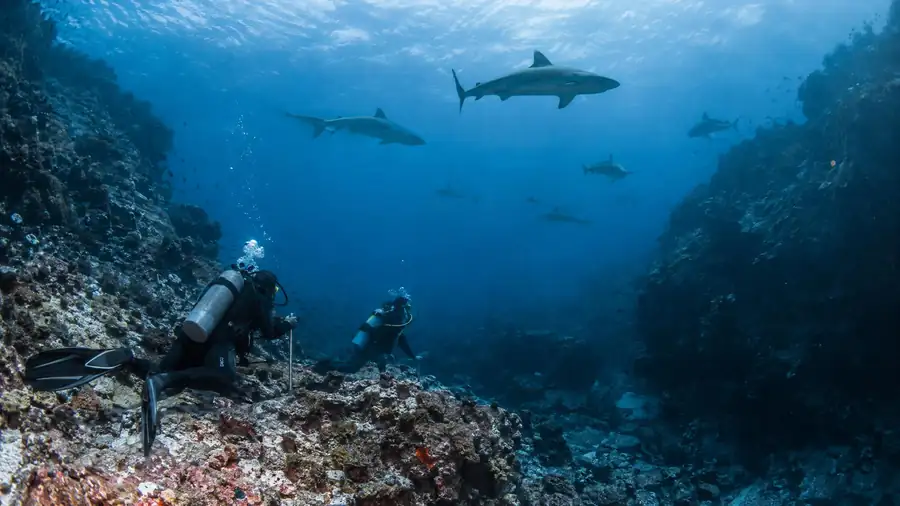
A country that barely has any land: twenty-six atolls built on a sunken volcanic ridge, more than ninety-nine percent of its area made of water. Diving here isn't about visiting isolated reefs, it's about entering the hydraulic system that connects the open ocean to the inner lagoons.
In this profile you'll find how the channels that define Maldivian diving work, why current is the tool rather than the obstacle, how the monsoon cycle shifts the best diving from one side of the atoll to the other, when mantas and whale sharks show up, and what level the destination really demands.
This is the destination where the most divers learn what diving in current actually means, and one of the few places in the world where the seasonal cycle decides not just when to go but which side of the atoll to dive.
Geography and access
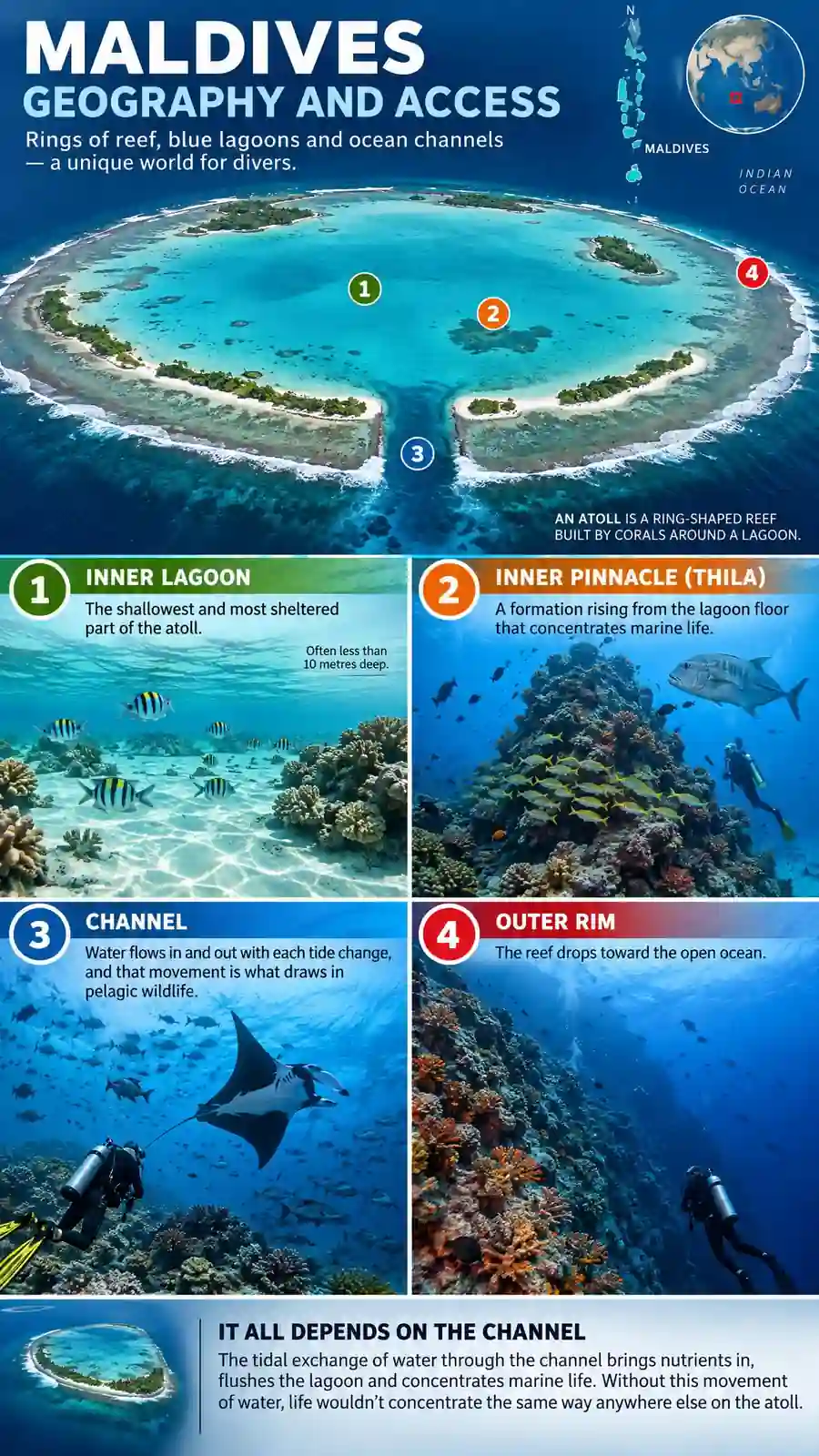
The Maldivian atolls are reef rings that grew on top of sunken volcanoes, forming relatively shallow inner lagoons surrounded by an outer edge that drops off into deep water.
That ring isn't continuous: it's broken by channels that connect the lagoon to the ocean. An enormous volume of water flows in and out through those channels with every tidal cycle, and that's where almost everything interesting happens. The current carries plankton, the plankton attracts fish, and the fish attract everything else.
Inside the lagoons there are also isolated pinnacles that rise from the bottom without reaching the surface. They're compact formations, surrounded by water on every side, that concentrate life out of all proportion to their size.
Logistics follow two models. The resort model means staying on one island and diving its surroundings with daily boat trips: comfortable, but limited to a short radius. The liveaboard model lets you cover several atolls and reach the good channels at the right tidal moment, which is the difference between seeing the channel and seeing the channel actually working.
International access is through the airport near the capital, with seaplane or speedboat transfers to the island or the boat, ranging from twenty minutes to several hours depending on the atoll.
Best areas
The atolls' entry channels are the signature of the destination. With an incoming current, water arrives clean from the ocean and visibility jumps; with an outgoing current, plankton-laden water pours out of the lagoon and the filter feeders show up. Knowing which phase you're diving in completely changes what you see.
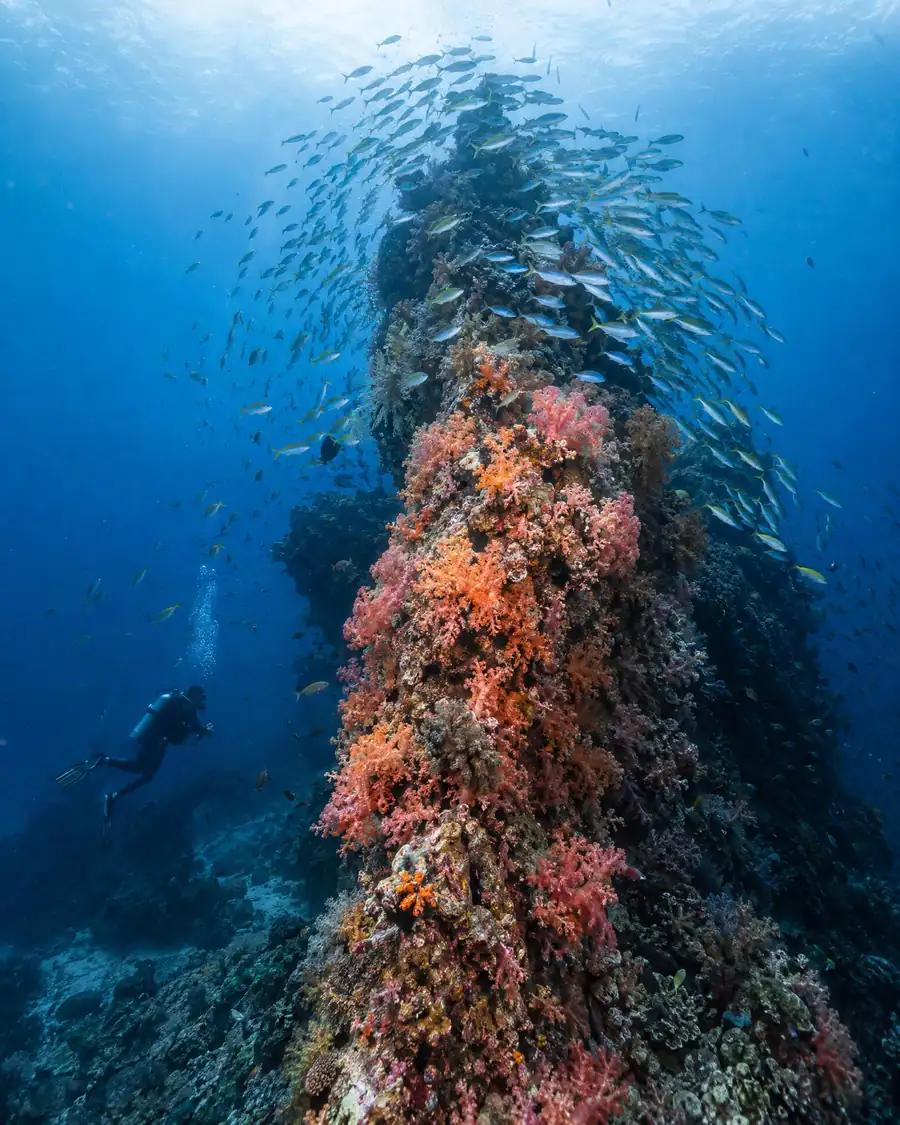
The inner pinnacles, known locally as thilas and giris depending on whether or not they come close to the surface, concentrate soft coral, gorgonians, and dense schools of fish in a small space. You dive them by circling around, using the pinnacle itself as shelter from the current.
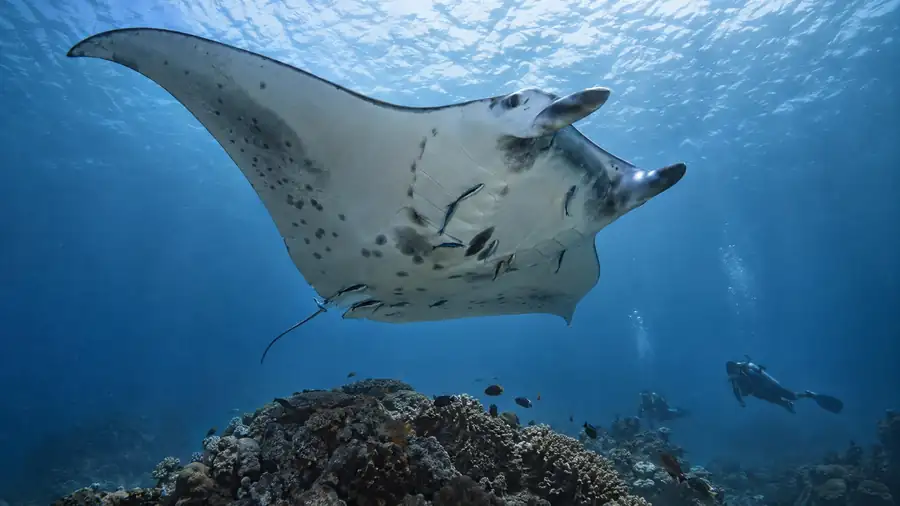
Several atolls have well-established manta cleaning stations, where the animals show up regularly to have parasites removed by cleaner fish. Observation works by staying still and low, never chasing.
One particular bay in the north concentrates, under very specific tide and moon conditions, massive aggregations of feeding mantas. It's a protected area with regulated access, and in most cases limited to freediving.
The house reefs of the resort islands allow for relaxed and night dives without depending on the tide.
Featured sites
Atoll entry channel
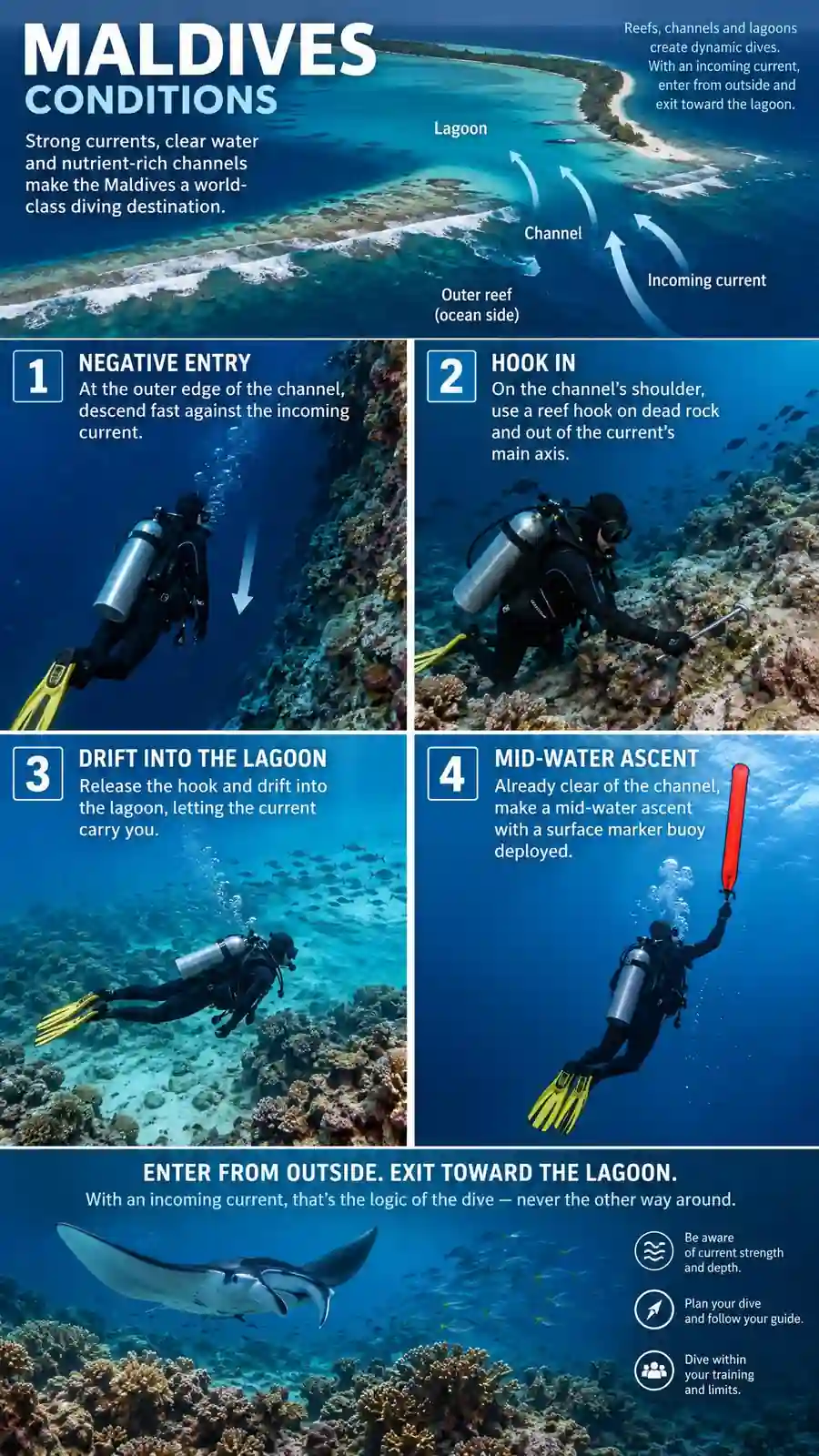
A passage between ocean and lagoon with strong, directional current. Dived with a reef hook and a mid-water ascent.
Inner pinnacle (thila)
An isolated formation inside the lagoon, covered in soft coral and surrounded by schools of fish. Dived by circling around, using the rock as shelter.
Manta cleaning station
A coral head where mantas come to be cleaned. Observation is still and from below the animal.
Manta aggregation bay
A massive seasonal aggregation tied to tide and moon, in a protected area with regulated access, normally on freedive only.
Island house reef
The island's own drop-off, accessible from shore, with gentle current. The base for training and night diving.
What you’ll see
- Reef manta
- Whale shark
- Grey reef shark
- Whitetip reef shark
- Nurse shark
- Eagle ray
- Hawksbill and green turtle
- Napoleon wrasse
- Schools of fusiliers and jacks
- Giant moray
- Batfish
- Nudibranchs
Ecosystems
- Coral atoll
- Tidal channel
- Lagoon pinnacle
- Fringing reef
- Cleaning station
When to go
- Best months
- Jan · Feb · Mar · Apr · May · Jun · Jul · Aug · Sep · Oct · Nov · Dec
- Water temperature
- 81–86 °F
- Visibility
- 49–131 ft
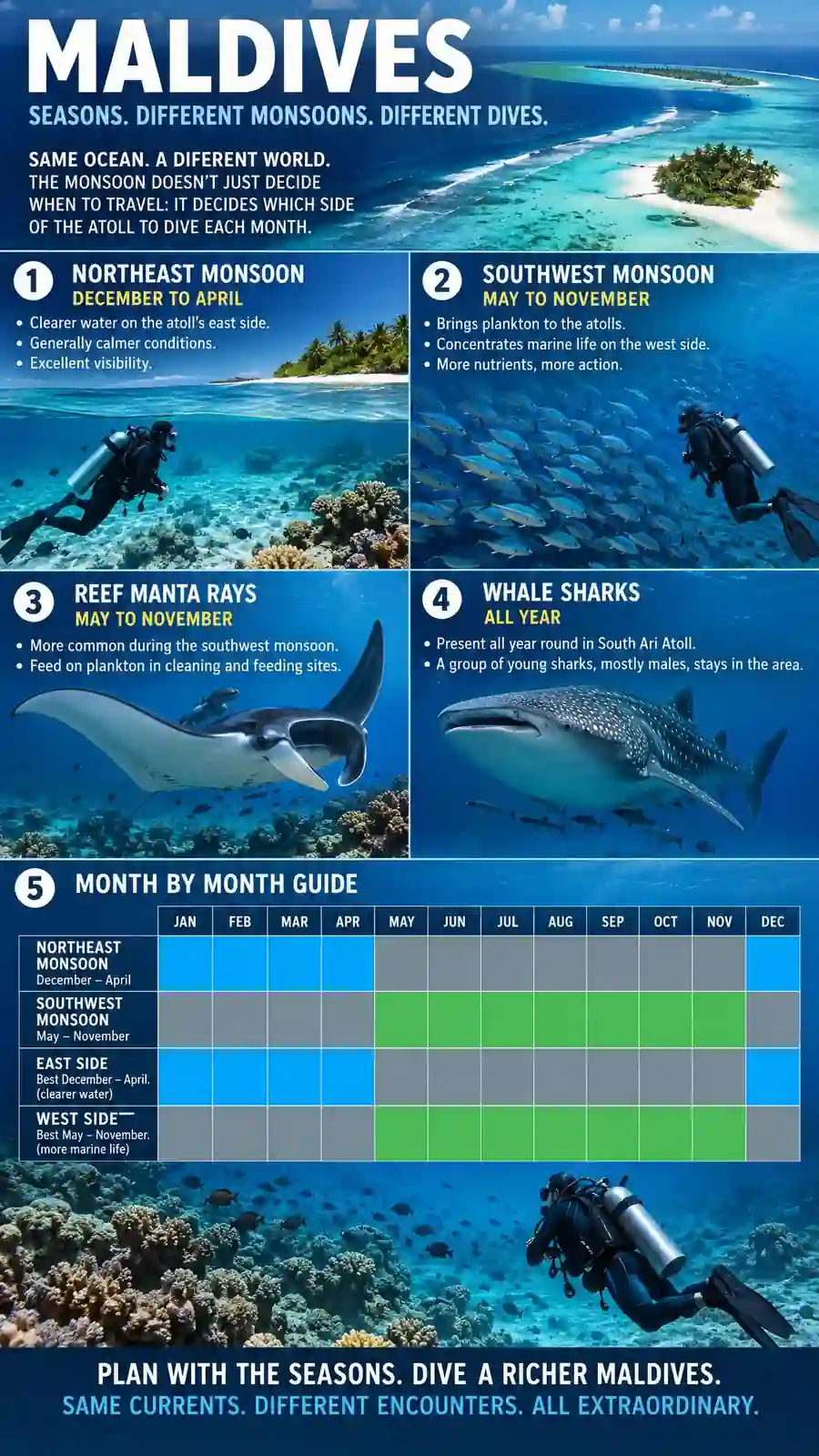
The climate is governed by two monsoons, and their effect on diving runs deeper than in most destinations: it doesn't just change water quality, it changes which side of the atoll you should dive.
During the northeast monsoon, from December to April, clean water enters from the eastern side of the atolls. Visibility is the best of the year on that flank, and it's the classic high season.
During the southwest monsoon, from May to November, the flow reverses: plankton-laden water concentrates on the western side, visibility drops but aggregations of filter feeders increase markedly. It's the season of the big manta aggregations. Whale sharks, by contrast, are seen all year round in South Ari Atoll, where a group of young sharks, mostly males, stays in the area.
Mantas don't disappear when the monsoon changes: from November to April they move. In South Ari Atoll they can be seen from December to April, peaking between February and April, taking advantage of the dry monsoon. And in Addu Atoll, in the south, giant individuals with a wingspan of more than 5 meters can be seen all year round.
There's no bad season, just two different seasons. Those looking for visibility and reef sharks go in winter; those looking for the big manta aggregations go in summer and accept murkier water, although in winter there are also mantas, for example in South Ari.
Depending on the water temperature that month, check with the operator which thermal protection to bring.
Wildlife by season
- Grey reef sharkYear-round
- Hawksbill turtleYear-round
- Napoleon wrasseYear-round
- Whitetip reef sharkYear-round
- Reef mantaYear-round
- Whale sharkYear-round
- Eagle rayOccasional
- Oceanic mantaRare
- Hammerhead sharkSite-specific
Conditions and level
- Typical depth
- 49–98 ft
- Maximum relevant depth
- 98 ft
Currents: The central variable of this destination. In the channels it can be strong and directional, incoming or outgoing depending on the tidal phase, and you dive with it, not against it. Using a reef hook (anchoring to dead rock to stay still while observing) is standard practice, and you should know how to use one before you arrive. On pinnacles and house reefs, current is usually moderate or gentle.
Waves: The surface inside the atolls is usually sheltered. In the channels and on the outer edge the sea can get rough when the monsoon is active, and trips are rerouted to the sheltered flank of the atoll.
Recommended experience: Entry level is enough for house reefs and some pinnacles. Advanced level and prior current experience are needed for the channels, which is where the destination's signature diving is. A personal surface marker buoy is recommended and, on many boats, mandatory.
A destination of medium difficulty that rises clearly in the channels. Depth isn't the problem: current, drift, and ascending in blue water without visual references are.
Types of diving
- Shore diving
- Boat diving
- Liveaboard
- Wreck diving
- Macro
- Wide angle
Courses that make sense here
- Advanced level
- Nitrox
- Deep diving
- Current and drift diving
- Underwater photography
Conservation and rules
Marine protected area
The Maldives banned shark fishing in its waters, and the effect is visible: reef shark populations are abundant and their behavior is calm compared to areas where they're fished.
Several areas are declared protected, and some, like the manta aggregation bay in the north, have biosphere reserve status with quota-based access, a ban on scuba tanks, and active supervision.
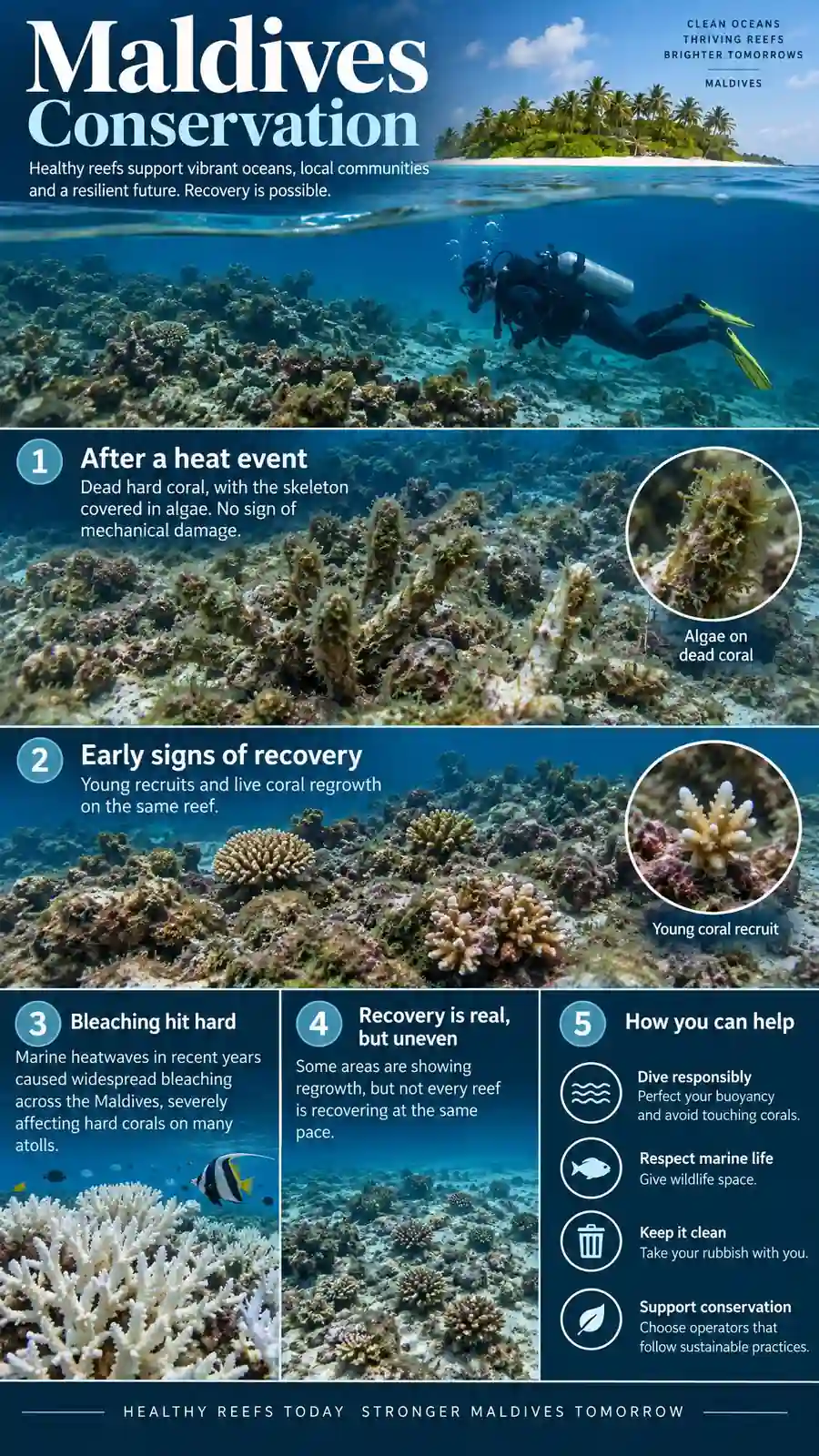
The main challenges are coral bleaching (Indian Ocean warming events have severely affected the archipelago's hard coral on several occasions) and the pressure of tourism development on the lagoons.
Permits
- Protected area fee in the declared zones
- Quota and prior registration in the manta aggregation bay
Local rules
- Touching, chasing, or blocking the path of mantas and whale sharks is prohibited
- Using scuba tanks in regulated aggregation zones is prohibited
- Reef hooks only on dead rock, never on live coral
- Collecting coral, shells, or wildlife is prohibited
- Shark fishing is prohibited in all of the country's waters
Logistics
- Airport
- International airport next to the capital, with connections from Europe, the Middle East, and Asia
- Transfer
- Seaplane, domestic flight, or speedboat to the island or the boat: from 20 minutes to several hours depending on the atoll
- Recommended days
- 8
- Budget level
- Moderate to high
Best for
- Current and channel diving
- In-season mantas
- Reef sharks
- Wide-angle photography
- A week-long liveaboard
Seasons, conditions and regulations change: these are guiding ranges, never guarantees. Seasonal data last reviewed: 2026-08-25