Beginner 8 minutes
Food chains: why there are so few big predators
The flow of energy from light to shark, and what's lost at every step
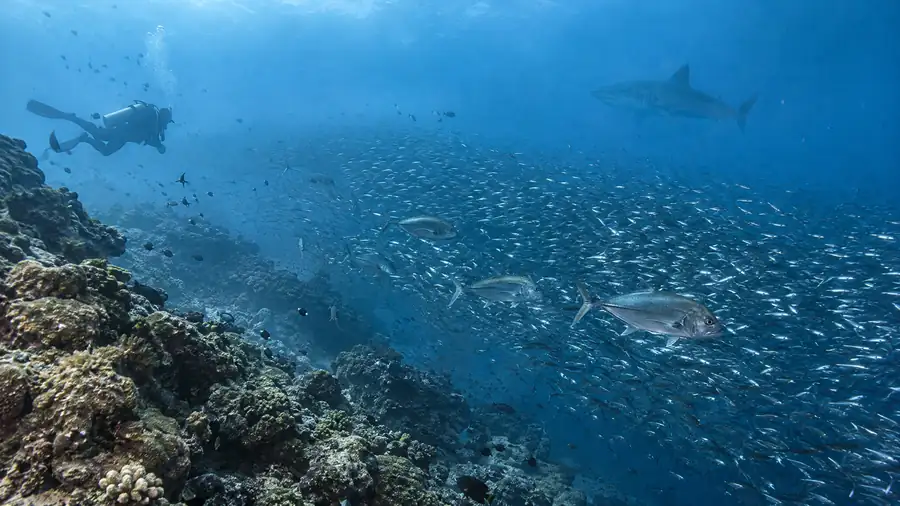
On a typical dive you'll see thousands of small fish, hundreds of medium ones, a few dozen large ones, and, if you're lucky, one sizeable predator. That ratio isn't chance or bad luck: it has a lot to do with how energy flows, and with thermodynamics.
In this article you'll see where the energy that sustains the ocean comes from, how it passes from one level to the next, why most of it is lost at every step, what shape the resulting pyramid takes, and why there's a food chain that doesn't depend on the sun at all.
Almost everything you observe underwater (where life concentrates, which animals are abundant and which are rare, why some sites are spectacular and others aren't) is better explained by the flow of energy than by any other idea.
The first link: light turned into matter
Almost all the ocean's energy enters through the same door: photosynthesis. Organisms capable of turning light and carbon dioxide into organic matter are the primary producers, and in the sea the leading role belongs to phytoplankton, an immense collection of microscopic organisms floating in the lit layer.
Phytoplankton is responsible for a huge fraction of the planet's oxygen production, comparable to all the world's forests combined. It's not visible, it doesn't photograph well, and it sustains everything else.
There are other, more visible producers of note: the macroalgae that form kelp forests, the seagrasses of meadows, and the microscopic algae that live inside corals (the zooxanthellae from the coral biology article) which turn the reef itself into a producer.
They all share one limitation: they need light, so they're confined to the ocean's lit zone, where, as you saw in the article on ocean zones, light still allows photosynthesis. That zone isn't just the first few meters, and darkness doesn't mean there is no primary production: some bacteria and archaea produce organic matter through chemosynthesis, using chemical energy.
And they all share one dependency: they need nutrients. That's the explanation for why tropical seas are clear and relatively low in production, while cold waters and upwellings (where deep, nutrient-laden water rises) are murky and extraordinarily productive.
The steps, and what's lost
At every step, most of the energy doesn't make it to the next one.
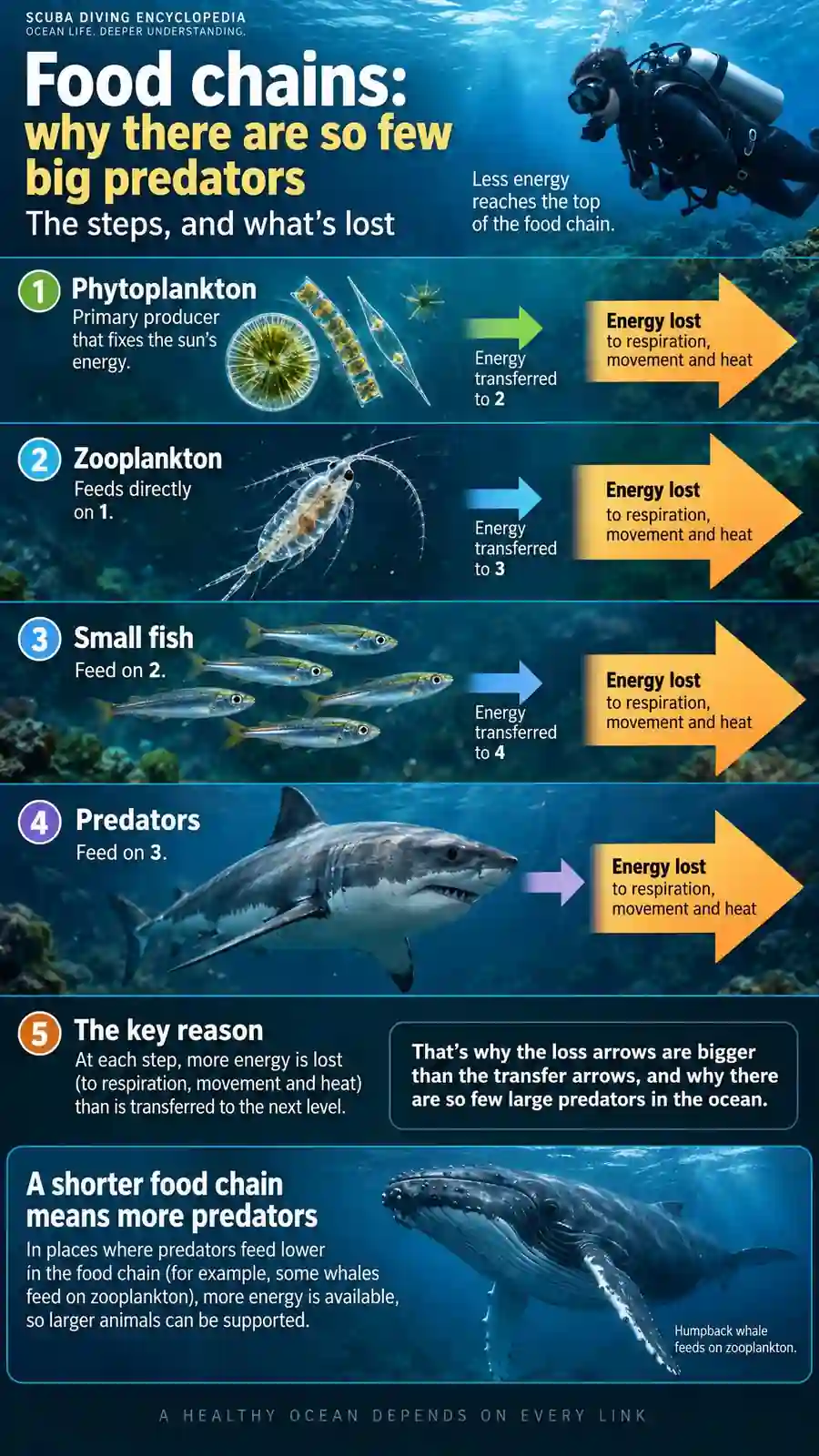
Phytoplankton is eaten by zooplankton: small animals, larvae, and tiny crustaceans that make up the second level. In turn, zooplankton feeds small fish and filter feeders, which feed larger fish, which feed the predators at the top.
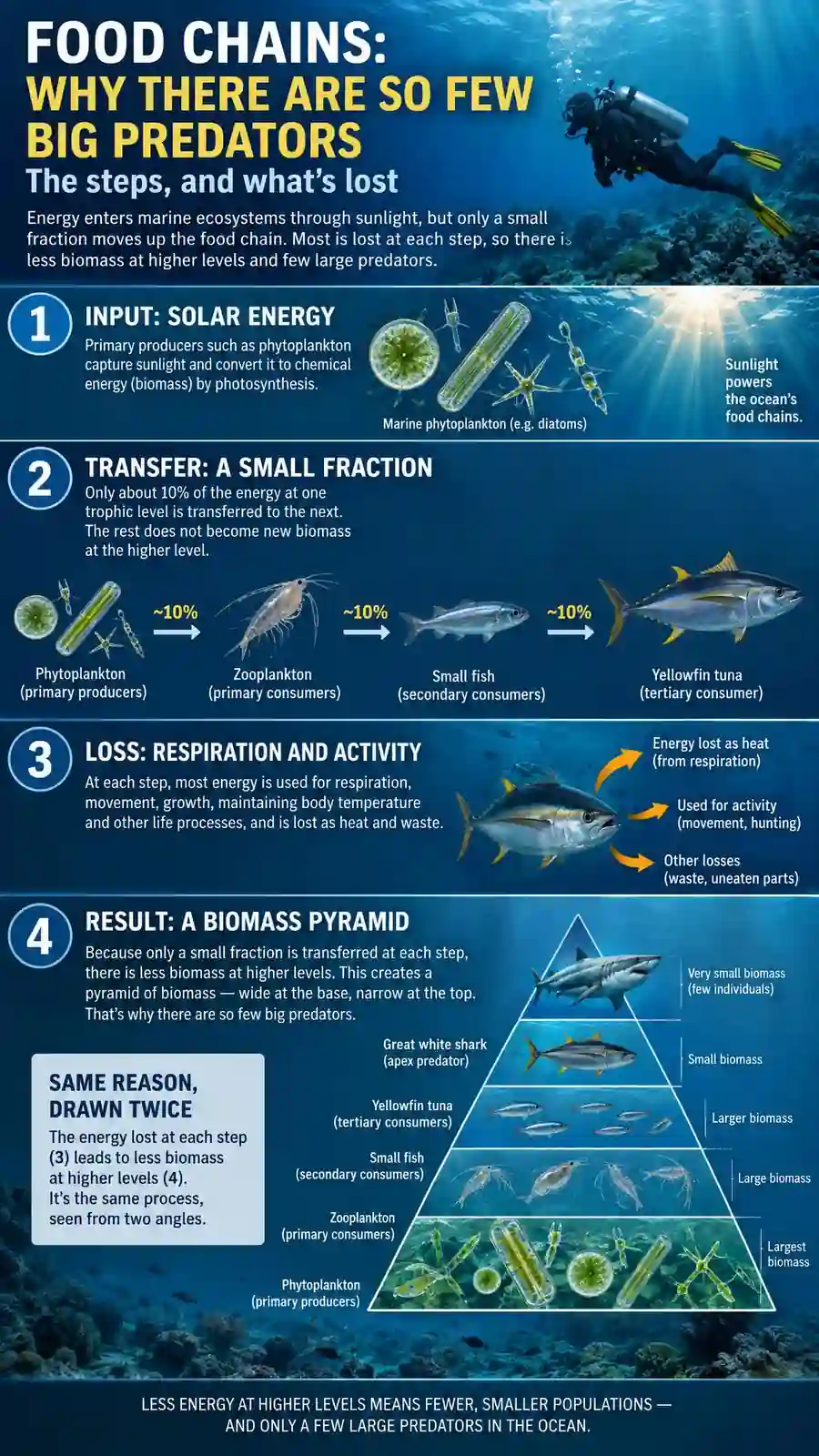
The interesting part is how much passes from one level to the next: as a rough rule, around a tenth. The rest is spent on breathing, moving, maintaining temperature, and all the other life processes, or lost as unused material.
That proportion has an enormous consequence. If, as an illustration, each level passed on a tenth of its energy, the production of one kilogram of a large predator would rest on the order of a thousand kilograms of primary production. It is a calculation about energy flow, not a fixed rule about the kilos present at any given moment: real efficiency varies, and standing biomass is another matter. Even so, it helps explain why large predators are scarce.
That's where the pyramid shape used to represent these systems comes from: a wide base of producers, and increasingly narrow levels toward the top. And it's also where the characteristic fragility of the top level comes from: any reduction at the base gets amplified going up.
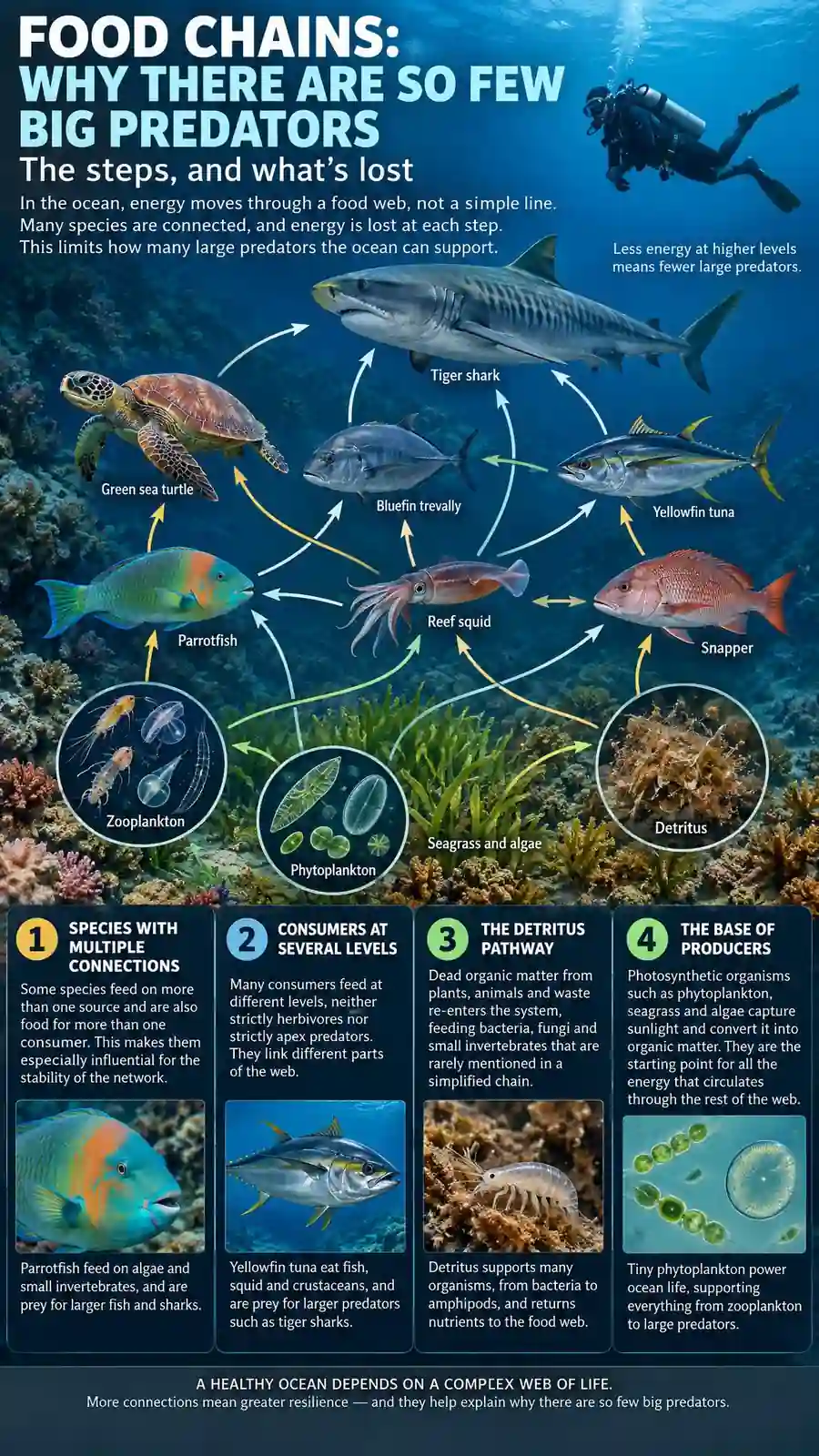
One nuance worth adding: the levels aren't clean-cut steps. Many animals feed at several levels at once, and almost all of them change diet over their lifetime, a larva and an adult of the same species can occupy completely different positions. That complication is the subject of the article on food webs.
The chain you don't see: detritus and bacteria
Alongside the classic chain, another one operates: less showy and probably more important in terms of mass: the decomposer chain. Everything that dies, everything that's excreted, and everything that sheds off ends up as decomposing organic matter.
Some of that material sinks slowly toward the bottom as particles: it's marine snow, that continuous drift of remains you can see crossing the beam of your torch on a deep dive. It's the mechanism by which energy captured at the surface reaches depths that never had any light.
Bacteria break down that material and release the nutrients back into the system, where they become available to producers again. Without that recycling, nutrients would stay trapped in dead matter and production would stop.
On the seabed, that supply sustains entire communities of detritivores and filter feeders: sea cucumbers, worms, mollusks, sponges. A good part of what you see on an apparently boring seabed is living off that rain.
And there's a radical exception to the general scheme: at the hydrothermal vents of the ocean ridges there are communities whose base isn't light but chemosynthesis, bacteria that get energy from chemical compounds released by the seafloor. They're complete ecosystems that function with no connection to the sun at all.
What this explains underwater
Why sites with current are the good ones. Current transports plankton, and wherever plankton arrives, filter feeders and the fish that eat filter feeders concentrate, and predators follow behind. It's the ecological reason channels, passes, and exposed points concentrate so much life, something you already saw from a technical angle in the article on currents and drift.
Why murky water is sometimes the best kind. Reduced visibility from plankton signals a productive system, and that's where the big filter feeders show up. The best whale shark or manta ray dives rarely happen in crystal-clear water.
Why the tropical reef, surrounded by nutrient-poor water, is so lush. The answer lies in internal recycling: the partnership between coral and its algae, together with an extremely efficient nutrient economy, makes it possible to sustain an enormous biomass in an oceanic desert.
Why seeing a large predator is a good indicator of a site's health. Since the top of the pyramid needs an intact base, the regular presence of large predators indicates that everything below it is functioning.
And why overfishing small species, the least glamorous ones, has such profound effects: removing the base of the pyramid affects every level above it at once.
Diving application
Ask yourself where the site's energy comes from: current that brings plankton, a reef that recycles, an upwelling that fertilizes, organic matter drifting down from above?
Watch the fixed filter feeders: gorgonians, sponges, soft corals: their abundance and orientation show where the food is coming from, and therefore where the prevailing current is heading.
Don't write off a site because of green water. Productivity and transparency tend to run in opposite directions, and the big encounters are on the side of productivity.
Use the presence of predators as a thermometer: a site with regular large predators is a site with the full pyramid intact.
And look at an apparently empty seabed with different eyes: a good part of what lives there feeds on the continuous rain of organic matter falling from above.
Common mistakes
"Clear tropical water is a sign of a rich sea."
It's the opposite: transparency indicates little plankton, meaning little production. The planet's most productive waters are murky, cold, and nutrient-rich.
"Large predators are scarce because they've been overfished."
Overfishing has drastically reduced them, but even in an intact system they're scarce: only a small part of the energy passes from one level to the next (a tenth is often used as an illustration).
"All ocean life depends on the sun."
At hydrothermal vents, entire communities exist based on chemosynthesis, getting energy from chemical compounds with no connection to light at all.
Did you know…?
- Phytoplankton produces a fraction of the planet's oxygen comparable to that of all the world's forests combined.
- Marine snow (that drift of particles you see in your torch beam) is the mechanism by which energy from the surface reaches the deep seafloor.
- With an illustrative 10% transfer per level, producing one kilogram of a large predator would take on the order of a thousand kilograms of primary production. It is an example of energy flow, not a fixed rule.
Key takeaways
- Almost all the ocean's energy enters through photosynthesis, and phytoplankton is the main producer.
- Only part of each level's energy reaches the next (much is used in respiration or goes to decomposers), hence the pyramid of energy flow and the scarcity of large predators.
- The detritus chain recycles nutrients and sustains seabed life through marine snow.
- Complete ecosystems exist that are based on chemosynthesis, with no dependence on the sun at all.
- Productivity and transparency run in opposite directions: green water often signals a rich system.