Advanced 10 minutes
Decompression sickness: when dissolved gas turns back into bubbles
What causes it, how to recognize it, and why the right response starts within minutes
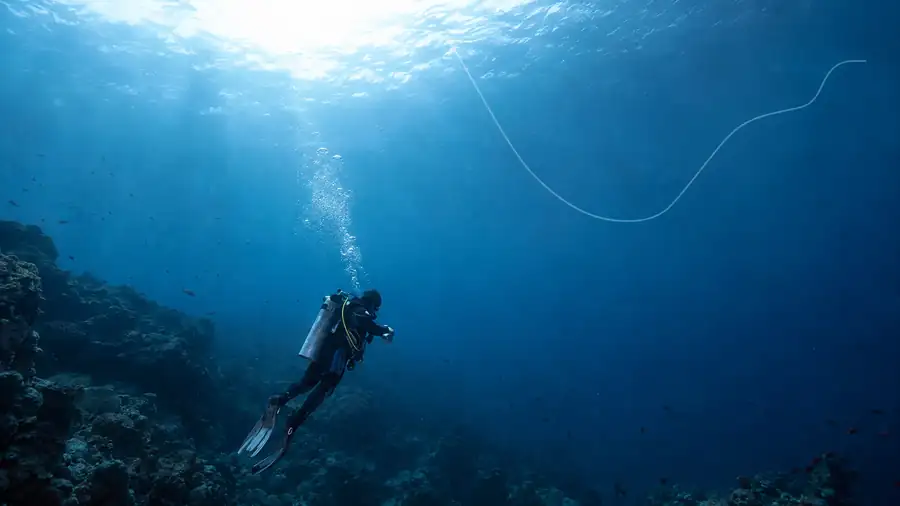
The gas you breathed throughout the dive didn't do anything to you while you were down there. The problem isn't having it inside you: it's the speed at which you let it out.
In this article you'll see why dissolved nitrogen turns into bubbles on ascent, what clinical forms decompression sickness takes, how long it takes to show up, which factors increase the risk, and what the correct initial response is when it's suspected.
It's the injury that defines the entire discipline: the whole system of limits, stops, and ascent rates exists to prevent it. And once it appears, the prognosis depends above all on one thing that doesn't require being a doctor: recognizing it early and not downplaying it. This article is educational material: it does not replace specific dive first-aid training or medical judgment, and if it's ever suspected the correct action is to activate the emergency system and consult a hyperbaric medicine service.
From dissolved gas to bubble
The whole mechanism fits into an idea you already saw in dive physics.
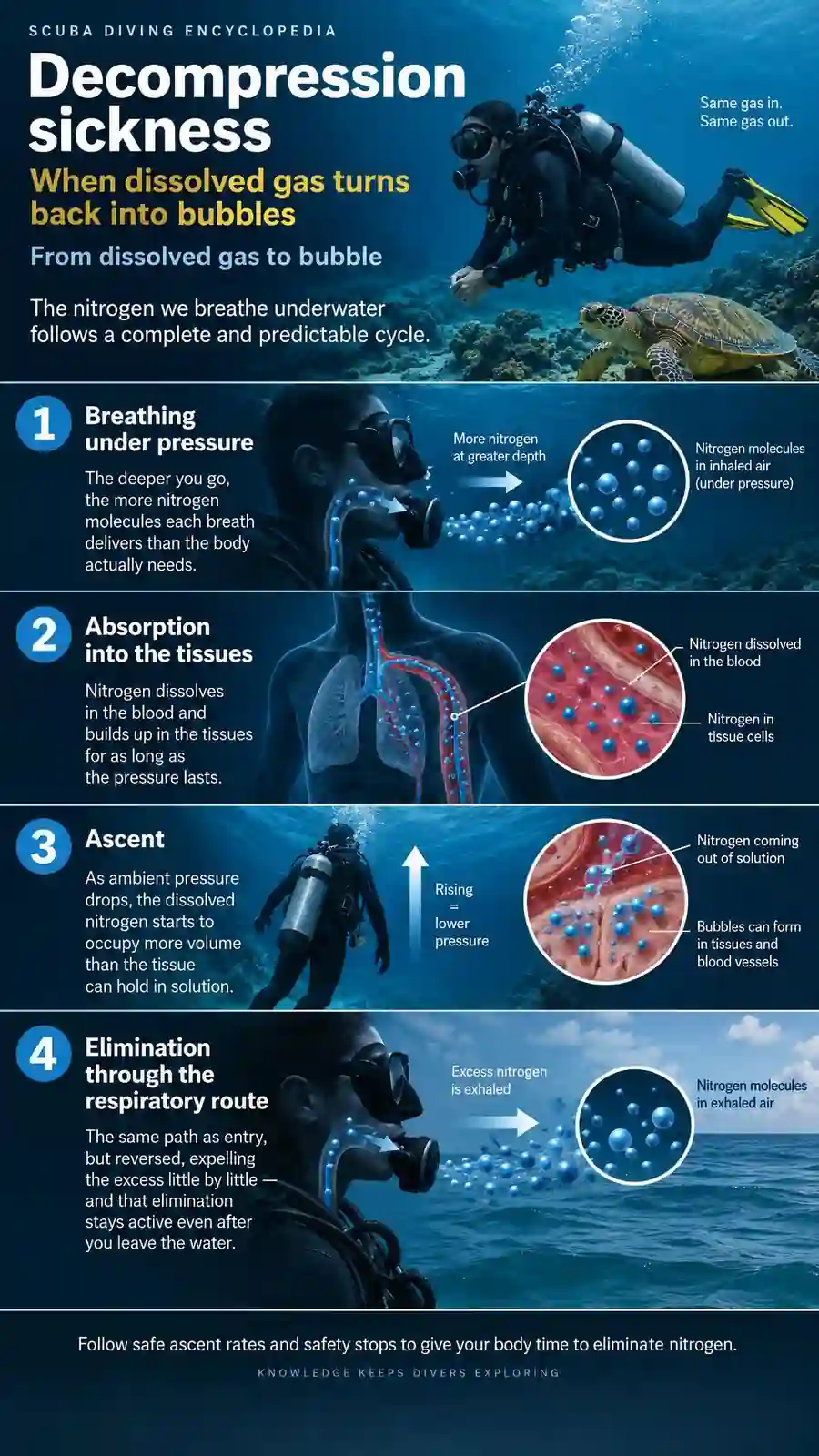
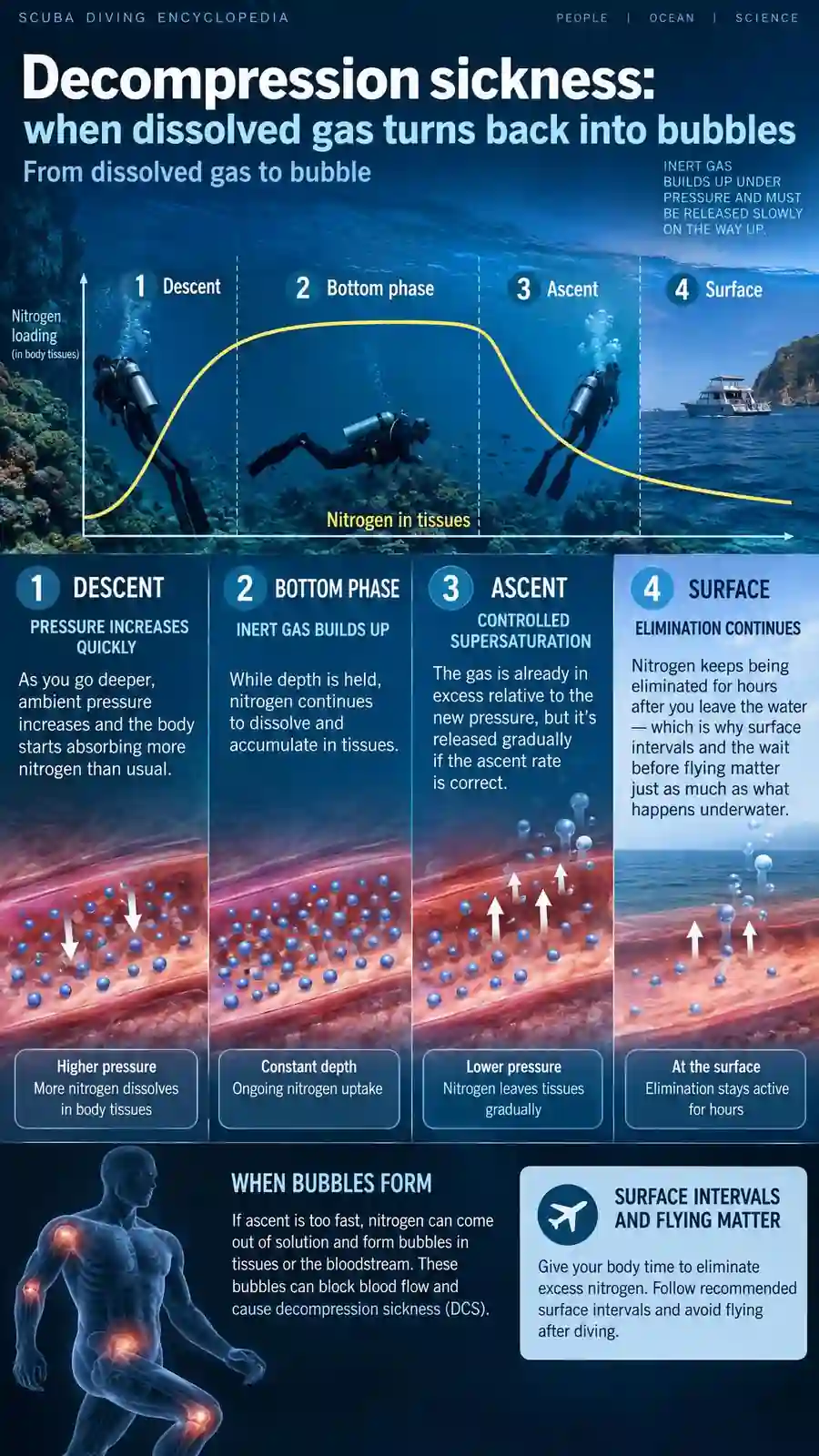
While you breathe under pressure, the nitrogen in the air (an inert gas the body doesn't consume) dissolves into your blood and tissues in proportion to the pressure at which you breathe it. It's Henry's Law applied to your body, as explained in the article on dissolved gases and saturation: more depth and more time mean more accumulated nitrogen.
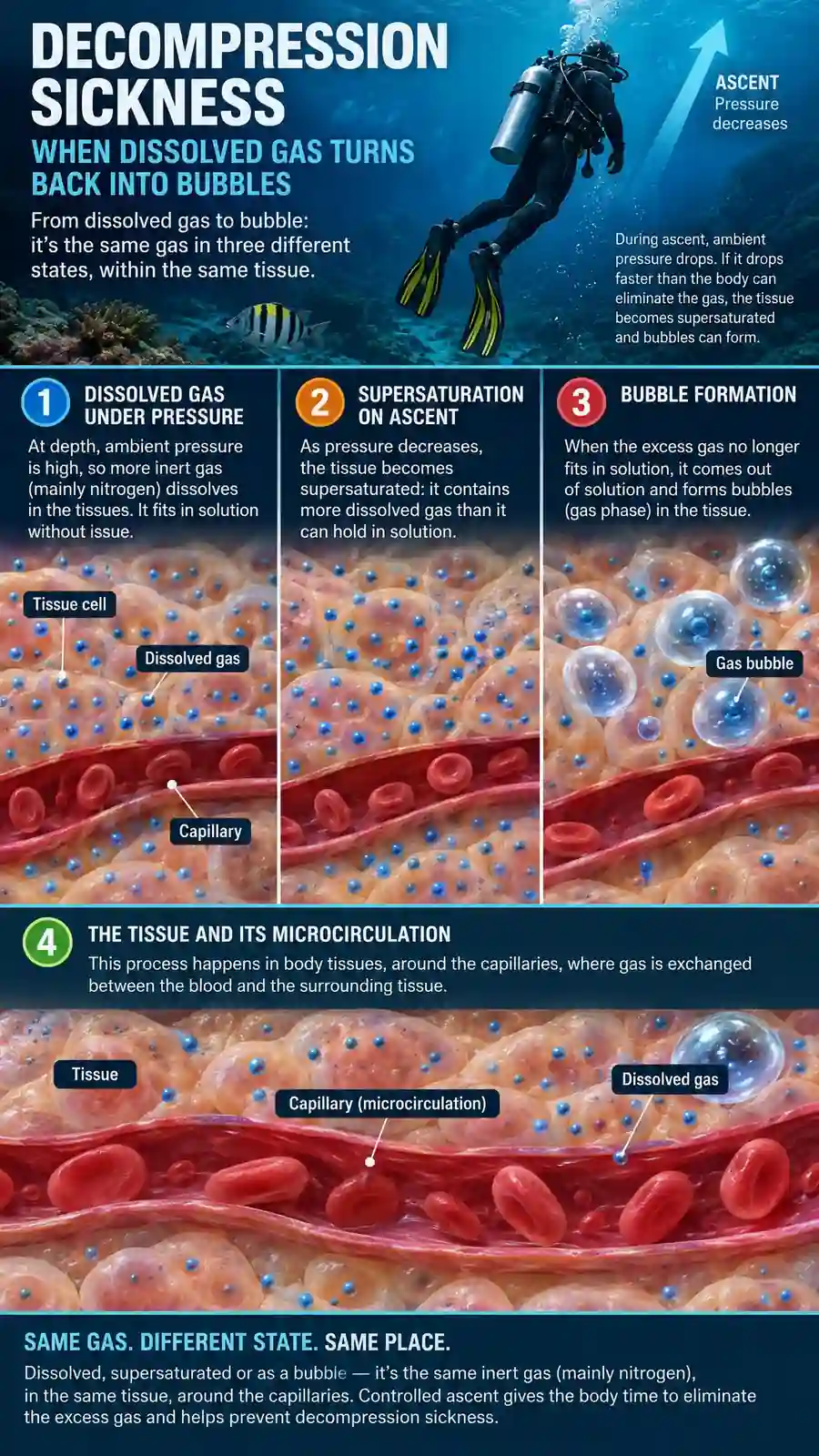
As you ascend, the ambient pressure drops and that nitrogen no longer fits in dissolved form. The difference between the amount present in the tissues and the amount the new pressure can hold in solution is supersaturation, and it's a normal, unavoidable situation: every ascent generates it. The body has some margin to tolerate it and eliminate the gas through breathing in an orderly way.
The problem appears when that supersaturation exceeds the margin a tissue can tolerate, either because the ascent was too fast, because the accumulated load was too high, or a combination of both. At that point the gas leaves solution inside the body and forms bubbles, just like a bottle of carbonated water that's opened suddenly.
Those bubbles cause damage in two ways. Mechanically, by occupying space where there shouldn't be any: they distend tissues, compress nerve structures, and obstruct microcirculation. And biologically, because their surface triggers an inflammatory and coagulation response that worsens and prolongs the condition beyond the initial physical effect.
An important nuance, and a hard one to accept: silent bubbles form in many perfectly normal dives, without producing any symptom at all. Decompression sickness isn't the presence of bubbles, it's the appearance of clinical harm caused by them. That's why limits aren't a line between safe and dangerous, but between low probability and increasing probability.
How it shows up
Two types are classically described, and the distinction matters less than it seems.
Type I groups together the forms considered mild. The most characteristic is joint pain, the shoulder and elbow are common locations, usually described as a dull, deep pain, hard to pinpoint precisely, that doesn't improve when the joint is moved. This group also includes skin manifestations, such as persistent itching, and swelling from lymphatic involvement. A purplish mottling (marbled skin) after diving, although often classed here, must not be treated as a mild symptom: it calls for oxygen and urgent medical assessment.
Type II brings together the severe forms, and it doesn't always start dramatically. Neurological involvement can present as tingling, numbness, or weakness in a limb, difficulty walking, altered speech or vision, or urinary retention. The vestibular form produces intense vertigo, nausea, and loss of balance. And the cardiopulmonary form, uncommon but serious, presents with chest pain, coughing, and difficulty breathing.
There's one symptom that deserves separate mention because it's the most frequently ignored: disproportionate fatigue. Tiredness that doesn't match the effort made, after a dive, is a sign that has to be taken seriously and not simply attributed to the sun, travel, or getting up early.
Timing of onset is key information. Most cases show up within the first hour after leaving the water, and the large majority within the first six. It can appear later, even up to twenty-four hours afterward, especially if there was physical exertion or exposure to altitude. What almost never happens is for it to start many days later: pain that appears on the fourth day is rarely decompression-related.
And a warning worth internalizing: symptoms can fluctuate. Improving on their own for a while doesn't mean the episode is over, and that temporary improvement is exactly what leads people not to seek help.
What increases the risk
The dive profile carries a lot of weight, but it doesn't explain everything.
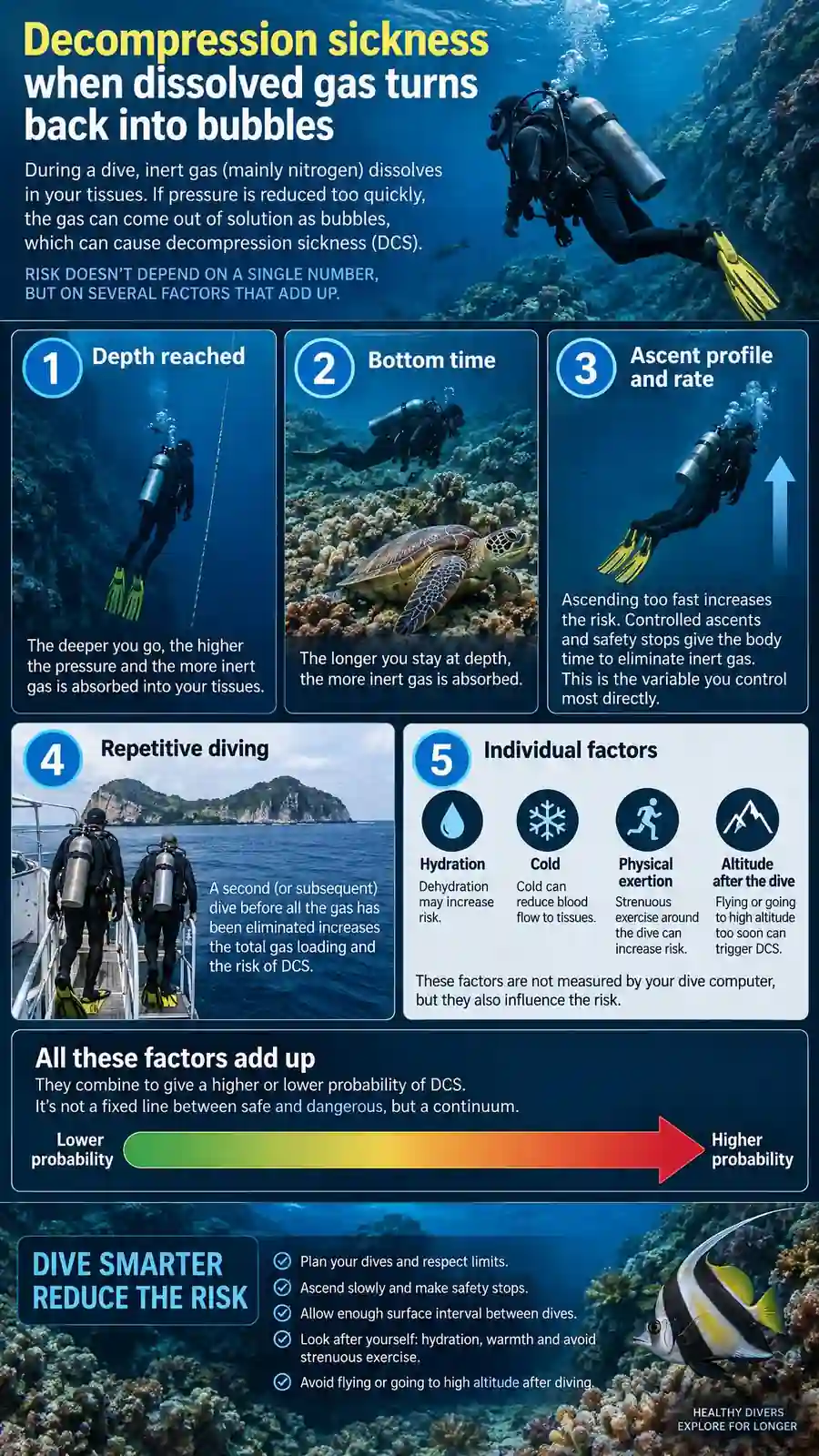
Profile factors are the ones under your direct control and the ones that govern the gas load: depth, bottom time, ascent rate, respecting stops, and the sequence of repetitive dives, with their accumulated residual nitrogen, as detailed in the article on repetitive diving. Sawtooth profiles and fast ascents are the ones tissues tolerate worst.
Individual factors explain why two divers with the same profile don't run the same risk. Dehydration reduces the efficiency of gas transport and elimination; cold, especially when it sets in during the ascent phase, hinders that elimination by reducing peripheral perfusion; intense physical exertion during or after the dive favors bubble formation; and fatigue, age, and body composition all shape the overall picture.
There are also less visible individual conditions. The best known is patent foramen ovale, a communication between the right and left chambers of the heart present in a sizeable proportion of the general population, which allows venous bubbles to pass into the arterial circulation instead of being filtered out by the lungs. It doesn't require you to stop diving, nor does it justify routine screening, but it's one of the explanations investigated when someone suffers an episode with an apparently conservative profile.
And then there's altitude exposure after diving, which reduces ambient pressure while residual nitrogen is still present: flying too soon or crossing a mountain pass on the way to the airport is a classic and entirely avoidable cause. Recommended surface intervals before flying depend on the type and number of dives, and are part of trip planning, not a decision improvised on the last day.
With all of this in hand, there's an uncomfortable conclusion left over from the discipline: episodes do occur on correct profiles, within the limits and with every stop done. They're a minority, but they exist, and that's why no plan lets you say "this can't be decompression sickness because I didn't exceed my limits."
What to do if it's suspected
The initial response is simple, and its value depends above all on speed.
The first step is to get the person out of the water and not let them go back in. In-water recompression isn't part of the recreational diving response: it requires specific equipment, gas, and training, and without them it makes the condition worse instead of resolving it.
The second step is to administer normobaric oxygen at the highest concentration possible, as soon as possible, and keep it going. It's the most effective first-aid measure that exists for this injury: it increases the gradient for eliminating nitrogen and improves oxygenation of the affected tissues. It's also why an emergency oxygen kit is part of the equipment of any serious diving operation.
The third step is to activate the emergency system: local emergency services, a diving assistance hotline if one is available, and the reference hyperbaric medicine center. The decision about chamber treatment is made by a doctor, not by the dive group, and early phone assessment is part of the treatment.
In the meantime, keep the person resting, comfortable, and warm, and give them fluids by mouth if they're fully conscious and can swallow without difficulty. Head-down or Trendelenburg positions are not recommended and are now discarded practice. It's also worth noting down the profiles of the last dives, the gas breathed, and the exact time symptoms started: that information is directly useful to whoever ends up treating them.
The rule that sums it all up: when in doubt, treat it as if it is decompression sickness. The cost of activating the response and it turning out not to be decompression sickness is low; the cost of waiting to be sure is a delay that worsens the prognosis. The full protocols for assessment, oxygen, and evacuation are covered in the chapter on first aid and response.
Diving application
Ascend slowly and respect the safety stop, even when the computer doesn't require it: ascent rate is the variable with the most influence and the easiest to control. The last few meters need the most care, because that's where the relative change in pressure is greatest.
Treat the limits as the outer edge of the plan, not as the goal. Diving with margin on your no-stop time, especially on days with repetitive dives, is the simplest form of conservatism there is.
Look after your own condition: adequate hydration, enough thermal protection that you don't end the dive cold, and avoiding intense exertion right before and after diving. These are factors that don't show up on the computer but do change the real outcome.
Plan the flight or the trip to altitude from the start of the trip, leaving the recommended interval after the last dive and not squeezing the last day of diving up against the flight schedule.
And talk about this with the group before it happens: where the emergency oxygen is, what the assistance number is, and which is the reference chamber for the area. That two-minute conversation on land is what makes the response work.
Common mistakes
"If I respected the computer's limits, it can't be decompression sickness."
Limits reduce the probability, they don't eliminate it. Episodes do occur on correct profiles, and ruling out suspicion because the plan was followed is one of the common causes of delayed treatment.
"I'm exhausted and my arm is tingling, but it'll pass."
Disproportionate fatigue and altered sensation are frequent and often-ignored symptoms. Fluctuating or improving for a while doesn't indicate the episode is over.
"The best thing is to go back down to recompress the bubbles."
In-water recompression isn't part of the recreational diving response: without specific gas, equipment, and training it makes the condition worse. The correct measure is high-concentration oxygen and activating the emergency system.
Did you know…?
- Silent bubbles form in many normal dives without producing any symptom: the illness isn't having bubbles, it's them causing clinical harm.
- Most cases show up within the first hour after leaving the water, and the large majority within the first six.
- High-concentration normobaric oxygen is the most effective first-aid measure available, and its value depends on how soon it's given.
Key takeaways
- Dissolved nitrogen turns into bubbles when pressure drops faster than the body can eliminate it.
- Bubbles cause harm through mechanical effect and through the inflammatory response they trigger, not just by taking up space.
- Symptoms range from joint pain and disproportionate fatigue to neurological involvement, and usually appear within the first hours.
- The profile carries a lot of weight, but hydration, cold, exertion, later altitude exposure, and individual factors shape the real risk.
- If it's suspected: get out of the water, give high-concentration oxygen as soon as possible, activate emergency services, and don't wait to be sure.