Intermediate 10 minutes
Sharks: learning to read them instead of fearing them
How they perceive the world, how they behave, and what to do in an encounter

Most divers who've spent years in the water have the same story: the first time they saw a shark, their stomach dropped, and by the thirtieth time, they were complaining that the animal left too quickly. Between those two reactions there's no bravery, there's information.
In this article you'll see what a shark encounter actually means for a diver, how these animals perceive their surroundings, how to read their movement patterns, what behavior is appropriate in an encounter, and why the real risk in this relationship runs in the opposite direction from what almost everyone assumes.
Miscalibrated fear has two costs: it ruins dives that would otherwise be exceptional, and it produces behaviors (thrashing your legs to flee, bolting to the surface) that actually increase the risk. Understanding behavior is what turns an encounter into what it almost always is: the best part of the dive.
The real size of the risk
It's worth putting the numbers in order before talking about behavior.
There are more than five hundred shark species, and the vast majority are small- to medium-sized animals that feed on fish and invertebrates and flee from a diver long before the diver ever sees them. The list of species capable of causing a serious injury to a person is very short.
Worldwide, on the order of a few dozen unprovoked incidents are recorded each year, with a minority of fatal cases, against a number of hours of human activity in the sea that's beyond comparison. Within that set, scuba divers make up a small fraction: most incidents happen at the surface and in shallow water, involving people swimming, surfing, or fishing.
The pattern that repeats in the cases that do involve divers has recognizable ingredients: murky water, low light, the presence of injured fish or spearfishing catches, artificial feeding, or an animal that's been cornered or handled. Almost none of them resemble an unprovoked attack on someone who was just looking at a reef.
And the fact that reframes the whole relationship: tens of millions of sharks die every year because of fishing activity, and numerous populations have suffered drastic declines in just a few decades. In this relationship, the threatened species isn't ours.
That asymmetry isn't a moral argument tacked on at the end: it's operational information. A diver who understands they're facing a scarce, cautious, ecologically central animal behaves differently than one who believes they're facing a threat.
How they perceive the world
Their behavior makes a lot more sense once you know which senses shape it.
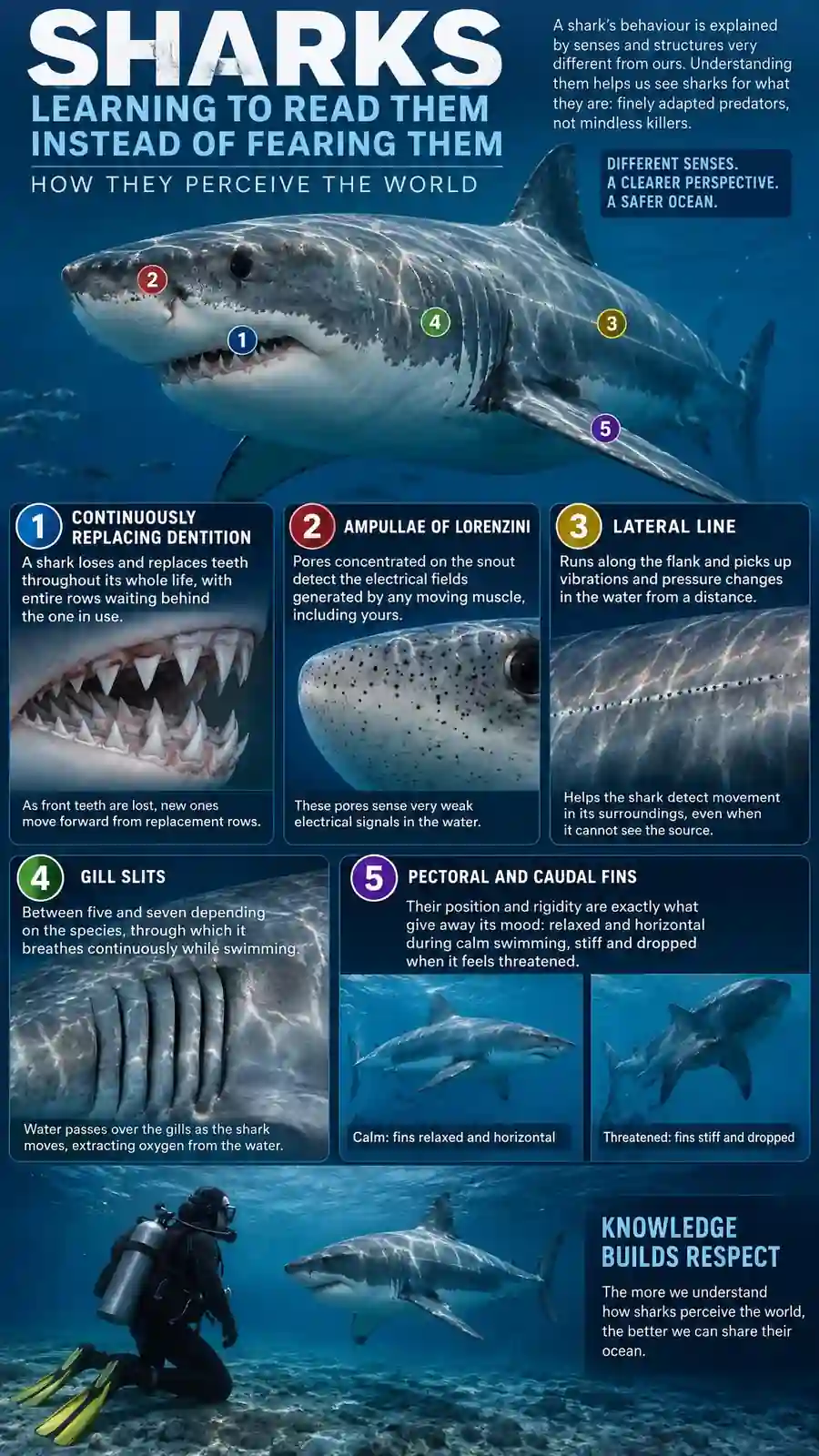
Smell is extraordinary and detects very low concentrations of dissolved substances, but it doesn't work the way it does in the movies: molecules travel with the current, so a shark positioned upstream of a scent trail picks up nothing. Chemical detection gives an approximate direction, not a position.
The lateral line detects vibrations and water movement at medium range, and it's probably the sense most relevant to a diver. What catches a shark's attention isn't the presence of a still person, but an erratic, jerky movement: exactly the kind an injured fish produces, or someone swimming in a panic.
The ampullae of Lorenzini, pores scattered across the snout, detect extremely weak electric fields, like the ones generated by the muscle activity of prey buried in the sand. It's a short-range sense they use in the final phase of an approach, and it explains why some sharks approach metal objects or electrical sources.
Vision is better than usually believed, especially in low light, and in most species it's adapted to dim conditions. That, combined with the fact that many species become more active at dawn and dusk, explains one of the classic recommendations about timing and murky water in areas with a history of incidents.
Put it all together: to a shark, a scuba diver is a large, noisy object that releases bubbles and doesn't resemble anything it eats. The curiosity they sometimes show usually isn't an intention to feed, it's what an intelligent predator does when faced with something unfamiliar. Even so, that's no guarantee: keep your distance and a way out.
Reading behavior
Almost everything you need to know is in how it swims.
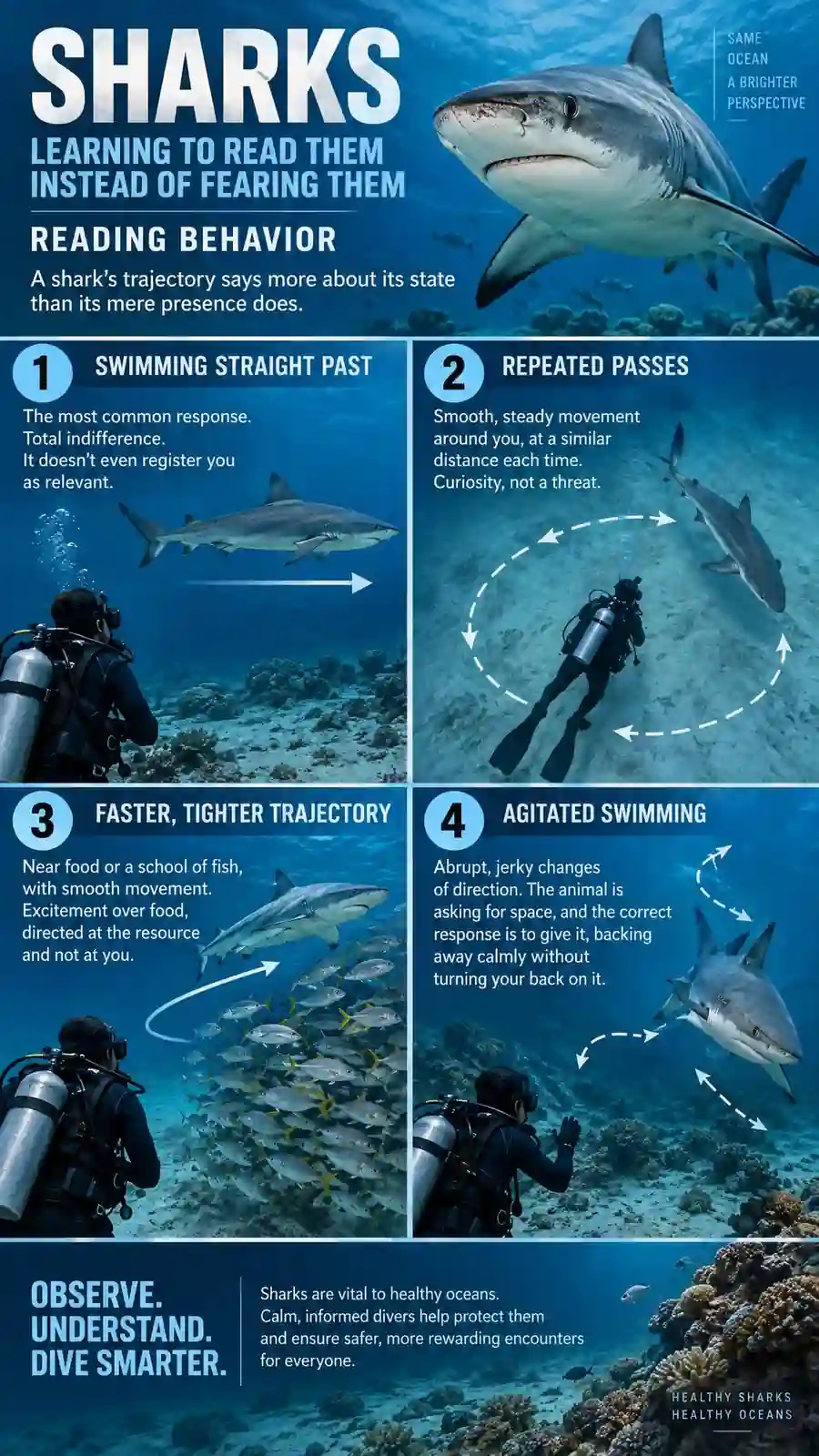
A calm shark swims smoothly and evenly, on a steady course, and usually keeps a constant distance or moves away. Many species simply swim on past, and reef species often rest under ledges or in caves, paying no attention at all to anyone watching them.
Curiosity shows up as repeated passes, each one a little closer, while keeping a smooth motion. It's exploratory behavior, not aggressive, even if it looks impressive, and it often fades once the animal confirms there's nothing interesting there. That's no guarantee: if the passes get progressively closer, withdraw in a controlled way, as the situation and your guide indicate.
The signals that do call for attention are different: agitated or jerky swimming, sharp turns, sudden bursts of speed, and, in some species, a pattern classically described as an arched back, pectoral fins pointed downward, and spasmodic movements. It isn't a threat in the human sense, it's an uncomfortable animal asking for space, and the correct response is to give it.
It also helps to read the context. A shark focused on a school of fish, on a feeding ground, or in the presence of fishing scraps is in a different state of excitement, and the rules of proximity change.
And a note about the group: sharks distinguish perfectly well between an isolated diver and a tight group. Staying together, and specifically not lagging behind, is one of the most effective behaviors there is.
What to do in an encounter
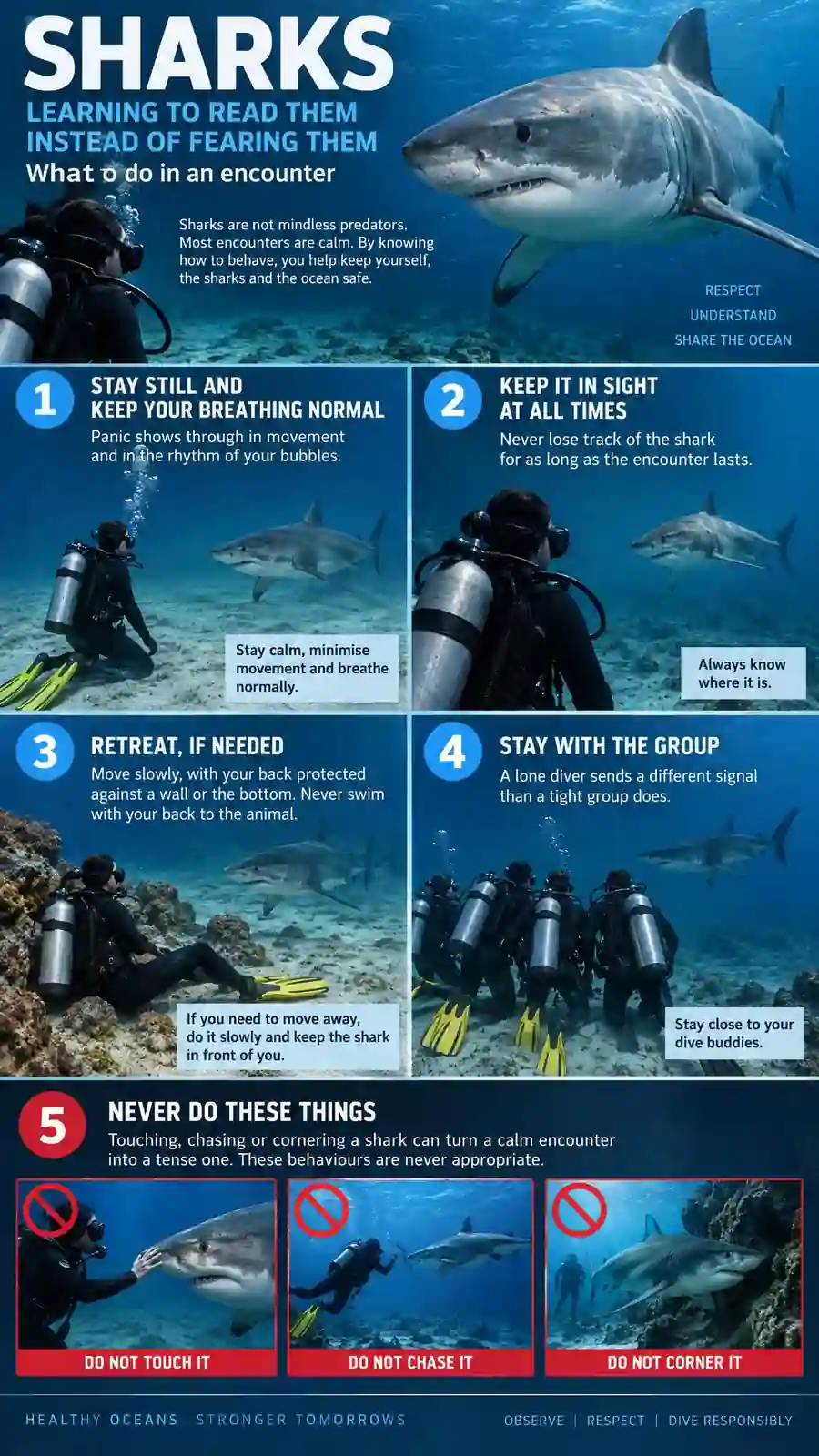
First, stay still and breathe normally. Stillness is the opposite of what prey does, and it also avoids generating the vibrations that draw attention. A stable diver with controlled buoyancy is an unremarkable object.
Second, keep the animal in sight and face toward it, turning slowly if needed. Losing sight of a curious shark is what usually precedes the closest passes, and turning your back on it while swimming away is exactly the wrong signal to send.
Third, if you want to leave the situation, do it slowly and with your back protected: retreating toward a wall, a ledge, or your own group, and ascending calmly and under control. Never by splashing at the surface or with sudden movements.
Fourth, don't touch, don't chase, don't block its path, and don't corner it against a wall or inside a cave. The vast majority of bites on divers are defensive and stem from one of those four behaviors.
And some context-specific rules: don't carry spearfishing catches on you (if you're fishing, they go on a float towed at a distance and get handed off promptly) avoid night diving or diving in murky water in areas with a history of incidents, and treat dives with artificial feeding for what they are: activities with their own rules, a specialized guide, and an open debate about their effect on animal behavior.
In the very unlikely case of aggressive contact, the response described by those who have experienced it and by standard protocols is to defend yourself by aiming strikes at the snout, eyes, or gills (the sensitive areas) and to exit the water. Wounds are managed like any major hemorrhage, as described in the article on first aid and response.
Diving application
Listen closely to the local briefing: every site has its own species, typical behavior, and rules, and the guide knows them far better than any generalization.
Keep the group tight and don't lag behind. A lone diver in midwater is the least advisable setup at any site with large sharks.
Control your buoyancy and avoid sudden movements. Stillness isn't just safety: it's also what lets the animal come closer and makes the dive worthwhile.
Don't chase for the photo. Chasing changes the animal's behavior, ruins the encounter for the rest of the group, and is the origin of some incidents.
And hold your camera, or your hands, out in front as a visual reference if a curious animal gets too close: keeping an object between you and turning with it is the standard way to mark distance without being aggressive.
Common mistakes
"If a shark shows up, you need to get out of the water as fast as possible."
Swimming hurriedly or splashing produces exactly the erratic vibrations that draw attention. The correct response is to stay still, keep the shark in sight, and retreat slowly with your back protected.
"A single drop of blood instantly attracts sharks from kilometers away."
Smell is very sensitive, but molecules travel with the current and give an approximate direction, not a position. An animal positioned against the current from the trail simply doesn't detect it.
"If it approaches several times, it's going to attack."
Repeated passes with smooth swimming are exploratory behavior. What calls for attention is agitated, jerky swimming, and the right response there is to give space, not to flee. If the passes get closer and closer, also withdraw in a controlled way, following your guide.
Did you know…?
- The ampullae of Lorenzini detect electric fields as weak as the ones generated by the muscle activity of prey buried in the sand.
- To a shark, a scuba diver is a large, noisy object that releases bubbles and doesn't resemble its usual prey, though that doesn't guarantee a safe encounter.
- Tens of millions of sharks die every year because of fishing activity: in this relationship, the threatened species isn't ours.
Key takeaways
- The real risk of a shark encounter for a diver is very low, and the pattern behind incidents is recognizable and avoidable.
- Smell, the lateral line, electroreception, and vision explain their behavior: what catches their attention is erratic movement, not presence.
- Smooth, repeated passes usually mean curiosity, and agitated, jerky swimming means an animal asking for space; if it keeps getting closer, withdraw in a controlled way with your guide.
- In an encounter: stay still, breathe normally, keep it in sight, and retreat slowly with your back protected.
- Don't touch, don't chase, don't corner, and don't carry catches on you: that covers nearly all of prevention.