Intermediate 8 minutes
The diver's respiratory system: why breathing takes more work and you never hold your breath on ascent
Why breathing underwater takes more work, and why you never hold your breath on the way up
Of all the rules of diving, only one admits no exception under any circumstance: never hold your breath. Everything else has nuance. This one doesn't, and the reason lies in the anatomy of your own lungs.
In this article you'll understand how gas exchange happens in the lungs, what changes when you breathe compressed air at depth, why breathing takes more work down there, and what carbon dioxide retention is.
The respiratory system is the body system that most directly affects diving: it determines your gas consumption, your sense of exertion, and it's behind the most serious injury a diver can suffer.
The path of the air
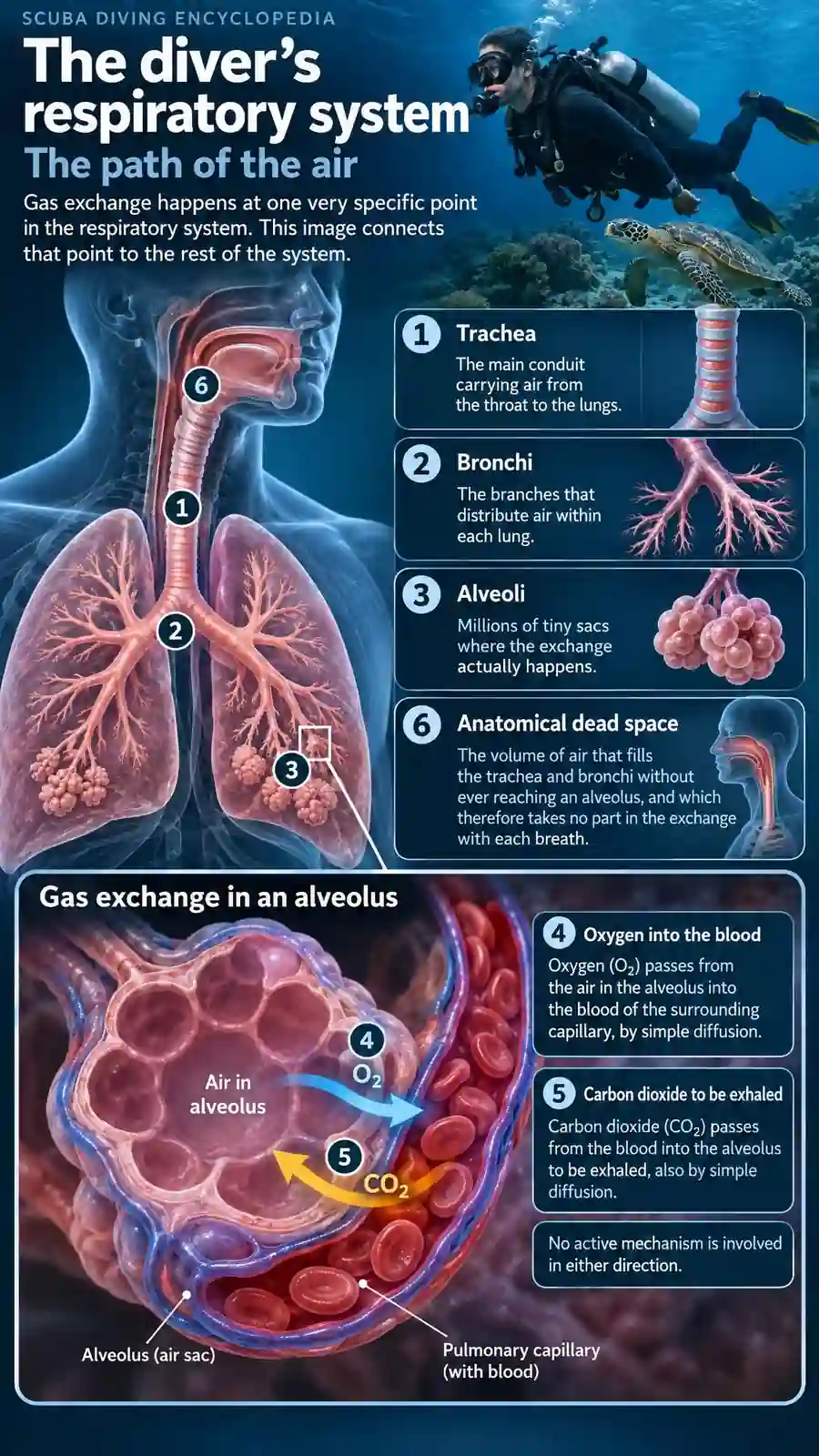
Air enters through the mouth or nose, passes through the trachea, and spreads through a network of airways that branch again and again (the bronchi and bronchioles) until it reaches tiny sacs at the end: the alveoli.
That's where it all happens. The alveoli are millions of extraordinarily thin-walled sacs, wrapped in blood capillaries. Their combined exchange surface is enormous: comparable to an entire room unfolded inside your chest.
The exchange works by a difference in partial pressure: oxygen moves from the alveolus into the blood because there's a higher concentration on one side than the other, and carbon dioxide makes the reverse trip for the same reason. There's no active pumping, only diffusion. This mechanism depends directly on the gas laws you'll see in the diving physics category.
And there's a portion of the air that never reaches the alveoli: the air left in the trachea and bronchi at the end of each inhalation. That's anatomical dead space, air that moves but doesn't take part in the exchange. The concept matters more than it seems, because dive gear adds dead space of its own.
What changes underwater
The first thing that changes is gas density. At depth you breathe compressed air, and that air is denser: at thirty meters, every breath moves a gas several times denser than at the surface. A denser gas flows worse through the airways, and that increases the work of breathing. It's one of the reasons why, at greater depth, breathing feels more effortful and you use more gas.
The second is body position and the water pressure on your chest, which slightly change breathing mechanics depending on whether you're horizontal, vertical, face up, or face down.
The third is the gear. The regulator delivers gas on demand, but it takes a minimum of effort to crack the valve open and more to exhale against the water. A well-maintained, properly tuned regulator reduces that work noticeably; a neglected one increases it.
The combined result is that breathing underwater is never exactly the same as on the surface, and the difference becomes more pronounced with depth and exertion.
CO₂ retention
The trigger that makes you breathe isn't a lack of oxygen: it's the build-up of carbon dioxide. The body's chemoreceptors watch CO₂ much more closely than O₂, and they're what set off the sensation of needing air.
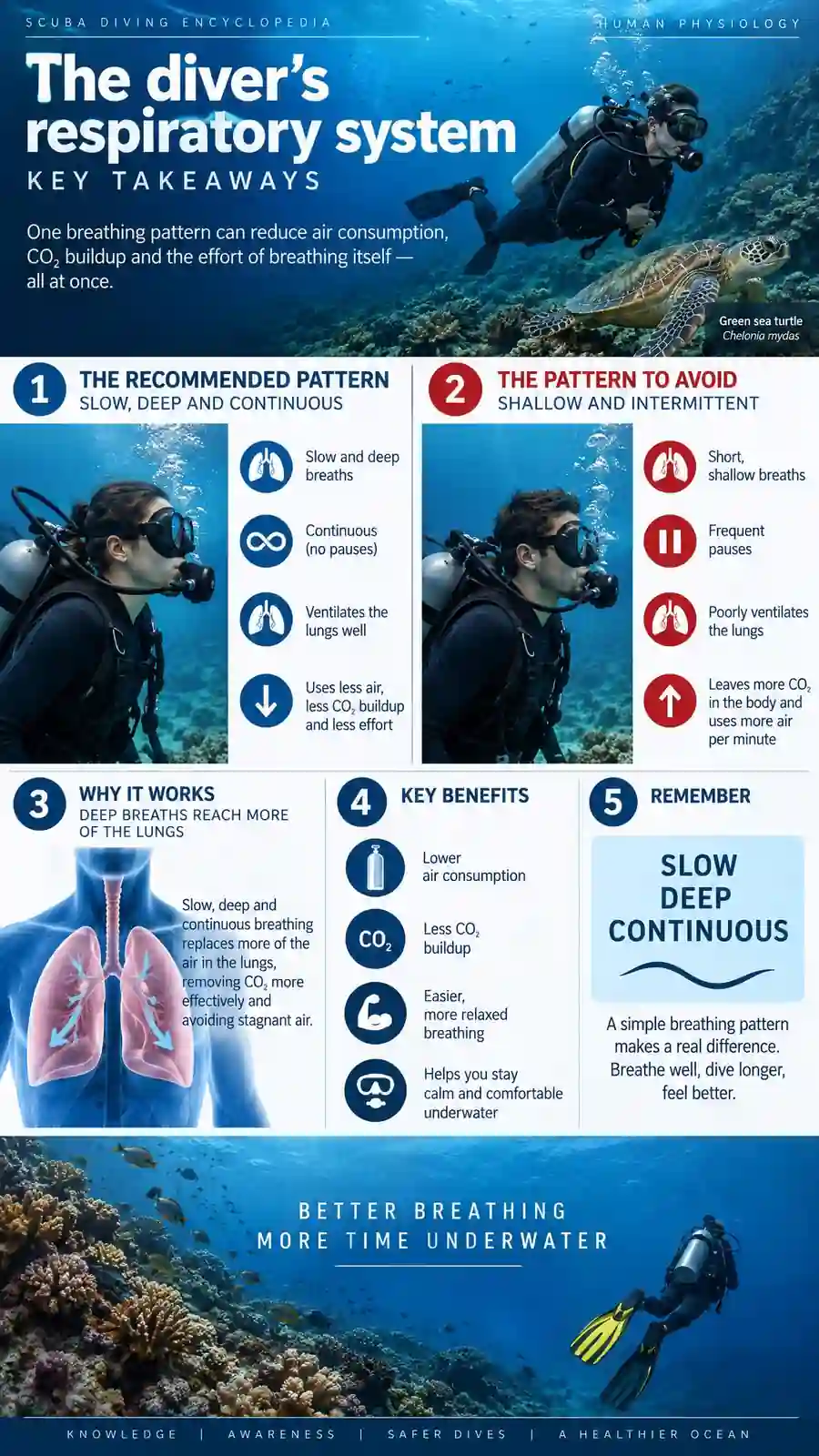
Some divers develop the habit of skipping breaths or breathing very shallowly, with the idea of saving gas. It's a practice unanimously discouraged: it reduces effective ventilation, causes a larger share of each breath to stay in dead space without reaching the alveoli, and causes CO₂ build-up.
The consequences of that build-up are concrete: headache, a feeling of suffocation, increased breathing rate, exhaustion, and a marked worsening of narcosis. In serious cases, impaired judgment right when it's needed most. These conditions are covered in detail in the illnesses and accidents category.
The recommended pattern is the opposite: slow, deep, continuous breathing. It ventilates better, uses less gas than most people assume, and keeps CO₂ under control.
The rule with no exceptions
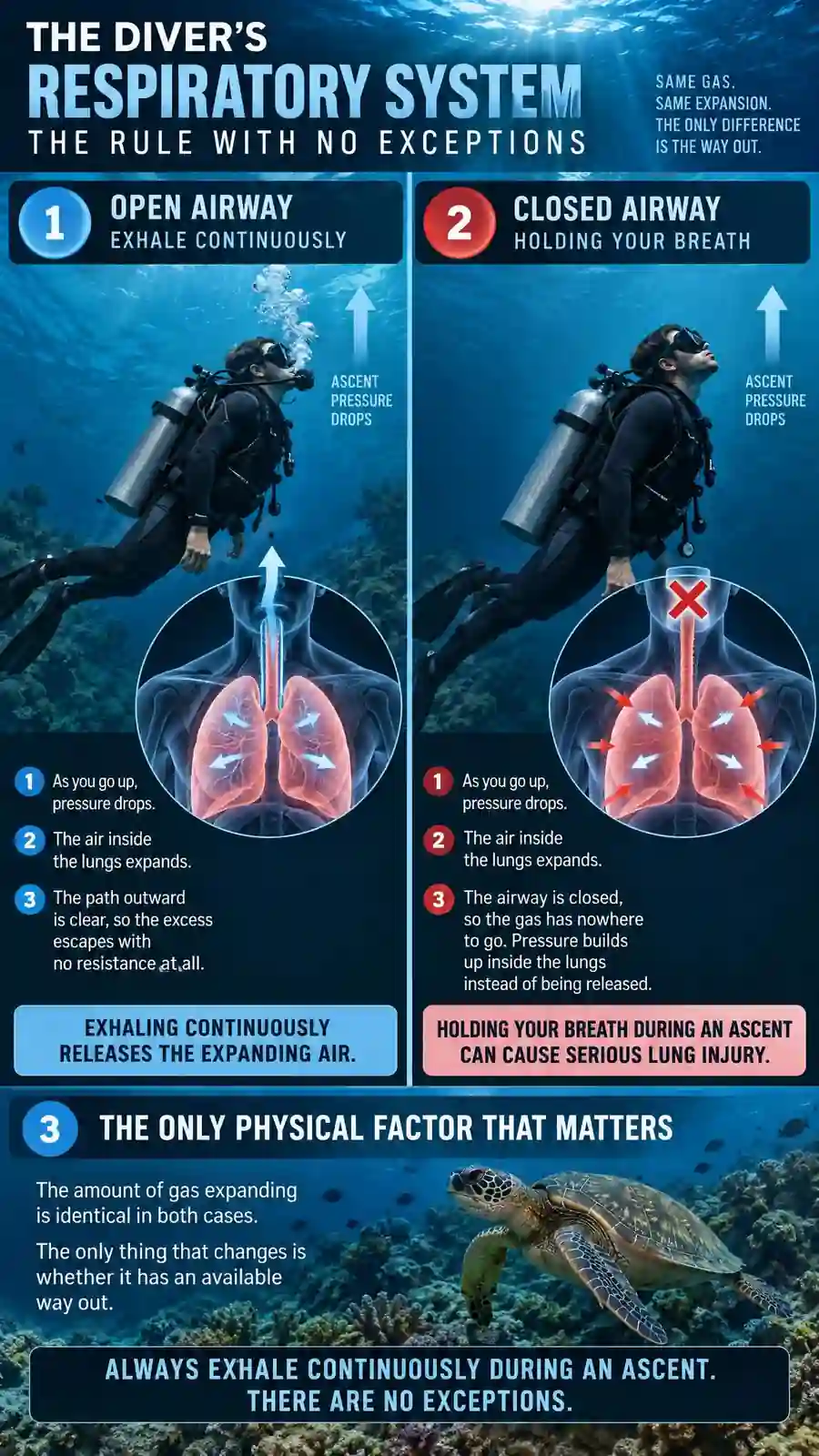
The air you breathe at depth is compressed. As you ascend, ambient pressure drops and that air expands. If the airway is open, the excess simply escapes and nothing happens: that's why continuous exhalation during ascent completely solves the problem.
If the glottis is closed, holding your breath, that air has nowhere to go. The volume increases against a lung that can't keep up, and lung tissue can tear. That's pulmonary overexpansion injury, and serious conditions like arterial gas embolism can result from it.
What makes this rule so serious is the scale involved. The greatest relative change in volume doesn't happen at depth: it happens in the last few meters before the surface, where pressure drops proportionally faster. An uncontrolled ascent from very shallow depth, while holding your breath, is enough to cause a serious injury.
Hence the rule repeated throughout all diver training: breathe continuously and never hold your breath while breathing compressed air underwater.
Diving application
Slow, deep breathing is the base technique and delivers three benefits at once: lower gas consumption, better buoyancy control (because the breathing cycle predictably raises and lowers your body) and less CO₂ build-up.
Exertion is the direct enemy of all of the above. Swimming against a current, carrying excess weight, or using a gear configuration with a lot of drag increases CO₂ production right when denser gas makes it harder to eliminate. If you feel a growing sensation of air hunger, the correct response is to stop, hold onto something stable if possible, and recover your breathing rhythm before continuing.
An important note for anyone who combines activities: the rules of freediving and the rules of diving with gear are different and don't mix. A freediver holds their breath by definition; a diver with a tank must never do so. Alternating between both disciplines on the same day has considerations of its own that go beyond this article.
Finally, any pre-existing respiratory condition (asthma, a history of pneumothorax, chronic lung disease) should be evaluated by a physician with specific training in diving medicine before you dive. This article is educational and does not replace that evaluation.
Common mistakes
"Breathing shallowly and skipping breaths saves air."
It reduces effective ventilation and causes CO₂ build-up, with headache, a feeling of suffocation, exhaustion, and worsening narcosis. Slow, deep breathing is more efficient and safer.
"Holding your breath for a moment on the way up isn't serious if it's brief."
The greatest relative change in gas volume happens in the last few meters toward the surface. A short ascent while holding your breath can cause a serious lung injury.
"The urge to breathe shows up when oxygen runs low."
The main trigger for breathing is the build-up of carbon dioxide, not a lack of oxygen. The body watches CO₂ much more closely than O₂.
Did you know…?
- The alveoli's total exchange surface is enormous: unfolded, it would be roughly equivalent to the size of a room.
- The air left in the trachea and bronchi at the end of each inhalation, anatomical dead space, never takes part in gas exchange.
- Compressed air breathed at thirty meters is several times denser than at the surface, and that density is one of the reasons breathing feels harder down there.
Key takeaways
- Oxygen and carbon dioxide are exchanged in the alveoli by diffusion, following differences in partial pressure.
- At depth the gas is denser, which increases the work of breathing and gas consumption.
- Skipping breaths to save gas causes CO₂ retention, with exhaustion and worse narcosis.
- The urge to breathe comes from accumulated CO₂, not from a lack of oxygen.
- Never hold your breath with compressed air: the gas expands as you ascend and can tear lung tissue.