Beginner 7 minutes
The first breathing systems: millennia of freediving and a persistent mistake
Gatherers, military divers, and why the long tube never worked
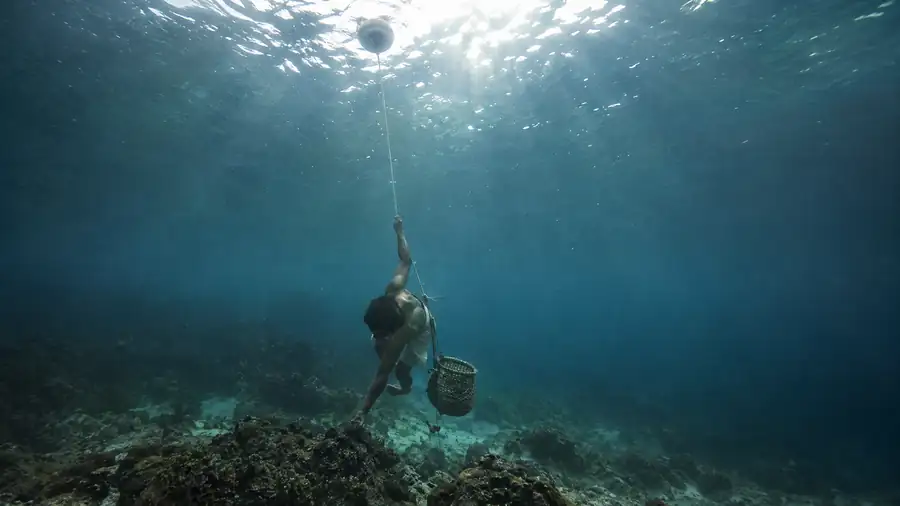
For most of the history of diving there was no equipment. There were people holding their breath, going down for food or for money, and coming back up. That period lasted several thousand years; the age of self-contained equipment has lasted less than a century.
In this article you'll see who the first divers were and why they went down, what attempts were made in antiquity to extend time underwater, why the most intuitive idea of all (a tube up to the surface) is physically impossible, and what had to be discovered before diving with equipment became viable.
Understanding what kept people from breathing underwater explains why the solution took so long to arrive: it wasn't an engineering problem but one of understanding pressure, and that understanding didn't exist until well into the seventeenth century.
Diving as a trade
Diving started out as work. There's archaeological evidence of mollusk and shell gathering going back thousands of years, and historical records of professional diving in the Mediterranean, the Persian Gulf, the Red Sea, India, and East Asia long before any equipment existed.
The goals were economic: sponges, pearls, red coral, mother-of-pearl, mollusks, and, when needed, salvaging sunken objects. Sponge divers in the Aegean went down with a ballast stone to descend quickly and were hauled back up with a rope.
Military applications appeared very early too: cutting mooring lines, boring through hulls, removing obstacles, and placing underwater defenses show up in classical sources, and diving was part of siege operations against ports.
Two traditions have survived to this day and are still practiced: the diving women of Japan and Korea, communities of women who have spent centuries freediving to gather shellfish and seaweed, and whose social organization and knowledge of the sea are a case study in their own right.
In all these traditions the limit was the same: however long a single breath lasts. And as you saw in the article on hypoxia, that limit has very specific physiology behind it, which none of these cultures understood but all of them managed through experience.
The tube mistake
The most intuitive idea in the history of diving, and the one that can't work.
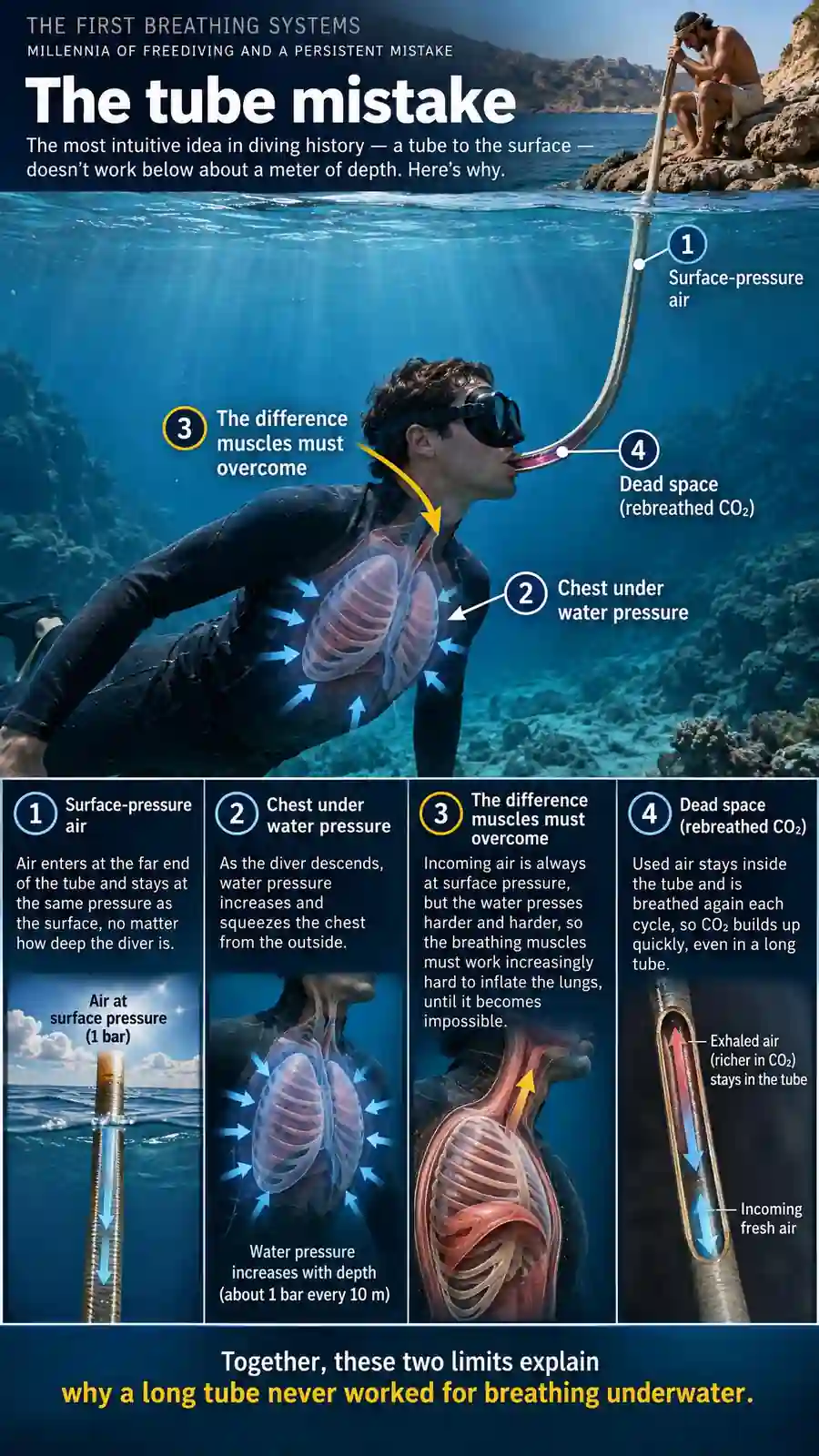
The obvious solution seems to be a tube from the mouth to the surface. It appears drawn in medieval and Renaissance manuscripts, several meters long and sometimes with a float on the end. It never worked, and the reason is physical.
At one meter of depth, the water is already exerting noticeably more pressure on your chest than the air coming down the tube from the surface. Your breathing muscles have to overcome that difference to inhale, and past a depth of roughly one meter, the task exceeds what the body can sustain.
The second problem is the dead space you already know from the article on carbon dioxide: a long tube holds a volume of exhaled air that gets breathed back in on the next breath, so CO₂ builds up quickly.
That's why a modern snorkel tube is short: it isn't a design limitation or a concession to the market, it's the maximum length physiology allows.
The historical consequence matters: breathing underwater required more than just getting air down there. It had to arrive at the same pressure as the surrounding water, and that idea required first understanding that water exerts pressure and that air compresses, something that wasn't formulated until the seventeenth-century work on gases.
What actually worked: trapped air
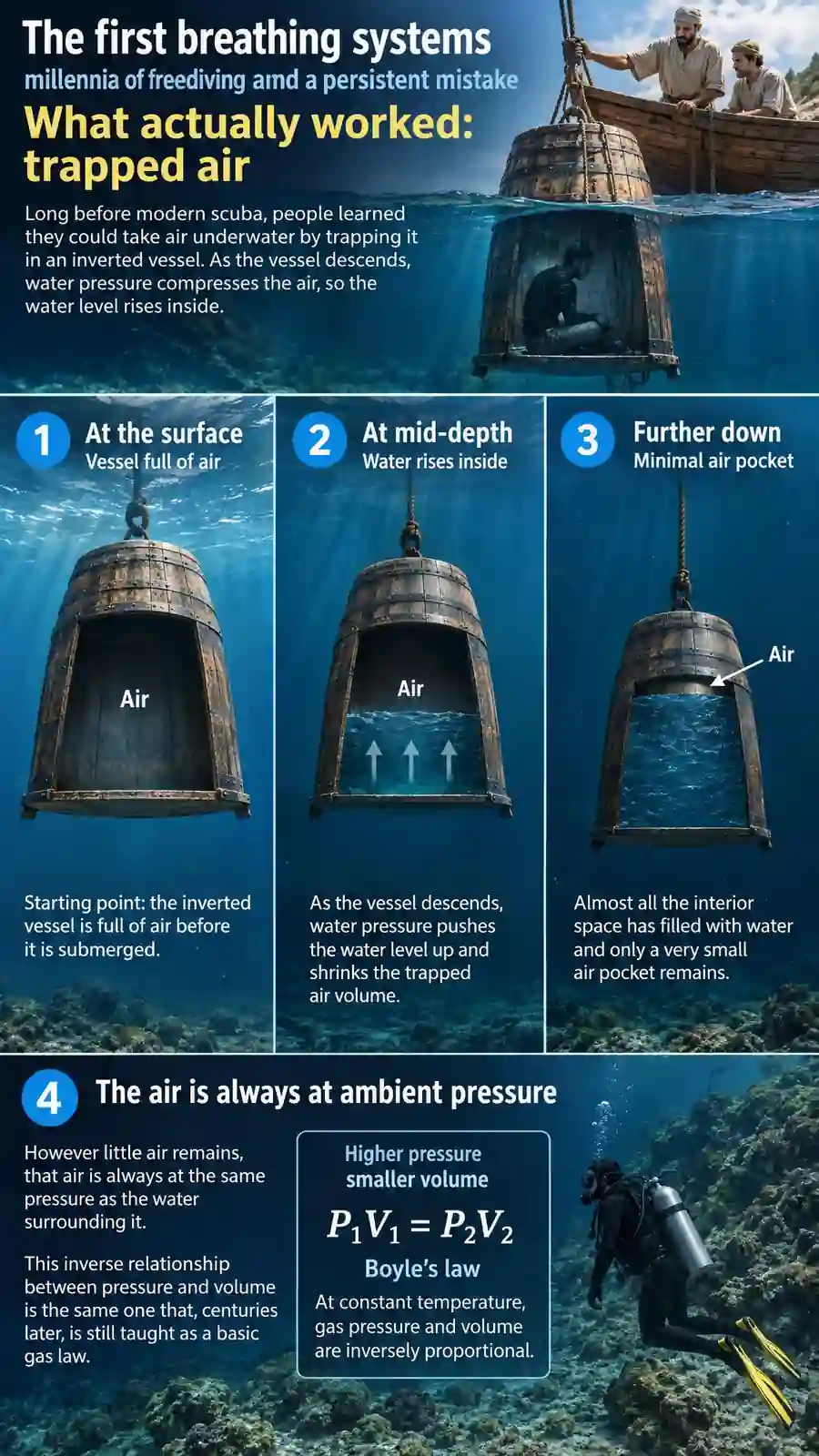
The only ancient solution that actually extended time underwater was carrying a volume of air down inside an inverted container. A cauldron, a barrel, or a bell turned mouth-down keeps air trapped inside when submerged, and that air is automatically at the pressure of the surrounding water.
Aristotle mentions a device of this kind, and tradition credits Alexander the Great with a descent inside a transparent vessel: a story that's probably legendary but indicates the idea was already circulating.
Air-filled skins and leather sacks were also used, with limited results: the volume is small, the air runs out quickly, and CO₂ builds up, so they were good for a few extra minutes rather than a real change of scale.
The limit of all these systems is that the trapped air compresses on the way down, following the relationship Boyle would later formulate: the bell loses usable volume with depth, and at a certain depth water rises inside it until only a minimal air pocket remains.
That observation (that the same air takes up less space the deeper it goes) is what links the ancient history of diving to the physics in the article on the gas laws, and it's what opened the way to the diving bell with air resupply, the subject of the next article.
What was still left to discover
What was missing, first of all, was an understanding of pressure: that water has weight, that pressure increases with depth, and that it acts in every direction. Without that, any piece of equipment was a blind guess.
It was also necessary to understand how gases behave: that they compress, that they dissolve into liquids in proportion to pressure, and that an accumulated inert gas has to leave the body in an orderly way. That last piece wasn't understood until the nineteenth century, and its absence cost many lives among the first compressed-air workers.
And technology was missing too: pumps capable of supplying pressurized air, watertight and durable materials, and, later, vessels capable of holding gas at high pressures.
The order in which those pieces arrived explains the sequence of the following articles: first the bell, which only needs trapped air; then the standard diving dress, which needs pumps and suits; then self-contained equipment, which needs high-pressure tanks and a valve able to deliver the gas at the right pressure.
And one note worth keeping in mind: throughout all of this, freediving never disappeared. It remained the working method of entire communities well into the twentieth century, and today it's a competitive sport with its own limits, its own physiology, and its own risks.
Diving application
The length of your snorkel is set by physiology, not by design: a longer tube wouldn't let you breathe any deeper.
The bell principle is still alive: the air in your BCD and in a drysuit compresses in exactly the same way on the way down, which is why you have to add more.
The sponge divers' ballast stone is the direct ancestor of modern weighting, and it answered the same problem: descending quickly without spending energy.
And the limit that governed that entire world, however long a single breath lasts, still defines freediving today, with the physiology from the article on hypoxia behind it.
If you ever dive in a destination with a freediving-gathering tradition, it's worth asking about it: in many places that practice is still alive, and it's the history of diving happening in the present.
Common mistakes
"With a long enough tube, you could breathe at several meters."
Past roughly one meter, the water pressure on the chest exceeds what the breathing muscles can overcome. On top of that, a long tube builds up CO₂ through dead space.
"Diving started out as a sport."
It started as work: sponges, pearls, coral, shellfish, salvage, and military operations. Recreational diving is less than a century old.
"Ancient diving bells let you stay down indefinitely."
Trapped air compresses on the way down and gets used up over time. Without resupply, a bell bought minutes, not hours.
Did you know…?
- Sponge divers in the Aegean descended with a ballast stone to go down quickly and were hauled back up with a rope.
- The diving communities of Japan and Korea have been freediving to gather shellfish for centuries, and the practice is still alive.
- Aristotle already describes the use of an inverted container to carry air down.
Key takeaways
- For millennia, diving was a freediving trade: sponges, pearls, shellfish, and military operations.
- A tube up to the surface is impossible because of the pressure on the chest and the dead space.
- The only thing that worked was carrying trapped air in an inverted container, already at ambient pressure.
- What was missing was an understanding of pressure, gas compression, and its dissolution into tissue.
- The order of these discoveries sets the sequence for the entire later history of equipment.