Intermediate 8 minutes
Air: the default mix and its three limits
What you're really breathing from a tank, how its quality is controlled, and where it stops working
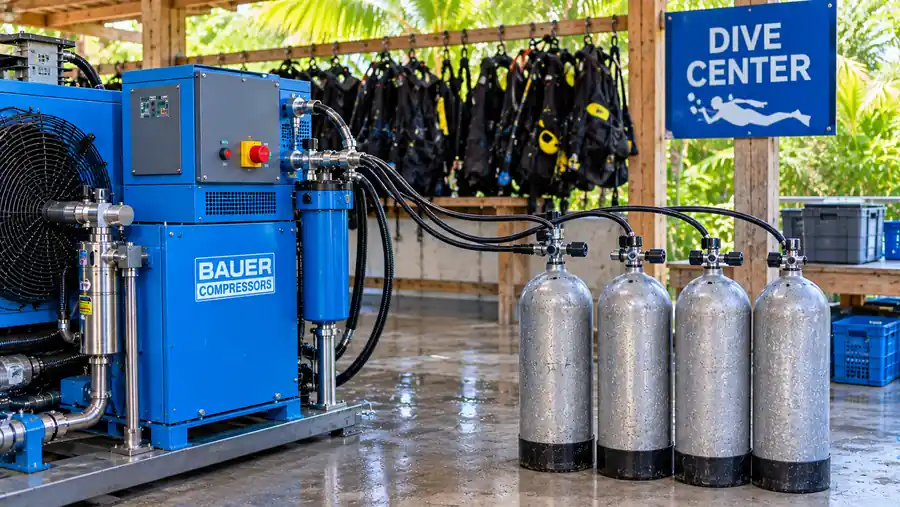
Air is the only mix most divers breathe their entire lives, and also the only one nobody analyzes. It's free, it's everywhere, and it works: until it doesn't, which happens at a fairly specific depth and for three distinct reasons.
In this article you'll see exactly what's in the air you breathe from a tank, what's controlled to keep it breathable under pressure, how to spot a quality problem, and what the three limits are that depth places on it: narcosis, the partial pressure of oxygen, and gas density.
Understanding why air has limits is what makes sense of the rest of this category: nitrox, trimix, and heliox aren't generic upgrades, they're answers to one or another of those three limits.
What's inside the tank
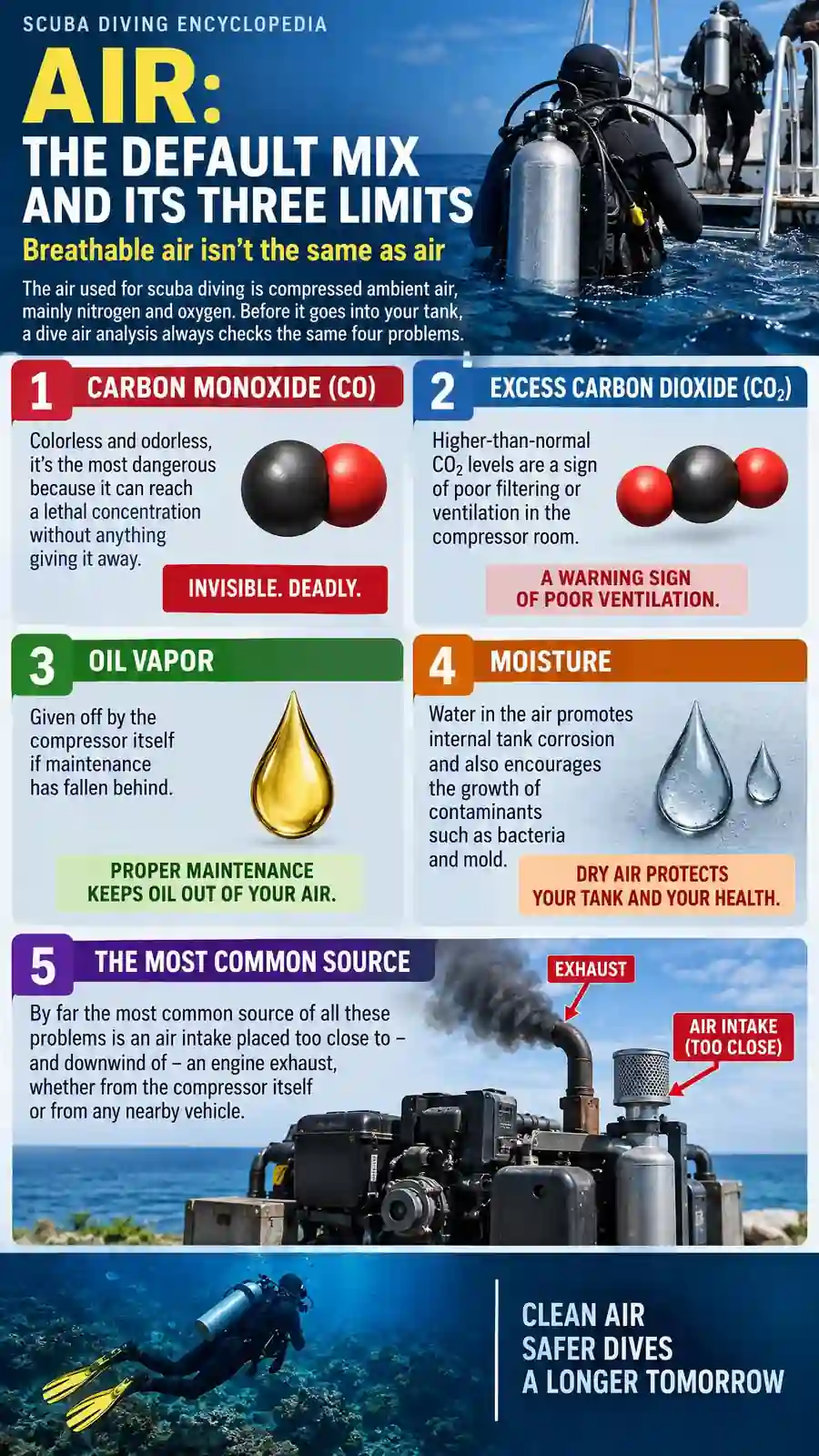
Atmospheric air is made up of roughly 78% nitrogen, 21% oxygen, and just under 1% argon, plus traces of other gases, including carbon dioxide. In diving, this gets simplified to 21% oxygen and 79% inert gas, because argon behaves the same as nitrogen for practical purposes.
The air in a scuba tank is exactly that same air, filtered, compressed, and dried. Nothing is added to it: a scuba tank does not contain pure oxygen, and that confusion (surprisingly common outside the field) matters, because breathing pure oxygen at depth is exactly what you shouldn't do.
What does change with compression is the amount of gas per unit of volume, and with it, the mass you have to move when you breathe. That's density, and it's one of the three limits in this article.
Another relevant detail is water: atmospheric air carries moisture, and compressing it would produce liquid water inside the tank, with corrosion and a risk of the regulator freezing when the gas expands in cold water. That's why the fill process includes drying, and why dive air is dry enough to contribute to the dehydration discussed in the hyperthermia article.
Breathable air isn't the same as air
Compressing bad-quality air compresses its problem too.
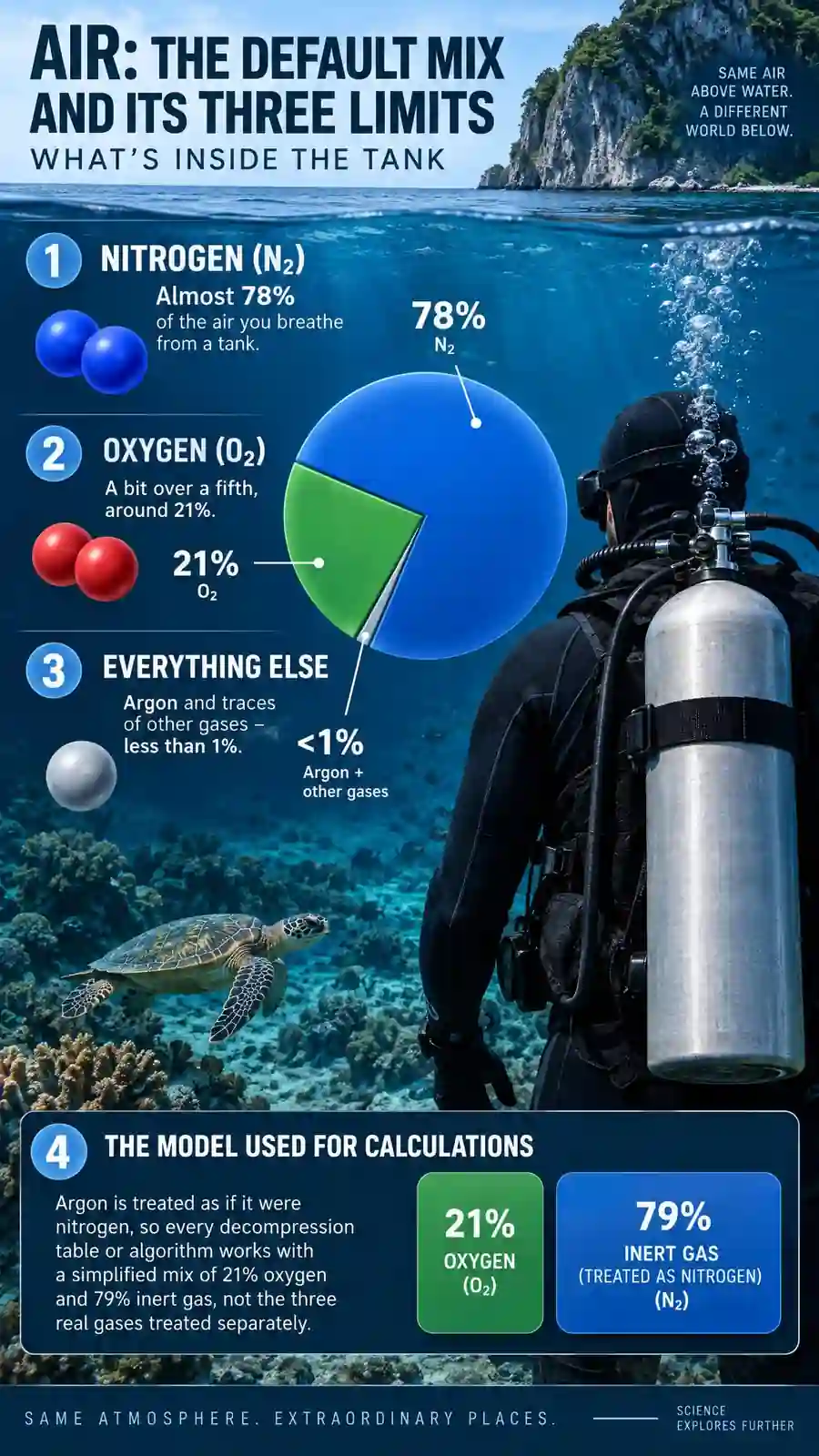
Dive air has to meet quality standards that limit the presence of contaminants: carbon monoxide, excess carbon dioxide, oil vapor from the compressor, particulates, and moisture. Serious fill stations periodically test their output and keep records.
The most dangerous contaminant is carbon monoxide. It binds to hemoglobin with a much higher affinity than oxygen and blocks oxygen transport to the tissues, producing headache, nausea, confusion, and loss of consciousness: a picture that's especially serious underwater. And there's an aggravating factor unique to diving: at depth, the elevated partial pressure of oxygen can mask the symptoms, which then appear all at once during the ascent.
Its usual source isn't a mystery: the compressor's air intake positioned near the exhaust of an engine, a generator, or a boat's exhaust pipe. It's an installation and operation problem, not bad luck.
As a diver, you can't test the air's quality, but you can do two things. The first is choosing where you fill: a station with visible maintenance and periodic testing. The second is smelling and tasting the gas before you descend: air with an unusual smell or taste (oily, metallic, sweetish) is reason enough not to use that tank and to report it. The reverse doesn't hold: carbon monoxide has no smell or taste, so noticing nothing doesn't prove the gas is safe; that depends on proper controls and analysis.
Correct air has no smell and no taste. Anything different from that is a warning sign, and heeding that sign has prevented more than one incident.
The three limits of depth
Air doesn't fail for one reason, but three, and at different depths.
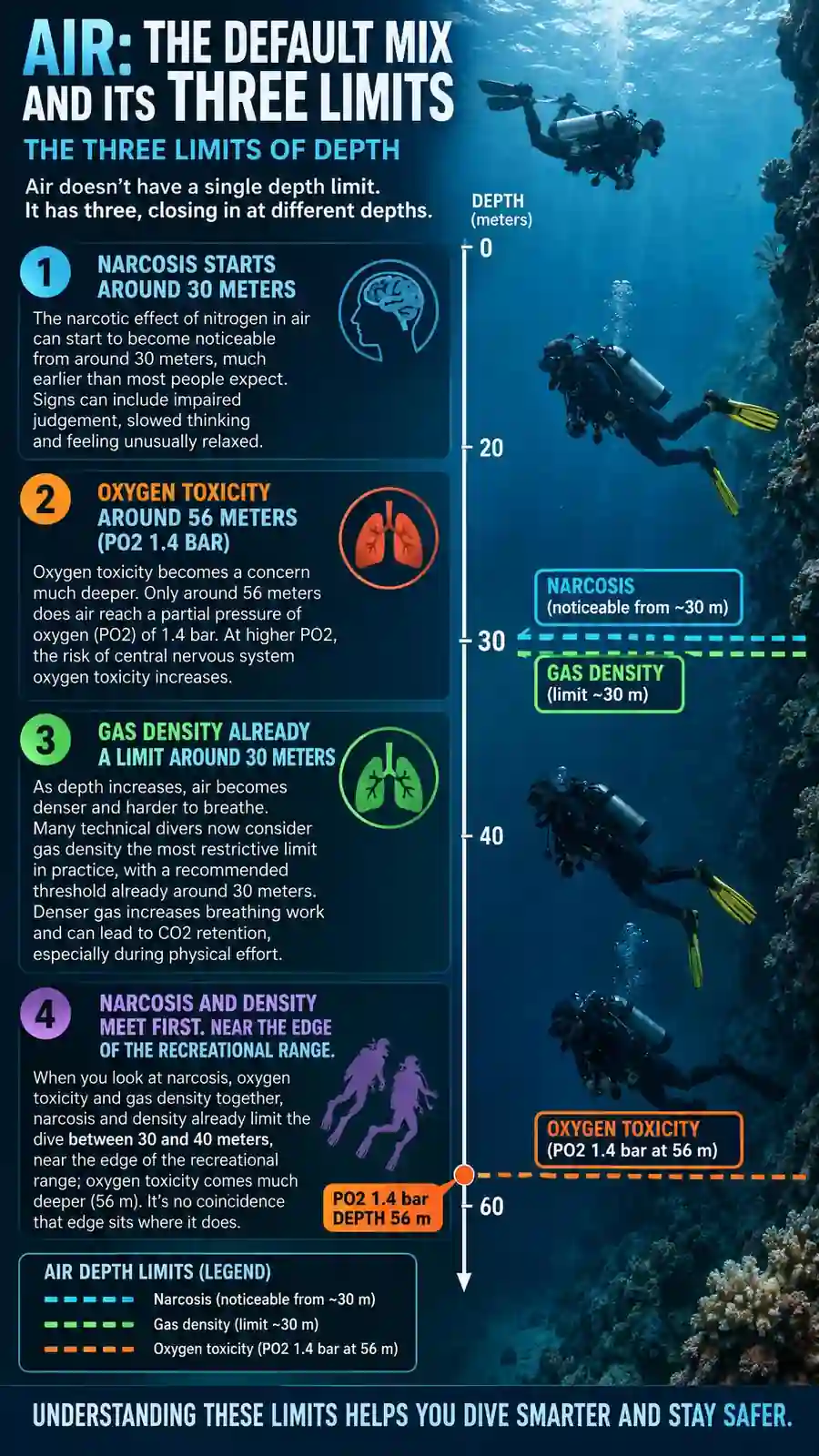
The first is narcosis. Nitrogen under pressure produces the anesthetic effect described in its own article, with noticeable manifestations that usually appear around thirty meters and clearly intensify from forty meters on. It's the limit that arrives first and, curiously, the least measurable one, because it depends on the person and the day.
The second is oxygen toxicity. At 21% oxygen, the partial pressure reaches the working limit of 1.4 bar at around fifty-six meters, and the exceptional ceiling of 1.6 bar at around sixty-six. That's why air isn't a valid gas for greater depths, regardless of decompression.
The third, less well known and just as important as the others, is density. Gas becomes denser under pressure, and moving a denser gas demands more work of breathing, which limits the maximum ventilation you can sustain and promotes the carbon dioxide buildup described in its own article. Research on this topic places the recommended density value at around thirty meters breathing air, and the suggested maximum near forty.
Taken together, these three limits explain why the recreational range stops where it stops: narcosis and gas density already limit the dive between thirty and forty meters, and that is why agencies place the air diving limit around forty meters. Oxygen toxicity comes well below that, but it is just as real a limit. It's not an arbitrary figure.
And they also explain the rest of this category: nitrox tackles the dissolved-nitrogen problem but makes the oxygen one worse; trimix tackles both narcosis and density at once; heliox eliminates nitrogen entirely. Each mix is a different answer to a different limit.
Diving air well
Air remains the right mix for the vast majority of recreational diving, and it's worth saying clearly: on dives to twenty or twenty-five meters, there's no problem to solve that justifies anything else, beyond the extra margin nitrox offers.
What is worth doing is diving it knowing where its limits are: planning your maximum depth with a margin, treating forty meters as the outer edge of the recreational range and not as a target, and recognizing that at that depth narcosis and the work of breathing are already affecting your performance even if you feel fine.
And respecting the logistics that make it safe: filling at trustworthy places, checking the tank's pressure and condition, smelling the gas before descending, and keeping your own gear in good condition, because a regulator that breathes poorly multiplies the effect of gas density right where it matters most.
The next step isn't a more exotic mix: it's training. Any mix other than air, starting with nitrox, requires a specific course that teaches, above all, analysis and configuration procedures, which is where the real risk lies.
Diving application
Smell the gas at the second stage before you gear up. Any unusual smell or taste means the tank is out and the shop gets told. Noticing nothing doesn't prove it's safe: carbon monoxide has no smell or taste.
Check the actual pressure with your own gauge, not just the label or what you're told: a badly filled tank is a planning problem from minute zero.
Plan your maximum depth below the range where narcosis and gas density start to limit the dive, and treat forty meters as an outer boundary, not a goal.
Look after your regulator: at depth, gear that breathes with resistance adds to gas density and pushes you toward CO₂ buildup.
And if you dive below thirty meters often, consider that the next step isn't going deeper on air, but training in gas mixes.
Common mistakes
"Your tank has oxygen in it."
A scuba tank carries compressed air: 21% oxygen and the rest inert gas. Breathing pure oxygen at depth is exactly what you don't do, because of oxygen toxicity.
"Air is air, it doesn't matter where you fill."
Quality depends on the compressor, the filters, and where the air intake is. Carbon monoxide from a nearby exhaust is a real and avoidable risk if you choose your fill station carefully.
"Air's limit is just narcosis."
There are three simultaneous limits: nitrogen narcosis, the partial pressure of oxygen (1.4 bar around 56 meters) and gas density, which drives up the work of breathing and CO₂ retention.
Did you know…?
- At depth, the elevated partial pressure of oxygen can mask the symptoms of carbon monoxide poisoning, which then appear all at once during the ascent.
- Dive air is compressed first and dried afterward, at high pressure, to prevent corrosion and regulator freezing, which is why it contributes to dehydration.
- Atmospheric argon behaves like nitrogen for practical purposes, which is why diving models air as 21% oxygen and 79% inert gas.
Key takeaways
- Dive air is atmospheric air, filtered, compressed, and dried: 21% oxygen and 79% inert gas.
- Quality is controlled by limiting carbon monoxide, CO₂, oil, particulates, and moisture, and it depends on the fill station.
- Depth places three simultaneous limits on it: narcosis, the partial pressure of oxygen, and gas density.
- Narcosis and gas density already limit the dive between 30 and 40 meters, the edge of the recreational range; oxygen toxicity comes deeper, around 56 meters.
- Each mix in the rest of the category is a different answer to one of those three limits.