Intermediate 8 minutes
Planning a dive: the decisions get made on land
Depth, time, gas, route, and conditions, agreed before you get wet
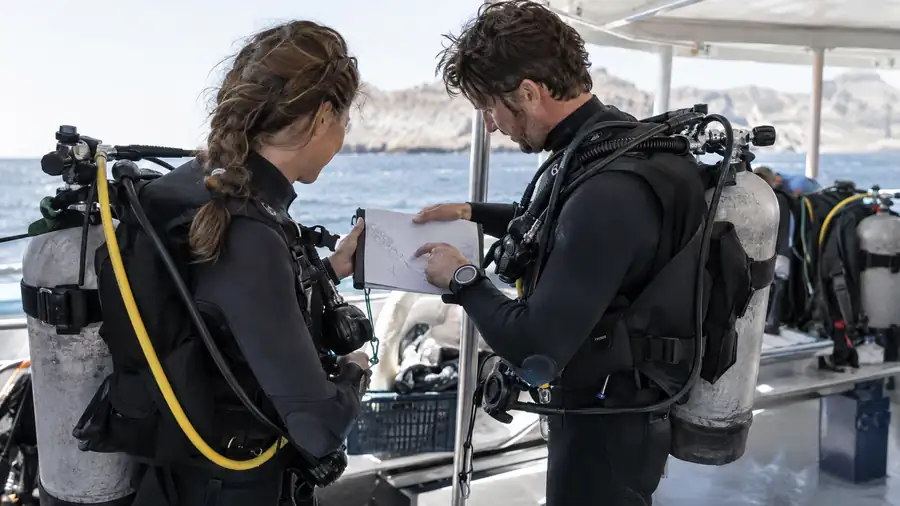
Underwater, your judgment is worse than you think: narcosis, cold, exertion, and that eagerness to see something interesting just a bit further. Planning exists precisely so the important decisions have already been made by a version of you that was on land, dry, and thinking clearly.
In this article you'll see what elements make up a dive plan, how limits are agreed with your buddy, what information you need to gather about the site, and what to do when reality doesn't match what was planned.
Most recreational diving incidents don't start with equipment failure, but with a decision made underwater that no one had anticipated on the surface.
The five elements of the plan
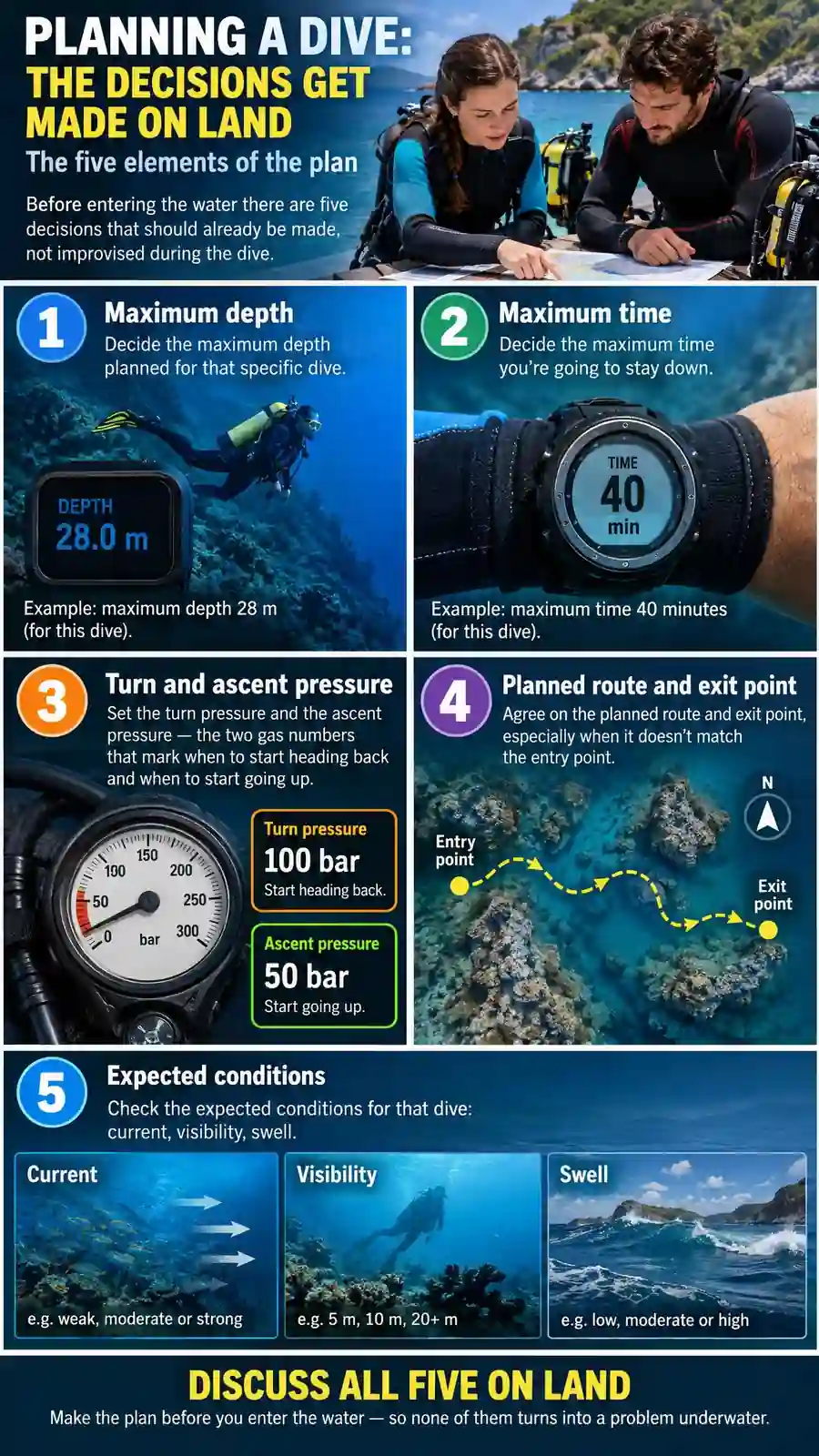
A dive plan isn't a document: it's an explicit agreement on five specific things.
Maximum depth. An agreed number, not a vague intention. It's set before entering the water, taking into account both divers' certification, recent experience, and the site. It's the limit neither of you is going to propose exceeding down there.
Maximum time. It can be set by the no-decompression limit, by the gas reserve, or by conditions. In practice, whichever of the three is reached first governs.
Gas. How much gas signals the moment to start heading back, and how much signals the start of the ascent. That's the topic of the next article in this category, and it's where most people improvise.
Route. Where you enter, what path you take, where you exit, and what the reference point is for orientation. It includes what to do if the group gets separated.
Conditions. Expected current, visibility, swell, temperature at working depth, boat traffic. This determines a good part of everything above.
Gathering information about the site
The local guide's briefing is the main source, and it deserves real attention, not treatment as a formality. Whoever knows the site knows things that appear in no guidebook: where the current enters with that tide, where the reference point for returning is, what depth the spot they call "the shoal" actually has.
Tide tables matter more than most people assume, especially in channels, straits, and sites with water flow, as you saw in the article on tides. At many destinations, the dive window is set by the tide, not by the dive center's schedule.
The marine weather forecast gives expected wind and swell, which affect both entry and exit and visibility. The meteorology category covers how to interpret it.
And at a new site, the most useful question you can ask a guide is direct: what usually goes wrong here. The answer is usually more informative than the entire route description.
The agreement with your buddy
Planning closes with a brief conversation between buddies, before gearing up. It should cover four points, and it takes no more than two minutes.
The agreed limits: depth, time, and turn-around pressure. Having both of you say the numbers out loud prevents discovering underwater that each of you understood something different.
Who leads and how you communicate. Who sets the pace, what signals you'll use, and how you signal wanting to turn back or ascend. Either of you can end the dive at any time and without justifying it: that's worth stating explicitly.
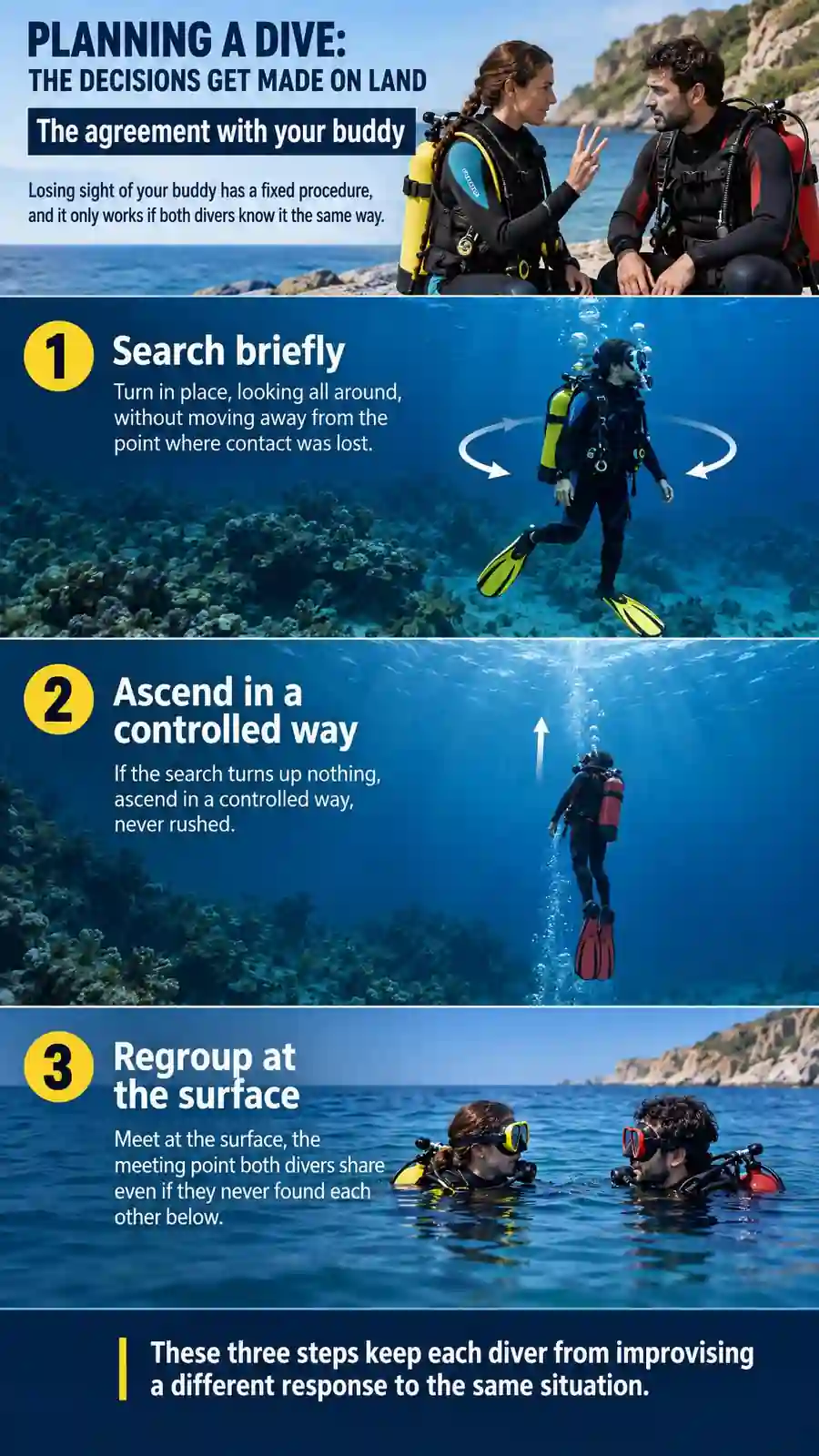
The separation procedure. The standard rule taught in recreational training is to look for each other for a brief period, on the order of a minute, and, if there's no contact, ascend and reunite on the surface. It's a rule that works because both divers do the same thing; if one improvises, it stops working.
And a mutual equipment check before entering, following the check taught by the organization you trained with. Checking your buddy's equipment catches things you'd overlook on your own.
When reality doesn't match
A plan exists precisely so you can recognize when something has gone off script. If the current is stronger than announced, if visibility is much worse, if someone is having trouble equalizing, or if consumption is running noticeably faster than estimated, the plan no longer matches the situation.
In those cases, the reasonable response is to adjust or abort, not to keep going while hoping it improves. That decision is much easier to make if you've already agreed beforehand that aborting is a normal option, not a failure.
Peer pressure is a real factor, documented in diving incidents. No one should feel obligated to do a dive they're not comfortable with just because they'd be the only one backing out. A serious operation respects that decision without comment.
And there's a rule worth adopting as your own: if a dive starts badly (equipment failing, stress, ears that won't equalize, a sense that something's off) it's better to exit and re-enter properly than to drag that problem through the whole dive.
Diving application
The plan only works if it's checked during the dive. That's where the periodic scan you saw in the article on instrumentation comes in: depth, time, gas, and buddy, in a cycle, comparing each reading against the agreed limit.
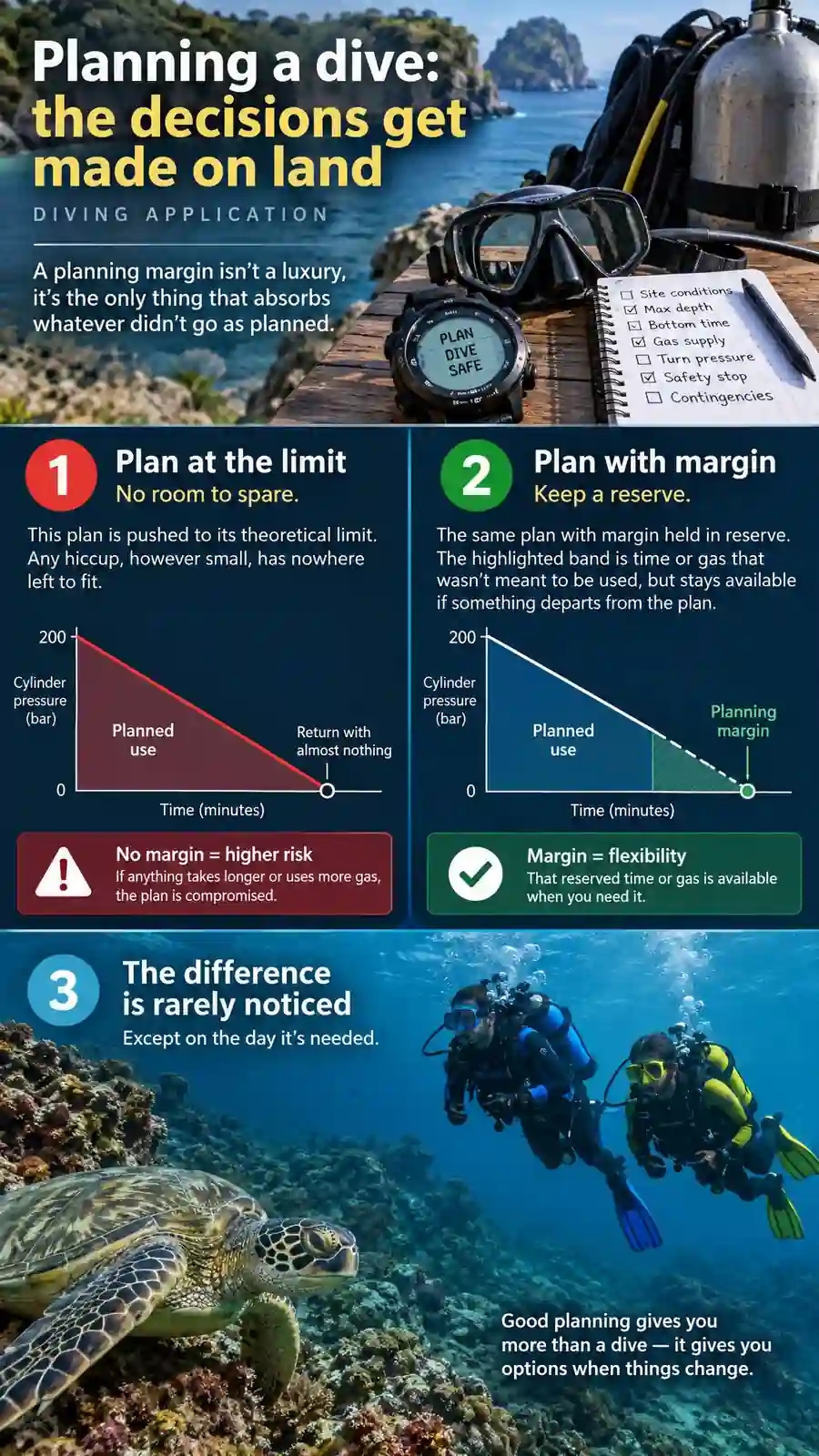
A practical recommendation: set your limits with a margin below the theoretical maximum. If your computer gives you forty minutes, plan for thirty-five. That margin is what absorbs the unexpected without it turning into a problem.
After the dive, spend a minute comparing what was planned with what actually happened: real maximum depth, real time, gas consumed. That habit builds your own database and makes future estimates increasingly accurate. It's also the real usefulness of a logbook.
And a note on guided diving: following a guide doesn't replace your own plan. The guide knows the site, but doesn't know your consumption, your comfort level, or your residual nitrogen load. Your limits remain your responsibility.
Common mistakes
"I'm diving with a guide, so I don't need to plan."
The guide knows the site, but not your consumption, your comfort level, or your residual nitrogen load. Your depth, time, and gas limits remain your responsibility.
"The plan is just maximum depth and time."
There are five elements: depth, time, gas, route, and conditions. Route and the separation procedure are the ones most often left out, and the ones most needed when something goes wrong.
"Aborting a dive means looking bad in front of the group."
Anyone can end a dive at any time and without justifying it. Peer pressure is a documented factor in incidents, and a serious operation respects that decision.
Did you know…?
- At many destinations with channels or straits, the dive window is set by the tide table, not by the dive center's schedule.
- The most useful question you can ask a guide at a new site is what usually goes wrong there: it tells you more than the entire route description.
- The standard rule for a separation works because both divers do the same thing: search briefly and reunite on the surface.
Key takeaways
- Important decisions are made on land, where judgment isn't affected by narcosis, cold, or excitement.
- The plan covers five elements: depth, time, gas, route, and conditions, with numbers agreed out loud.
- The separation procedure works only if both divers do the same thing: search briefly, then ascend to reunite.
- Set your limits with a margin below the theoretical maximum: that margin is what absorbs the unexpected.
- Diving with a guide doesn't replace your plan: your limits remain your responsibility.