9 minutes
Maldives Manta Conservation Programme: the people who know every manta by its spots
Baa Atoll, Maldives. How two decades of patient diving, photographs and island partnerships helped protect the largest recorded population of reef mantas
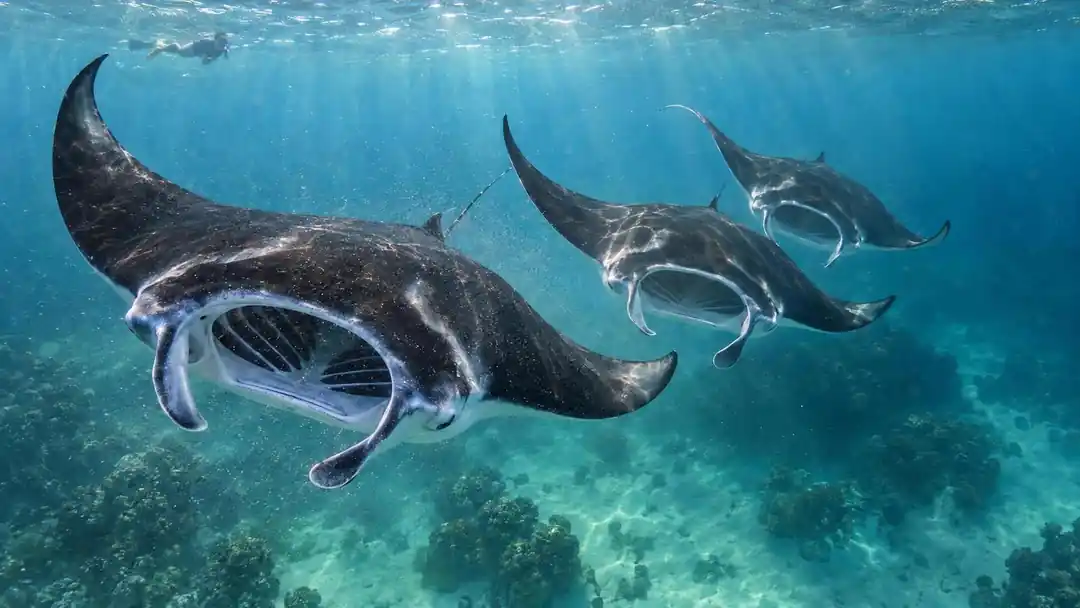
The tide turns, the water clouds with life, and out of the green haze comes a mouth wide enough to swallow your mask, then another, then dozens. At the peak of a feeding event in Hanifaru Bay, as many as 247 reef mantas have been counted looping through the same small corner of the Indian Ocean.
This is the story of the people who decided to learn each of those animals one by one. You will see how a research project that began in 2005 became a Maldivian charity, how a photograph of a belly can follow a manta for years, what has already been protected, what still threatens these giants, and how you can help, even from your next dive.
The Maldives holds the largest recorded population of reef manta rays on Earth and the third largest recorded population of oceanic mantas. Mantas grow slowly and have very few young, so every adult that survives counts.
The project at a glance
Where: Baa Atoll, Maldives, with research in other atolls across the country
Working since: 2005, as the Maldivian Manta Ray Project
Who runs it: A registered Maldivian organisation affiliated with the Manta Trust, a UK charity formed in 2011
How it is funded: Four Seasons Resort Maldives at Landaa Giraavaru provides a base, field resources and education space, and the Save Our Seas Foundation funded the research for six years. Partners include Six Senses Laamu, Blue Marine Foundation and Olive Ridley Project. The Manta Trust raises public support through memberships, fundraising events, expeditions and project funding.
Who are the giants of Baa Atoll?
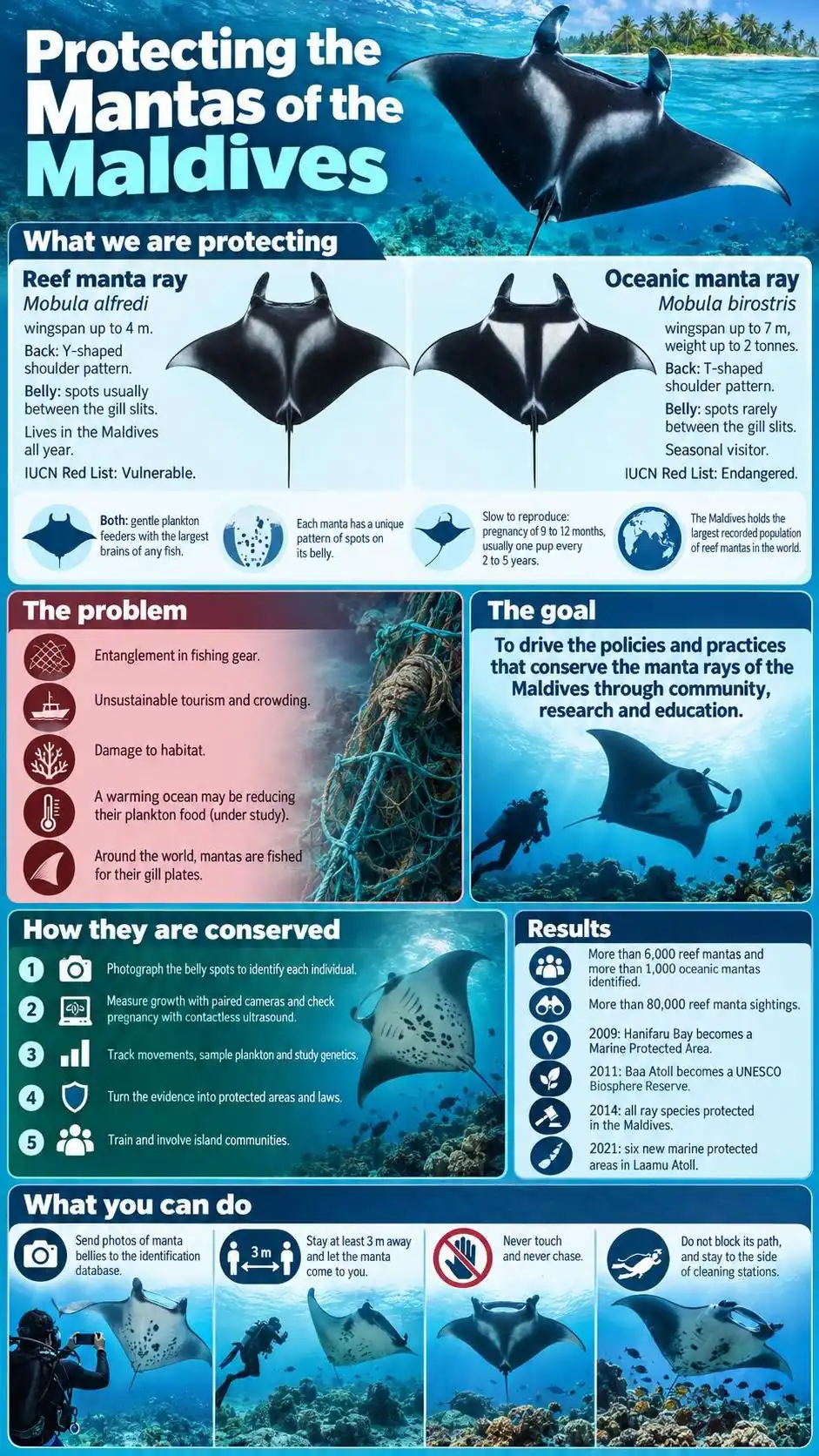
Two species of manta visit these islands. The reef manta can reach a wingspan of four metres. The oceanic manta can reach seven metres, and the largest can weigh up to two tonnes. Science only established that they were two different species in 2009.
You can tell them apart underwater with a little practice. The reef manta shows a Y-shaped pattern on its shoulders and usually has spots between its gill slits. The oceanic manta shows a T-shaped pattern, has dark edges around its mouth and rarely has spots between the gills.
They are curious animals with the largest brains of any fish. Females grow noticeably larger than males. And they reproduce very slowly: a female usually gives birth to a single pup every two to five years, after a pregnancy of nine to twelve months. A population like this cannot bounce back quickly from losses.
In the Maldives, reef mantas are residents all year round. They travel between the atolls as the monsoon changes, following the plankton that feeds them. Oceanic mantas are visitors that pass through each year, and researchers are still working out their timing.
How did it all begin?
In 2003 a young British marine biologist, Guy Stevens, arrived in the Maldives to work aboard a resort vessel. He later remembered the first mantas as curious and social, more like dolphins or seals than fish. In 2005 he founded the Maldivian Manta Ray Project, the first full-time manta research project in the country.
When Four Seasons Resort Maldives at Landaa Giraavaru opened in Baa Atoll in 2006, Stevens joined as its resident marine biologist, and the island became a base for field work. The Save Our Seas Foundation funded his work in the Maldives for six years.
From there the idea grew in two directions. In 2011 Stevens co-founded the Manta Trust, a UK charity that today coordinates manta and devil ray research with more than two dozen affiliate projects around the world. In the Maldives, the original project became the Maldives Manta Conservation Programme, now a registered Maldivian organisation affiliated with the Trust.
In 2026 the programme and the resort celebrated twenty years of manta work together, with a week of events around World Manta Day.
How do you recognise one manta among thousands?
Every manta carries its own name on its belly.
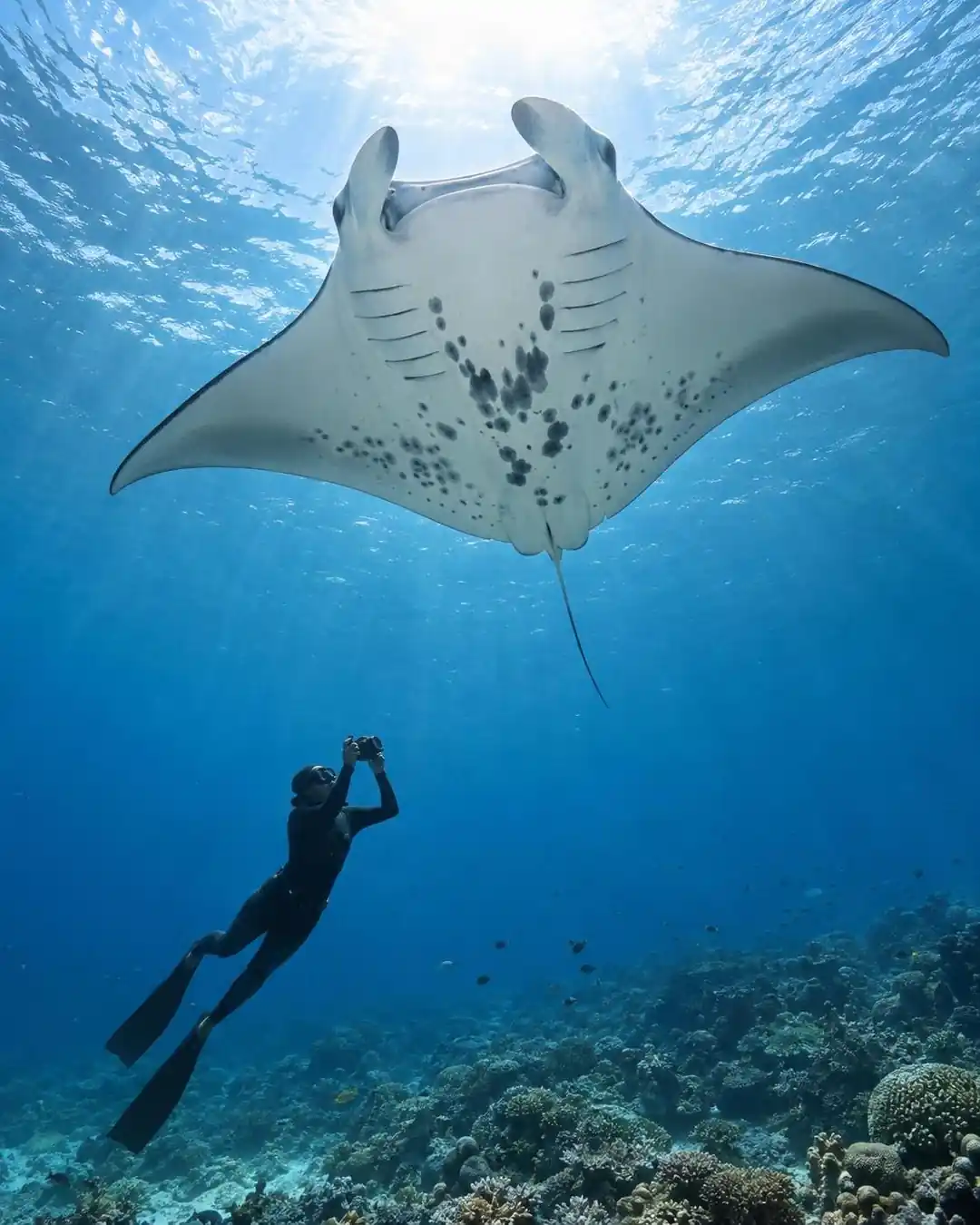
The pattern of dark spots on a manta's underside is unique to each animal, a little like a fingerprint. A diver or snorkeller photographs the belly, and the researchers compare the image with their catalogue. When it matches, the story of that individual gains a new chapter: where it was, when, in what condition and with whom.
Year after year those chapters have added up. The programme has identified more than 6,000 individual reef mantas from over 80,000 sightings, and more than 1,000 oceanic mantas. In Hanifaru Bay alone, over 1,800 individuals have been recorded.
Anyone can contribute. Photos of a manta's belly can be sent to the Manta Trust's identification database, and a holiday snapshot may turn out to be the first record of an animal, or the proof that an old friend is still alive.
What do the scientists actually do?
Photo identification is only the beginning.
To find out whether a female is pregnant, the team and its partners developed what they describe as the world's first contactless underwater ultrasound scanner, so she can be examined without being caught or touched. To measure growth, two small cameras are calibrated together to take the wingspan of a swimming animal.
Time-lapse cameras left on the reef record how mantas use a site both when people are there and when they are not. Plankton samples show what is on the menu and whether a warming ocean may be shrinking it. Measurements of currents and water conditions help explain why mantas appear where and when they do.
The researchers also take samples of the mucus on a manta's skin to measure hormones, study genetics, follow movements with electronic tags and listen to the soundscape of cleaning stations, the reef spots where small fish pick parasites off the giants. Interviews with fishers and island communities add knowledge that no instrument can collect.
Why is Hanifaru Bay so special?
Hanifaru is a small reef bay in Baa Atoll. During the southwest monsoon, roughly from May to December, currents and tides can trap clouds of plankton inside it. Mantas arrive to feed, sometimes forming a spiralling chain as each one follows the next. Whale sharks come to feed here too.
Success brought crowds. The research showed rising pressure from uncontrolled tourism growth and local development, and in 2009 Hanifaru Bay was declared a Marine Protected Area, together with nearby Anga Faru. In 2011 the whole of Baa Atoll became a UNESCO World Biosphere Reserve. A management plan for the bay came fully into effect in 2012.
Today scuba diving and fishing are banned inside Hanifaru, and visitors snorkel. The number of boats and people is limited, liveaboards and resort boats take turns, boats follow set routes and speed limits, and rangers are on site to enforce the rules.
What has changed for mantas?
The numbers collected underwater have travelled a long way. In 2014 the Maldives added every species of ray, including mantas and devil rays, to its national list of protected species. Data from the programme also supported the Biosphere Reserve designations of Fuvahmulah and Addu atolls. In 2021 six marine protected areas were designated in Laamu Atoll with the help of a wide partnership.
In 2023 the programme provided guidance on how to safeguard manta ecology for an amendment to the national wildlife protection regulations. Its scientists have led more than ten peer reviewed publications, and the team proposed 43 Important Shark and Ray Areas, of which 26 were approved.
Internationally, manta data has fed into assessments of the IUCN Red List, which classed the oceanic manta as Endangered in 2022, and into global wildlife trade and migratory species agreements. According to the programme's anniversary report, countries voted in 2025 to move all manta and devil ray species to the highest level of trade protection under CITES.
Can a manta remember a diver?
Stevens once told the University of Plymouth about a diver who came across a manta in distress, with fishing line wrapped around its mouth and gills. The diver removed the line. Two days later, at the same place, the same ray returned and circled the diver's head.
Scientists are careful about reading human feelings into animals, and Stevens said as much. Still, he had no doubt that this manta had sought the diver out. It is the kind of encounter that turns a visitor into a defender of the ocean.
How should you dive or snorkel with mantas?
The Manta Trust created a ten step code of conduct, based on years of research in the Maldives. It is short, and it works at any manta site.
For everyone in the water
1. Enter quietly and calmly, no closer than 10 metres from the manta.
2. Keep your fins below the surface. Splashing and noise can scare mantas away.
3. Do not approach closer than 3 metres. Stay still and let the manta come to you.
4. Approach from the side, leaving a clear path ahead of the animal.
5. Never chase a manta that swims past. You will not catch it, and you will probably scare it off.
6. Do not touch. You will ruin the encounter and, depending on local law, you may be fined.
For scuba divers
7. At a cleaning station, stay to the side. Do not swim onto the main cleaning area.
8. Stay low and close to the seabed, without damaging the reef. Some sites have an area set aside for divers.
9. When a manta swims towards you, do not block its path overhead. Stay low and stay where you are.
10. Follow any extra rules and laws of the site you are visiting.
What still threatens them, and what comes next?
The programme names three main dangers at home: entanglement in fishing gear, unsustainable tourism and damage to habitat. The team is also studying whether a warming ocean is reducing the plankton that mantas live on. Around the world, Stevens considers fishing the biggest threat, since mantas and their relatives are targeted for their gill plates.
Mantas also matter to the economy of the islands. The programme estimates that manta tourism brings the Maldives around 8.1 million US dollars a year in direct revenue, a strong reason to keep these animals alive and undisturbed.
The next chapter is local. The Ocean Women initiative, launched in 2022, trains women as swim instructors, with seven in training and sixty children taught during 2023. The RahVeshi programme, also from 2022, aims to build research and outreach led by Maldivians for the long term. The stated priorities now are long term population monitoring, responsible tourism and locally led education.
Did you know…?
- Reef mantas in the Maldives move between atolls as the monsoon changes direction.
- A female manta usually has just one pup every two to five years.
- Fuvahmulah is the only place in the Maldives regularly visited by oceanic mantas.
Key takeaways
- Each manta can be recognised by the spots on its belly, and your photos can help.
- More than 6,000 reef mantas and over 1,000 oceanic mantas have been identified in the Maldives.
- Research helped protect Hanifaru Bay, Baa Atoll and, since 2014, every ray species in the country.
- Slow reproduction makes mantas fragile: calm, distant and respectful encounters matter.
Internships and volunteering
Takes interns or volunteers: Yes
Type: Research and guest engagement internship, resort based, in Raa Atoll. Food, shared accommodation and internal flights are covered, and interns arrange their own insurance. No volunteer positions were open when we checked.
Requirements: A degree in marine biology, environmental science or a related field, or equivalent experience (not required for Maldivians); an active PADI Rescue Diver or equivalent; confident freediving to 10 to 15 metres and strong swimming; fluent English; your own mask, snorkel, fins and waterproof watch.
Do participants pay a fee?: Not stated by the project
Dates: The last call was for January to March 2027 and closed on 22 November 2026. Watch the careers page for the next one.
How to apply: Send a CV of up to two pages and a one page cover letter to the internship address, quoting the reference number of the open call. Maldivians can also use the programme's online form.
- Manta Trust careers and internships
- Volunteering and careers in the Maldives
- Internship applications: raa@mantatrust.org
Contact the project
Website
- Maldives Manta Conservation Programme
- The Manta Trust
- How to swim with manta rays
- Send your manta photos
- General: info@mantatrust.org
- Manta sightings and photos: mantabase@mantatrust.org
Social media
- Instagram: Maldives Manta Conservation
- Facebook: Maldives Manta Conservation Programme
- Instagram: Manta Trust
- YouTube: Manta Trust
Information checked on: 2026-11-26