Advanced 9 minutes
Deep diving: everything speeds up except you
Why your margin disappears at forty meters, and what you need to do differently
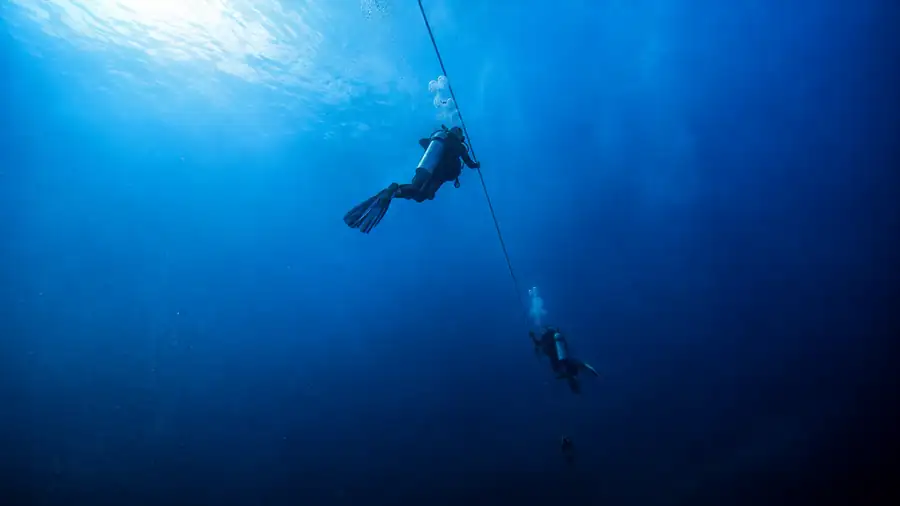
At forty meters you burn through gas five times faster than at the surface, you have only a few minutes of no-decompression time, you're narced, you're breathing dense gas, and it's cold. And all of that happens while the dive feels, to you, like it's going perfectly.
In this article you'll see what changes quantitatively with depth, why your margin for error shrinks so much, what equipment and procedures deep diving adds, and where the real boundary lies between the recreational and technical ranges.
Depth doesn't introduce any new problem: it intensifies all the ones you already know and makes them hit at the same time. Understanding that pile-up is what separates a well-planned deep dive from a string of lucky breaks.
The numbers that change
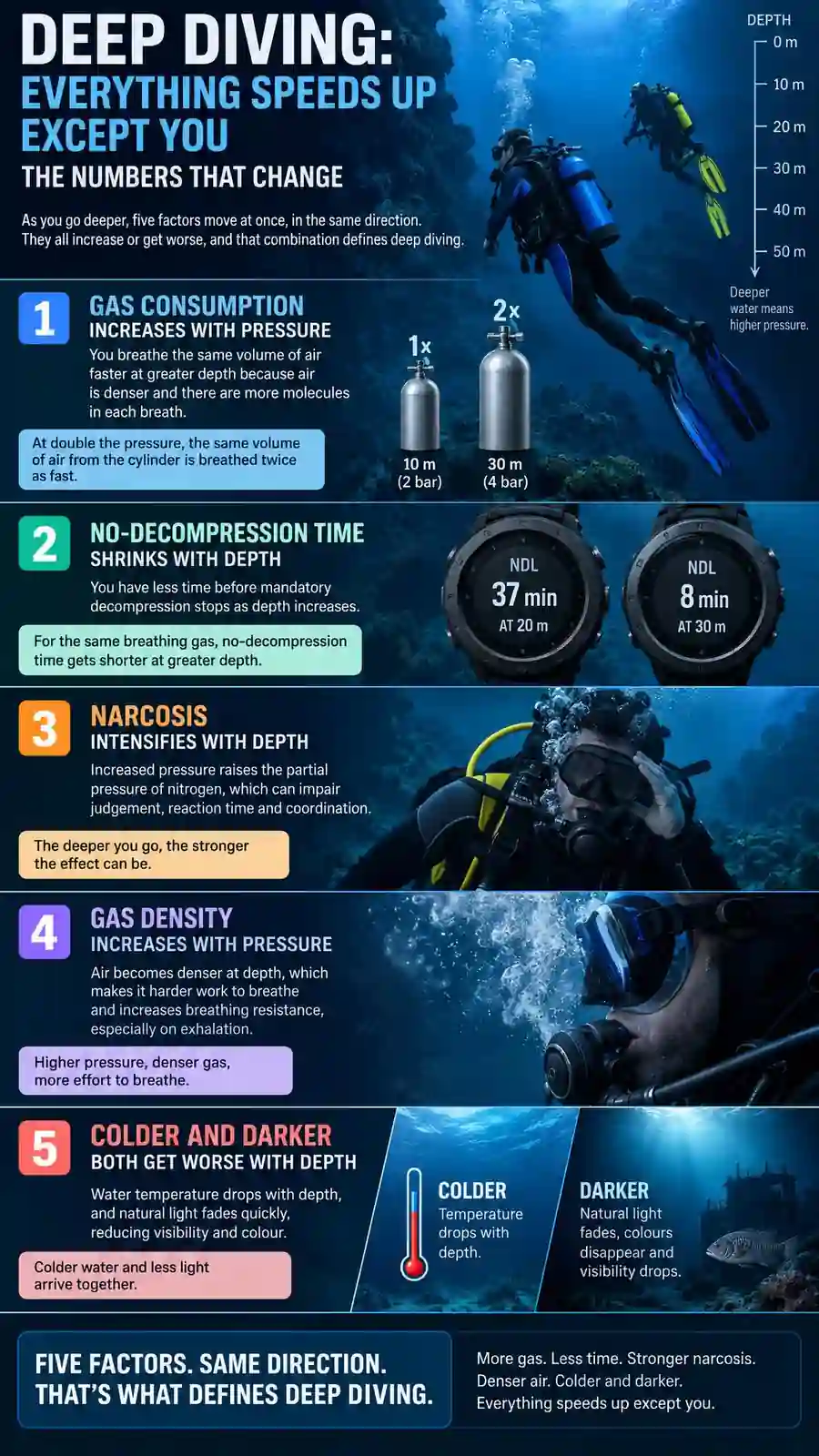
Almost everything that changes with depth does so in proportion to absolute pressure.
Gas consumption is the most direct example. At ten meters you breathe twice as much gas per minute as at the surface; at thirty meters, four times as much; at forty, five times. A tank that gives you an hour of bottom time at ten meters gives you on the order of twenty-four minutes at forty, and that's before you count the ascent, the stop, and the reserve. The full calculation is worked out in the gas management article.
No-decompression time shrinks even more sharply, because your inert gas loading increases with pressure. Around forty meters, the no-decompression limit comes down to just a few minutes, which means the dive becomes a descent, a very short spell at the bottom, and a long ascent.
Narcosis appears and intensifies, with the effects described in its own article, and at the same time the gas becomes dense and your breathing work increases, which favors carbon dioxide buildup, and that, in turn, makes the narcosis worse. It's the feedback loop that makes the decline non-linear.
Cold adds to the mix because the water is usually colder at depth and your suit insulates less once it's compressed, as covered in the hypothermia article. And the light disappears: by that depth, red has long since vanished, the scene turns blue and monotone, and visual references thin out.
Put together, these five factors explain the defining trait of deep diving: your margin for error shrinks at exactly the moment your ability to manage it does too.
Where the boundaries lie
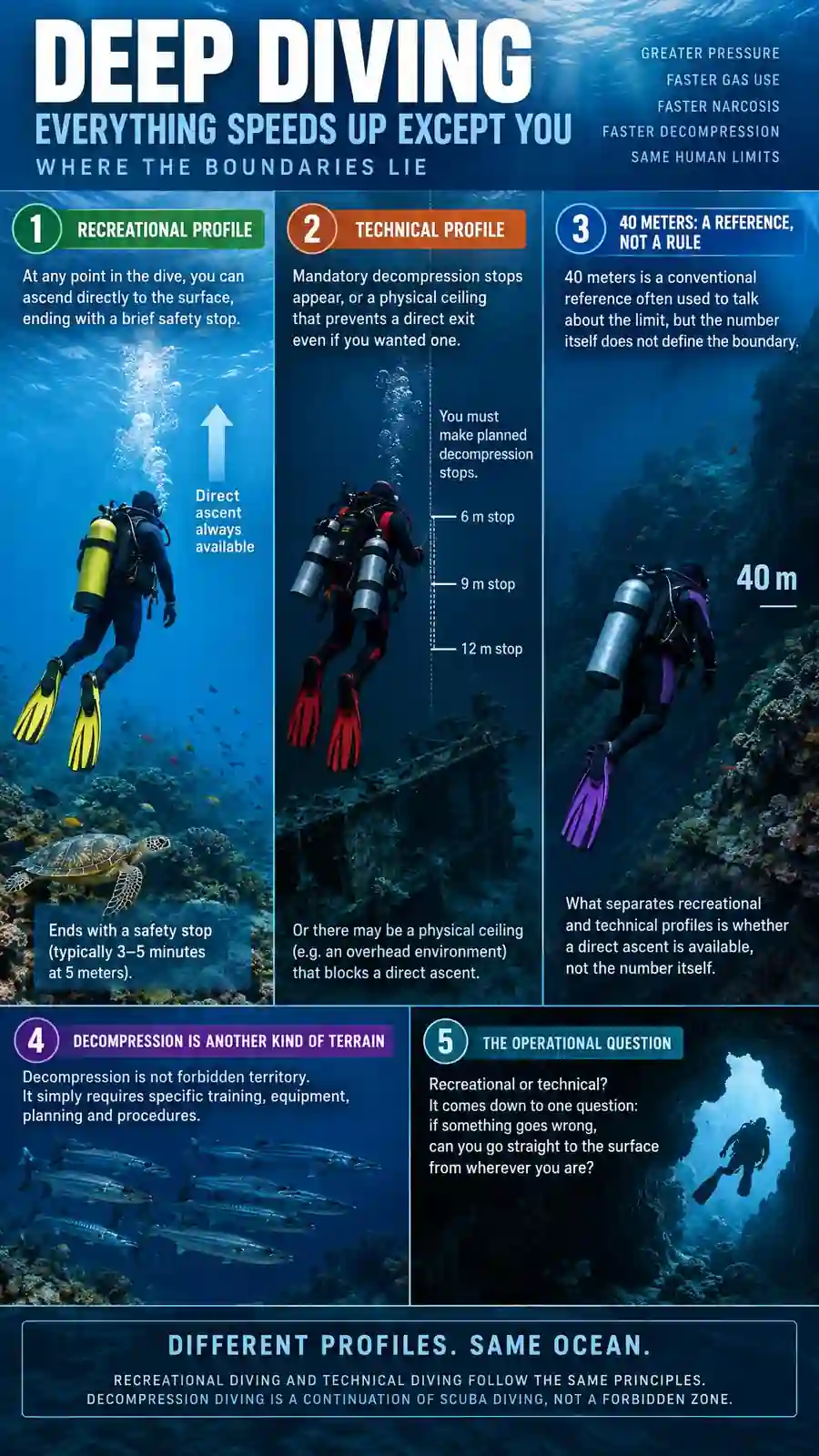
By convention, recreational diving calls anything past eighteen meters "deep," and sets its limit at forty. That number isn't arbitrary: as you saw in the article on air, it's roughly where narcosis and gas density start to limit the dive on air.
Within the recreational range, deep diving keeps one structural rule: the dive is always planned within no-decompression limits, with the option to ascend directly to the surface (making your safety stop) at any moment.
Beyond forty meters, different territory begins. There, gas density, narcosis, oxygen exposure, and decompression weigh far more heavily; the mix is chosen according to them, the profile, and your training, often adding helium; redundant gas and stage cylinders are required, and the ascent is planned minute by minute. That's technical diving, and it isn't an extension of recreational diving: it's a distinct discipline with its own training.
The real boundary, though, isn't a number: it's a question: can you go straight up if something goes wrong? As long as the answer is yes, you're in the recreational range. Once the answer becomes no (because of mandatory decompression or a physical ceiling) every rule changes.
One more thing is worth saying: diving deep doesn't make a dive better on its own. Most of the life, the color, and the light is above twenty meters, and depth is only justified when there's something specific worth seeing down there.
What gets added
Equipment and procedures change modestly, but significantly.
Enough gas, plus a larger-than-usual reserve. Your turn pressure is calculated accounting for the fact that the ascent from that depth burns considerably more gas, and that you might have to share it with someone: the reserve for a deep dive is a reserve for two people.
A physical reference for the ascent. With no bottom in sight and no one else's bubbles to guide you, holding a controlled ascent rate in open water is surprisingly hard, and a mooring line, a wall, or a deployed buoy solves the problem.
Reasonable redundancy: an accessible, tested alternate air source, a backup computer or instrument when the dive depends on one, and a light even by day, because visibility down there is worse than you'd expect.
An explicit, simple plan, made on land: maximum depth, maximum time, turn pressure, dive sequence, and what to do if someone gets separated. You already saw in the narcosis article why a plan that depends on your ability to do math at forty meters isn't a plan at all.
And gradual progression. Adapting to depth is mostly a matter of familiarity and automatic procedures: you gain it by going a little deeper at a time across several dives, with specific training, and you lose it fast without practice.
How it's executed
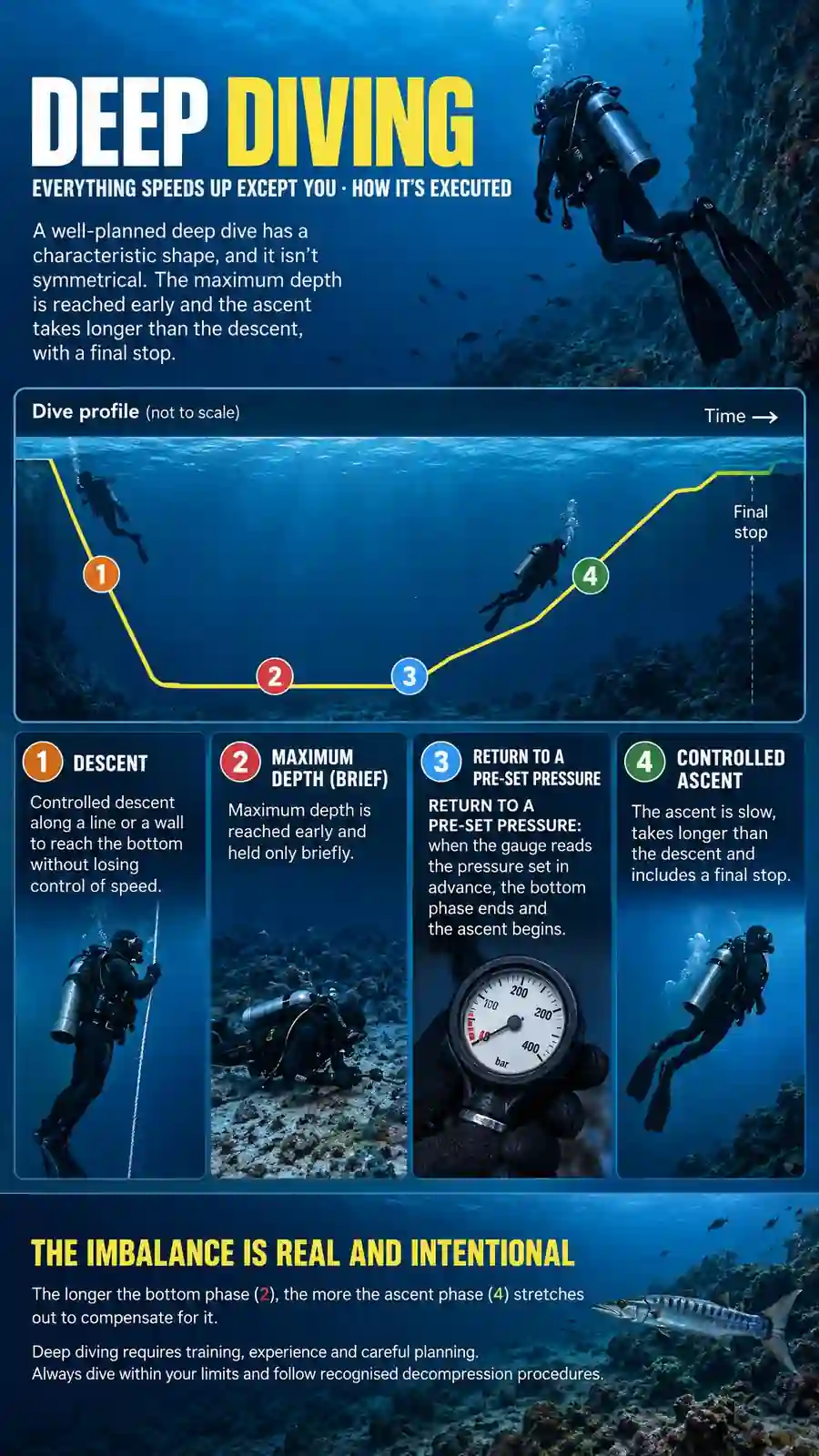
The descent, controlled and along a reference whenever possible. Descending fast saves you a few seconds and costs you equalization, orientation, and often, an arrival at the bottom with your breathing already elevated.
At the bottom, the discipline comes down to two checks repeated over and over: gas and time. Maximum depth is touched early, then you work your way up: a profile that starts deep and finishes shallow is more decompression-efficient than one that goes up and down repeatedly.
Turn pressure is respected without negotiation. It's the rule most often broken on deep dives (there's always something worth seeing for one more minute) and the one that prevents the most incidents.
The ascent is the long part, and the one that demands attention: controlled speed, the mandatory stops your profile or computer requires (with their own contingency procedures), an extended preventive safety stop if the dive was deep and gas and conditions allow it safely, and a pace that doesn't speed up even if gas is running tight. An emergency may require skipping the safety stop. If gas is running tight, the problem was already mishandled earlier, and rushing the ascent only trades one problem for a worse one.
And afterward, at the surface, treat the dive as what it was: a demanding profile. A generous surface interval, hydration, no intense exertion, and no stacking another deep dive right away, following the guidance in the repetitive diving article.
Diving application
Calculate your gas backward: starting from the reserve you want on reaching the surface, adding the ascent, the stop, and a margin for sharing. The result is your turn pressure, and you write it down.
Choose your mix based on oxygen, gas density, narcosis, profile, and training, and check its maximum operating depth (MOD): nitrox can be used in part of the 30-to-40-meter range if its MOD allows it (for example, at a pO₂ of 1.4 bar, EAN32 has a MOD of about 33.7 m).
Descend along a reference and use it for the ascent too. In open water with no reference, deploy your buoy from depth and ascend along its line.
Touch maximum depth early and spend the rest of the dive working your way up, not the other way around.
And accept the real size of the window: at forty meters you're going to be there for a few minutes. If the plan needs more time than the profile allows, the plan is wrong, not the limit.
Common mistakes
"If I handle narcosis well, I can just dive deep without any other changes."
Narcosis is only one of five factors that intensify at once, along with gas consumption, no-decompression time, gas density, and cold. All of them reduce your margin at the same time.
"I'm low on gas, so I'll speed up the ascent and get out."
Ascent rate and mandatory stops aren't negotiable because you're low on gas; the preventive safety stop is done when gas and conditions allow it safely. Running low means the mistake happened fifteen minutes earlier, when you set (or ignored) your turn pressure.
"Deeper means a better dive."
Most of the life, the color, and the light is above twenty meters. Depth is justified when there's something specific worth seeing, not as a goal in itself.
Did you know…?
- At forty meters you burn gas five times faster than at the surface: a tank that lasts an hour at ten meters gives you on the order of twenty-four minutes of bottom time.
- The real boundary between recreational and technical diving isn't a number: it's whether you can ascend directly to the surface at any moment.
- A profile that starts deep and ends shallow is more decompression-efficient than one that goes up and down repeatedly.
Key takeaways
- Depth doesn't add new problems: it intensifies familiar ones and makes them coincide.
- Gas consumption, no-decompression time, narcosis, gas density, and cold all change at once and in the same direction.
- The recreational limit of 40 meters coincides with the zone where narcosis and gas density start to limit the dive on air.
- What gets added is margin: a bigger reserve, an ascent reference, redundancy, a written plan, and gradual progression.
- Turn pressure is the rule most often broken at depth, and the one that prevents the most incidents.