Beginner 8 minutes
The breathing system: the gas's journey to your mouth
From 200 bar in the tank to the exact pressure of your lungs, in two steps
In the tank there's gas at around 200 bar: enough pressure to cause serious harm if it reached you directly. At your mouth it arrives at exactly the pressure of the water around you, not a bit more. Between those two extremes there's a two-step system that works with no electronics and nothing for you to do.
In this article you'll follow the gas's full journey: what each component does, why the pressure reduction happens in two stages instead of one, and how the hoses of a recreational configuration are laid out.
This is the equipment your breathing depends on. Understanding how it's set up lets you spot problems before entering the water and know what's happening when something isn't working the way it should.
Why two stages and not one
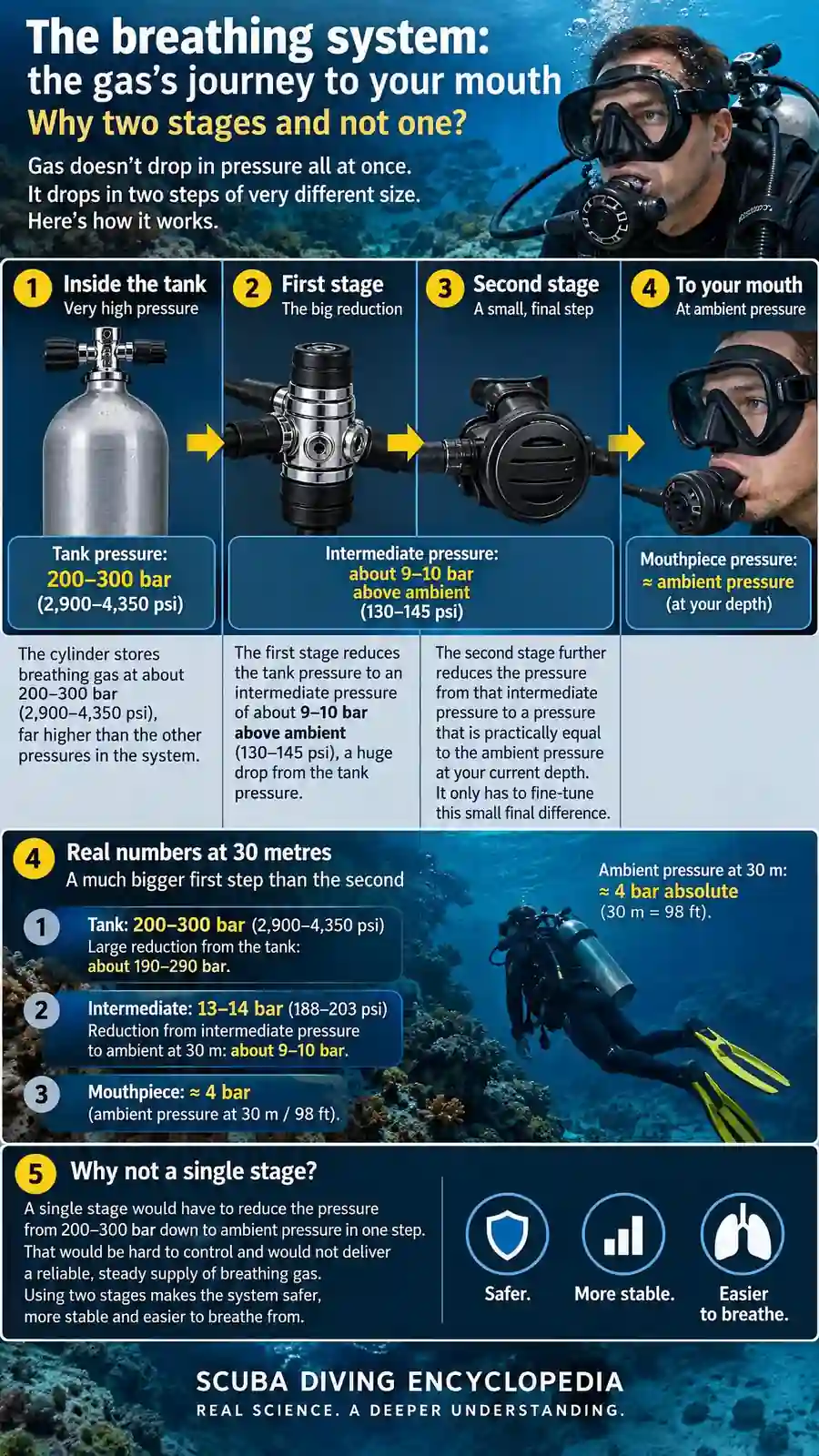
Reducing from 200 bar to ambient pressure in a single step would be mechanically demanding and unstable: small variations would produce large changes in supply. The solution that historically prevailed is to split the work.
The first stage does the big reduction: it drops tank pressure down to what's called intermediate pressure, typically around nine or ten bar above whatever the ambient pressure is at any given moment. That detail is key: intermediate pressure isn't a fixed value, it tracks ambient pressure as you descend.
The second stage does the fine reduction: it takes that gas at intermediate pressure and delivers it at exactly the pressure of the water around you, and only when you inhale.
The result is a system that self-regulates with depth without you having to do anything: at thirty meters you breathe gas at thirty-meter pressure, and at five meters at five-meter pressure, without touching a thing.
The components, one by one
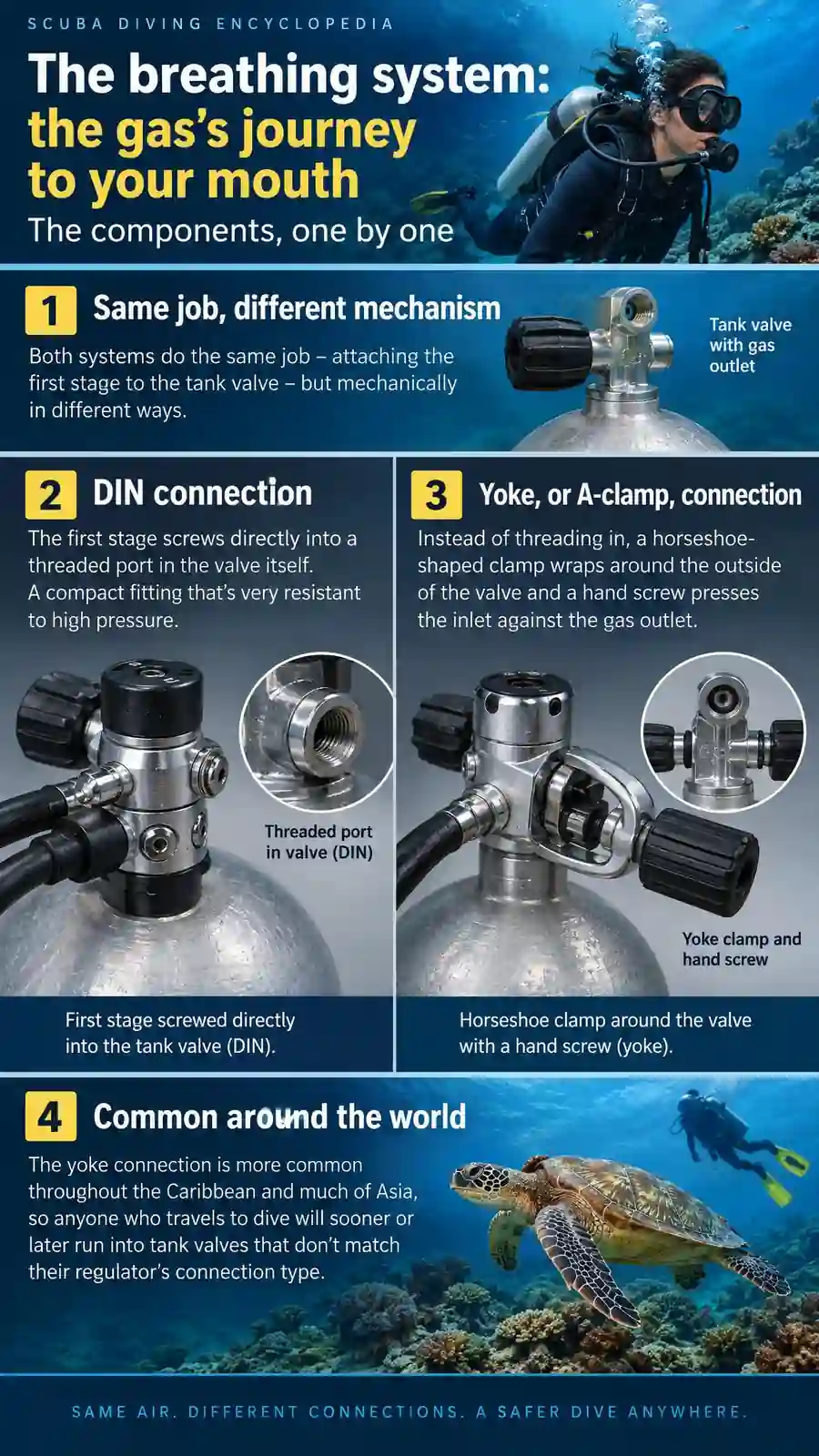
The first stage attaches to the tank valve through one of two systems: DIN, which screws into the valve, or yoke (also called INT) which clamps around the valve from outside. DIN is the standard in technical diving and increasingly common in recreational diving; yoke remains very common at dive centers worldwide. Adapters exist between the two.
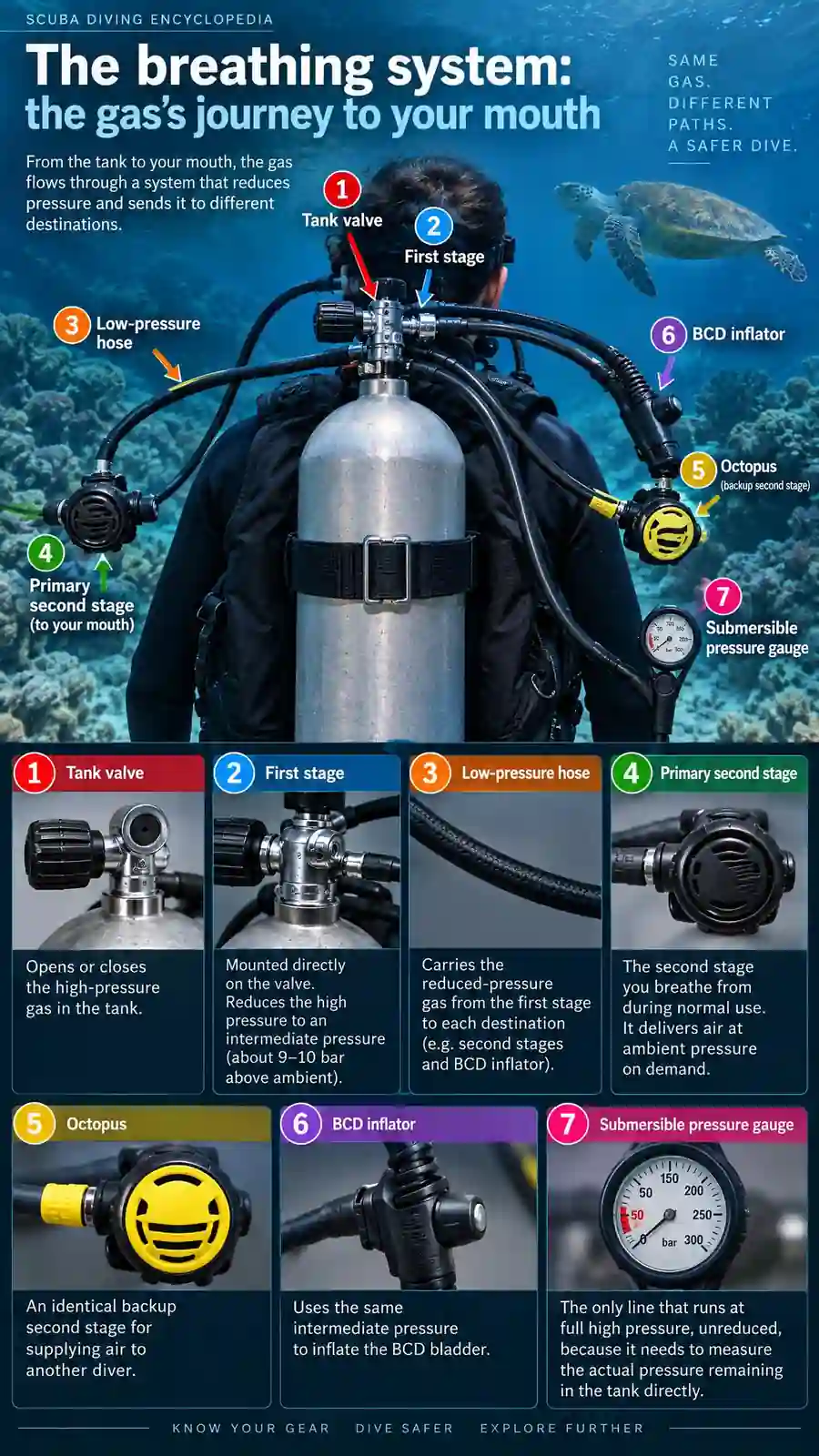
Two kinds of ports come off the first stage. The low-pressure ones, which feed the second stage, the octopus, the BCD inflator, and, if used, the drysuit inflator. And the high-pressure one, which feeds the pressure gauge or the dive computer's wireless transmitter.
The primary second stage is the one you hold in your mouth. The octopus is the alternate second stage, meant for sharing gas in an emergency: it's usually marked in yellow with a longer hose, and it's positioned in the chest area, reachable with one hand and where another diver can find it.
The inflator connects the BCD to the tank's gas and lets you add air with one button, plus purge it with another. The pressure gauge shows how much pressure is left in the tank: it's the instrument you need to check most often throughout the dive.
The hoses deserve their own attention: they should be organized and secured, not hanging loose. A loose hose snags, drags along the bottom, and can damage the reef.
How to check it before entering
The pre-dive check isn't a formality: most breathing-system problems are caught on the surface with less than a minute of attention.
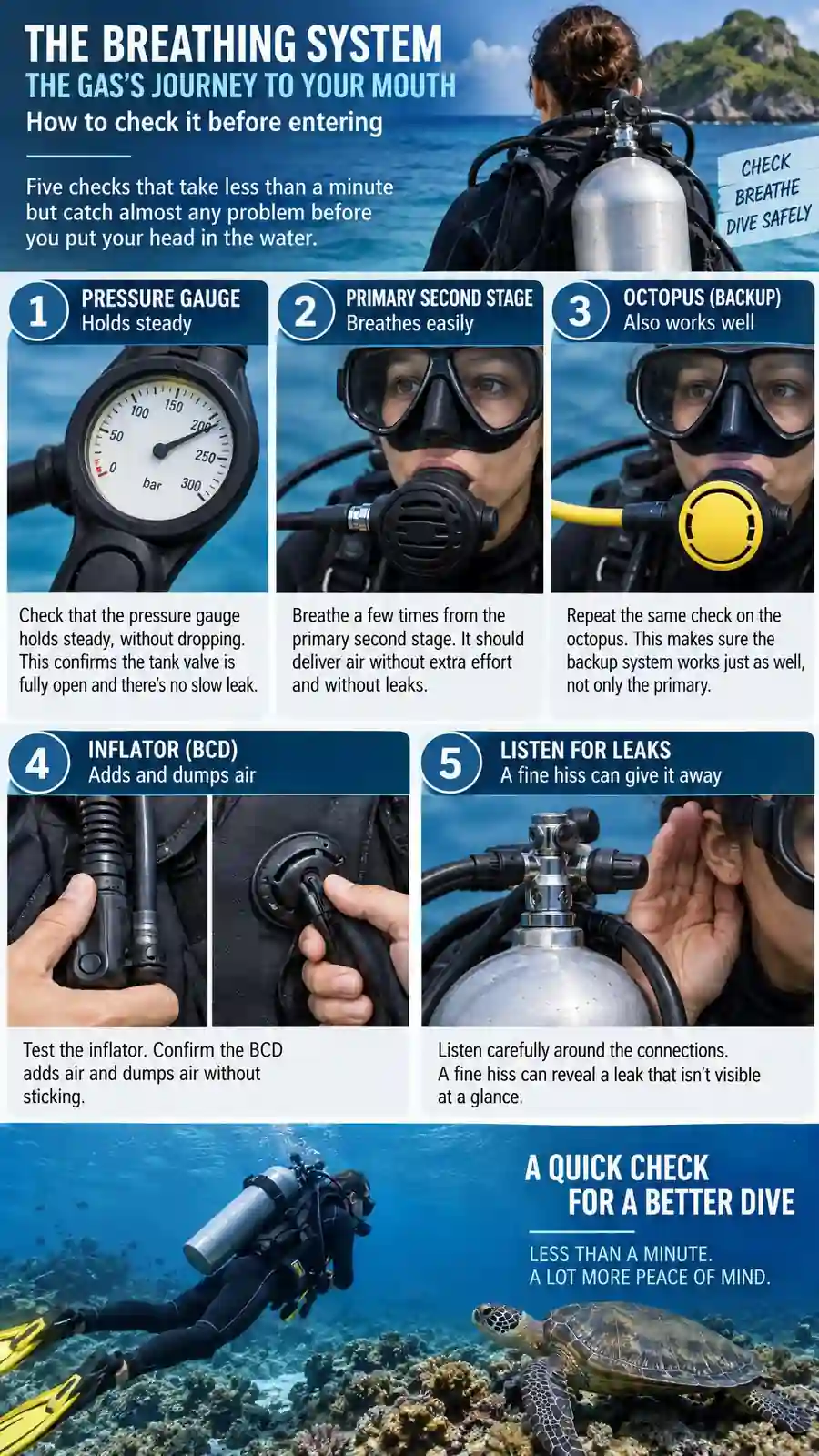
With the tank open, look at the pressure gauge: it should read an adequate pressure and stay stable. If the reading drops and recovers with each breath, the tank valve isn't fully open.
Breathe several times from the primary second stage and also from the octopus. Both should deliver gas smoothly, without noticeable resistance and without an odd taste or smell. An octopus that's never tested is an octopus you don't know works.
Test the inflator both ways: adding air and purging it. Check that the BCD holds air and that the dump valves work.
Listen. A continuous hiss indicates a leak, and even if it's small it's worth fixing before entering. And check that all the hoses are properly routed and secured.
This check is part of the buddy check that every training organization teaches, and it's one of the practices with the best ratio of effort to safety.
Diving application
Dense gas at depth makes breathing cost a bit more, as you saw in the respiratory physiology article. Well-maintained, well-adjusted equipment noticeably reduces that extra effort; neglected equipment makes it worse. It's not a matter of comfort: it affects your CO₂ production.
About the octopus: its place is where another diver can find it without searching, in the triangle formed by your chin and the sides of your chest. An octopus dragging along the bottom doesn't do its job and also fills up with sand.
If a second stage starts delivering gas continuously without you inhaling, what's called a free flow, it's not a random failure: most regulators are deliberately designed to fail in that direction, because losing gas is preferable to running out of it. You can keep breathing from a second stage in free flow with a specific technique taught in basic training, and the right move is to end the dive in a controlled way.
And the most important habit of all: check the pressure gauge regularly, not just when you remember to. Gas management is covered in the planning category.
Common mistakes
"The first stage delivers gas at a fixed pressure."
It delivers at intermediate pressure, a value above whatever the ambient pressure is at the moment. As you descend, that pressure rises with you: that's why the system self-regulates without intervention.
"You only need to check the octopus when you use it."
It's precisely the component that will only be used in an emergency, so it must be tested at every pre-dive check. An octopus that's never breathed from is an octopus of unknown reliability.
"A free flow means the regulator broke."
Most regulators are designed to fail in free flow on purpose, because losing gas is preferable to running out of supply. You can breathe from it and end the dive in a controlled way.
Did you know…?
- Intermediate pressure isn't a fixed value: it stays around nine or ten bar above ambient pressure, so it rises with you as you descend.
- If the pressure gauge drops and recovers with each breath, the tank valve isn't fully open: it's one of the most common setup mistakes.
- The octopus is marked in yellow with a longer hose precisely because it's meant to be found by someone else, not you.
Key takeaways
- Gas goes from the tank to your lungs through two reductions: first stage to intermediate pressure, second stage to ambient pressure.
- Intermediate pressure tracks ambient pressure, so the system adjusts itself to depth.
- The first stage sends out low-pressure lines (second stage, octopus, inflator) and a high-pressure line (pressure gauge).
- The pre-dive check should include breathing from the octopus and confirming the pressure gauge stays stable.
- A free flow is a failure designed on purpose: you can breathe from it and end the dive in a controlled way.