Beginner 9 minutes
The origin of the oceans: where all that water came from
Four billion years, a seafloor that recycles itself, and plates that keep moving everything
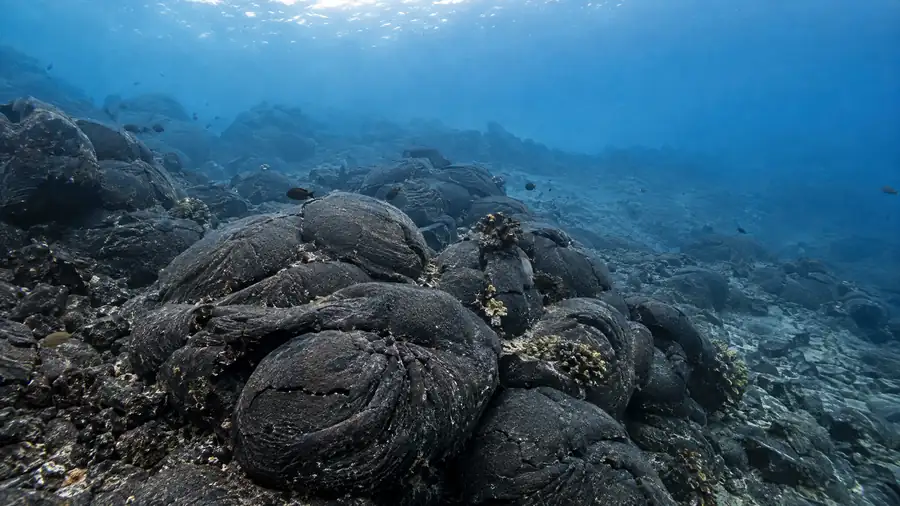
The ocean floor seems like the oldest place on the planet, and it's exactly the opposite: the oldest continental crust is over four billion years old, while almost all of the ocean floor is less than two hundred. The sea recycles itself.
In this article you'll see where the water that fills the oceans came from, how that ocean changed over Earth's history, what plate tectonics does to keep it moving, and how much of all that you can actually see on a dive.
The shape of a coastline, the existence of a vertical wall, the depth of a channel, the color of the sand, and even the layout of atolls are direct consequences of this history. Knowing it turns the underwater landscape into something legible.
Where the water came from
Two sources, and a debate that's still open about the proportions.
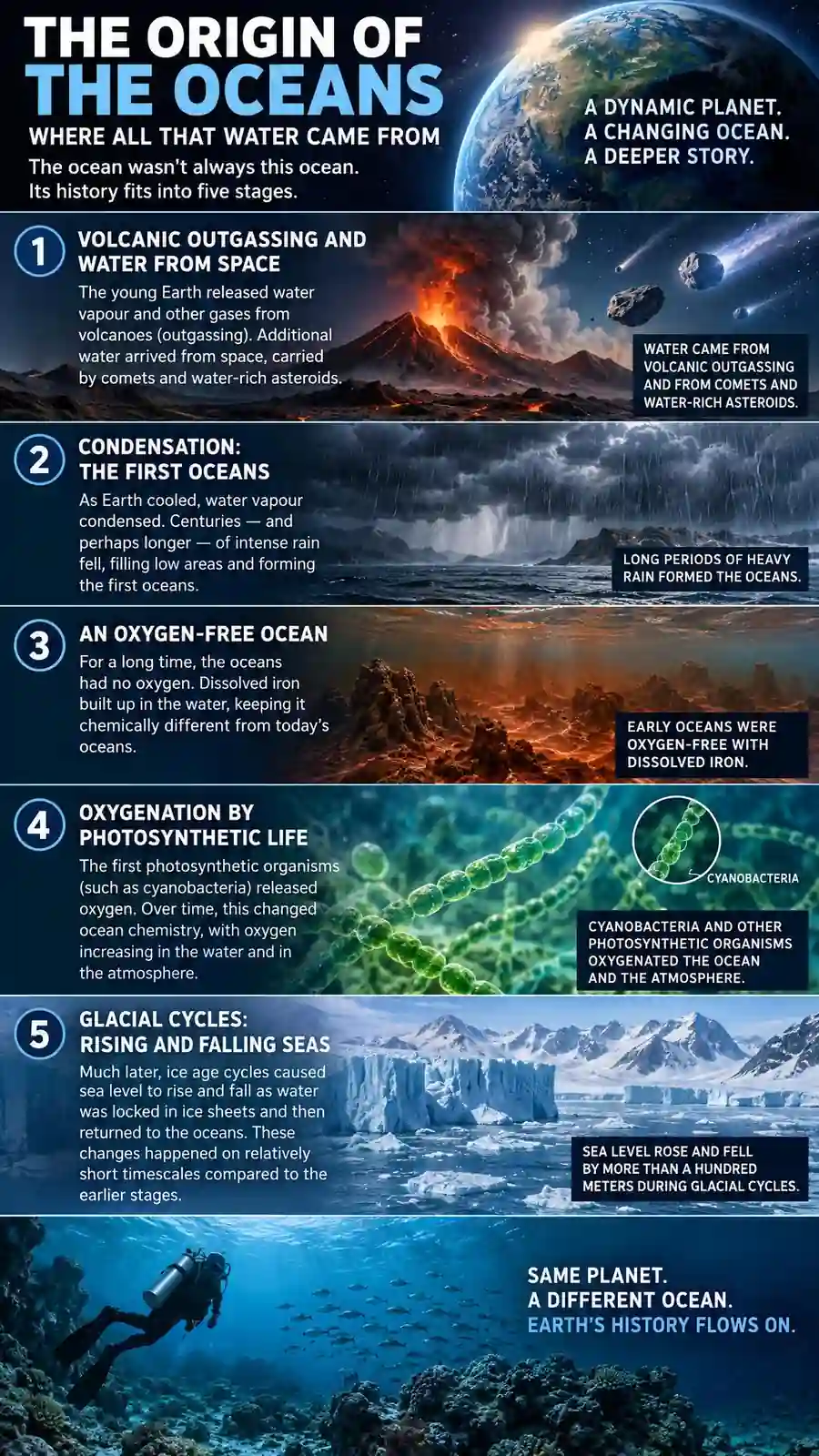
The first source is internal. The early Earth was a molten, highly active body, and its interior held water trapped in minerals. The intense volcanism of that era released huge amounts of vapor into the atmosphere along with other gases, in a degassing process that lasted millions of years.
When the surface cooled enough for that vapor to condense, it started to rain. And it rained for a length of time that's hard to imagine, until the water accumulated in the low basins of the crust.
The second source is external: the bombardment of icy bodies during the formation of the solar system, comets and above all water-rich asteroids that were incorporated into the growing planet and kept impacting it afterward.
Working out how much each pathway contributed is an active problem, and the main tool is isotopic: the ratio between different types of hydrogen in ocean water is compared with that of comets and meteorites, and that comparison points to certain groups of asteroids fitting much better than comets.
Whatever the split, the result is ancient: there's evidence of liquid water on the surface very soon after the planet formed, meaning the ocean has been there for practically all of Earth's history.
The ocean wasn't always this ocean
The primitive sea was a very different place: with no dissolved oxygen, with an atmosphere lacking an ozone layer, with large amounts of dissolved iron, and probably more acidic than today's because of that atmosphere's enormous partial pressure of carbon dioxide.
The decisive change was produced by life. When photosynthetic organisms began releasing oxygen, it was first consumed oxidizing the dissolved iron, which precipitated to the bottom and left the banded iron formations that are mined all over the world today. Only once that iron was exhausted did oxygen start accumulating in the water and the atmosphere.
That episode, which happened about two point four billion years ago, is probably the greatest environmental transformation in the planet's history, and it's the precondition for everything that later occupied the sea.
Salinity, by contrast, stabilized early: rivers contribute salts continuously, but they're also continuously removed through precipitation and hydrothermal circulation at the ridges, so the ocean hasn't kept getting indefinitely saltier.
What has changed a lot, and many times, is the level. During glacial maxima, with huge amounts of water locked up in continental ice, sea level dropped more than a hundred meters below today's: much of the continental shelves you dive today were dry land, and many caves that are flooded today formed on dry ground.
Tectonics: the seafloor is made and destroyed
This is what explains why the ocean floor is so young.
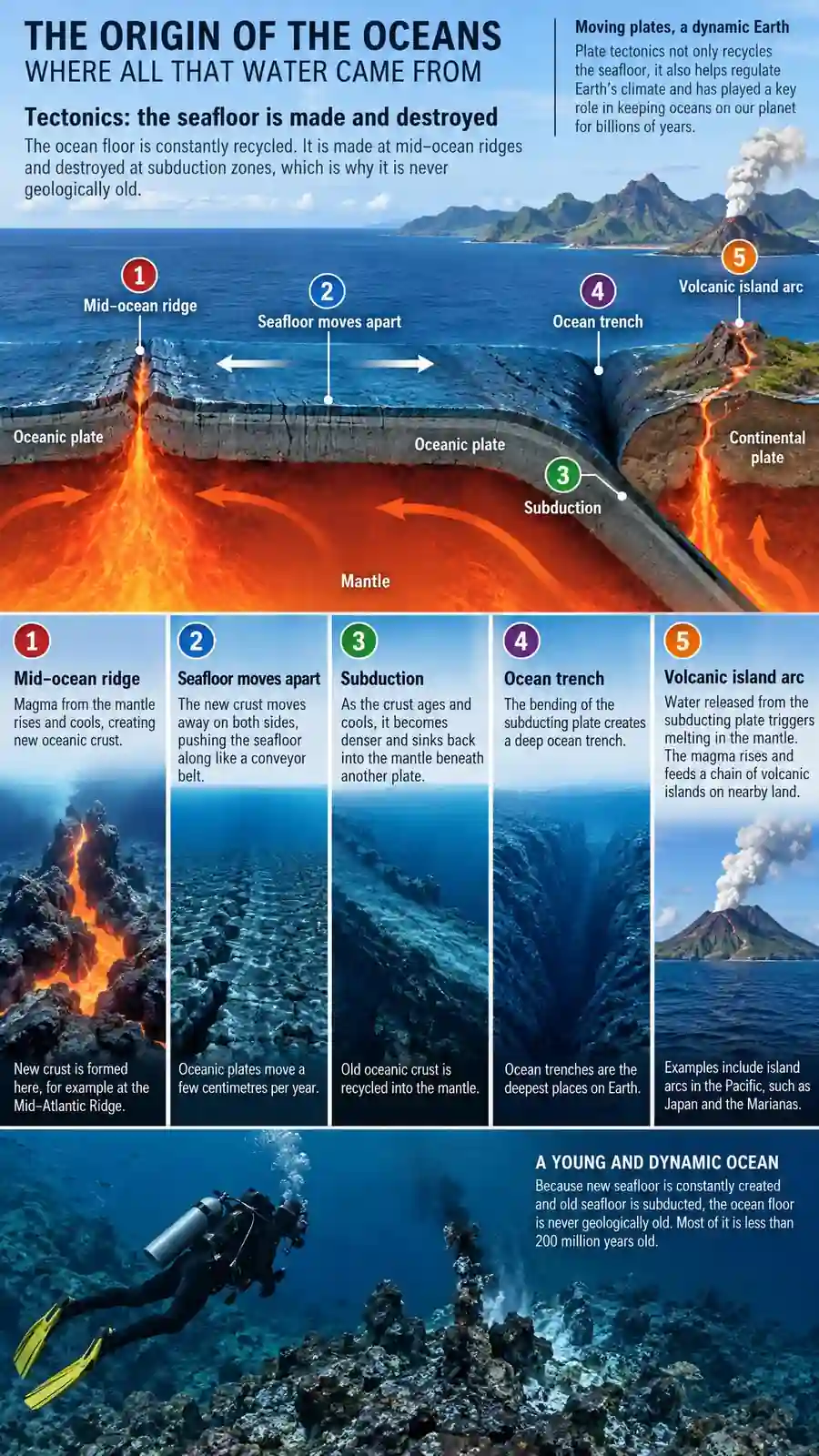
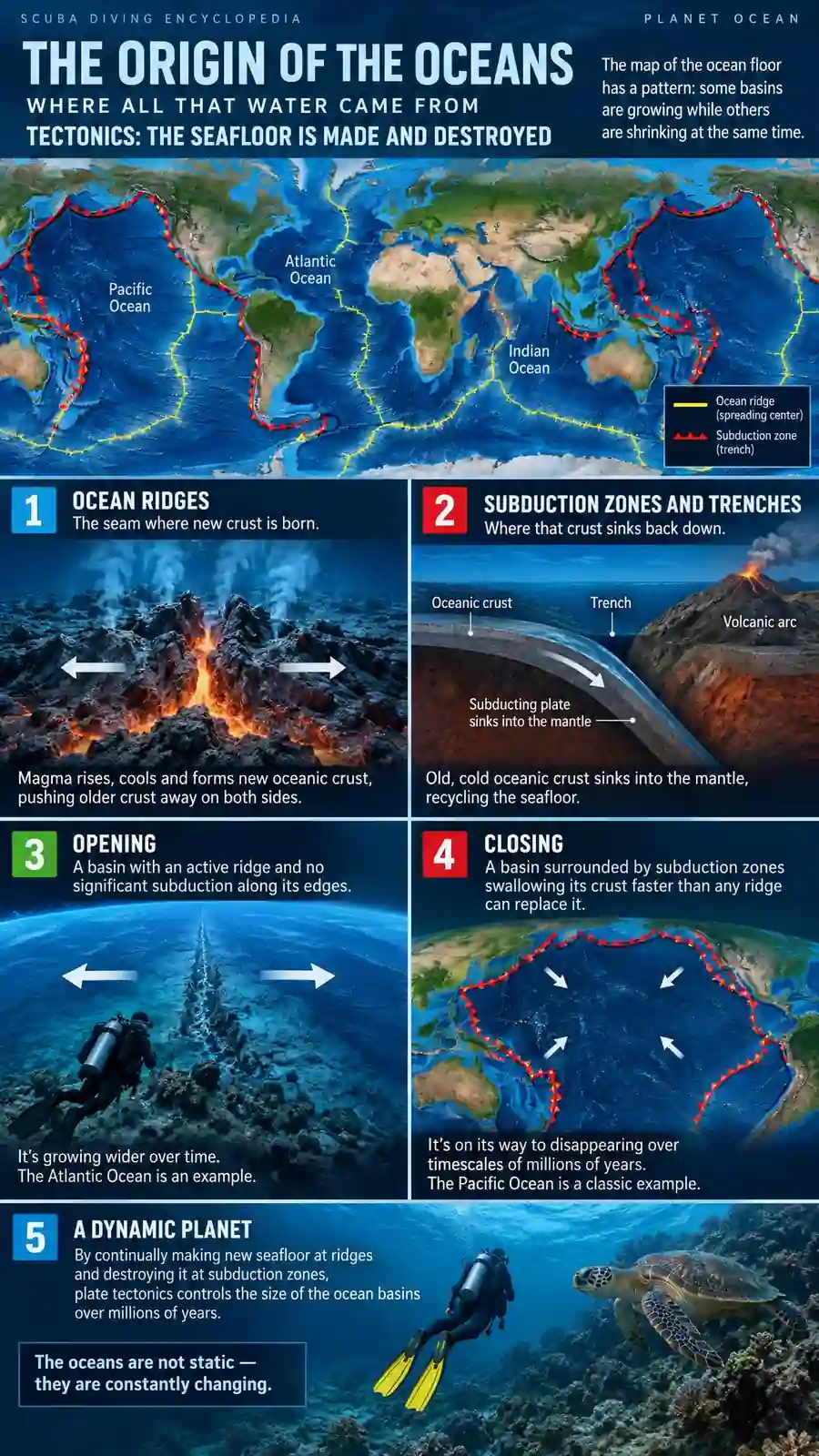
At mid-ocean ridges, submarine mountain ranges that run for tens of thousands of kilometers, mantle material rises and solidifies, creating new crust. That crust moves away from the axis on both sides, so the basin widens a few centimeters a year.
At the opposite extreme are subduction zones, where one plate sinks beneath another and oceanic crust is recycled back into the mantle. The deepest trenches on the planet, most major earthquakes, and volcanic island arcs all form over those zones.
Between the two, an arithmetic consequence: the ocean floor renews itself completely within a few hundred million years, which is why there's no old seafloor. All the earlier geological history is on the continents, not in the sea.
The movement also reorganizes entire oceans. The Atlantic opened a little over a hundred million years ago and is still widening; the Mediterranean is what's left of a much larger ocean that closed as Africa approached Eurasia; the Red Sea is a young basin opening right now that in millions of years will be an ocean.
And the ridges have an unexpected biological product: where water circulates through hot crust and emerges loaded with chemical compounds, hydrothermal vents appear, with communities that don't depend on the sun, as covered in the food chains article.
What you can see of all this underwater
The most elegant case is that of tropical volcanic islands. A volcano emerges, a fringing reef forms around it, the island slowly sinks and erodes while the coral keeps growing upward, and the end result is a ring of reef around a lagoon with no island in the center. That sequence, proposed by Darwin, is what explains the atolls in the reef-types article.
The vertical walls that divers love so much usually have a structural origin: shelf edges, faults, and block margins that subsided. A hundred-meter drop-off isn't a coincidence of terrain, it's a geological boundary.
The color of the sand gives away the rock: white in areas of coral-derived carbonate, black on young volcanic islands, golden where the input is continental. It's the fastest clue to a destination's geology.
The cenotes and flooded caves of many regions are ancient seafloors turned to limestone, uplifted, dissolved by rainwater during periods of low sea level, and reflooded afterward. Diving in one means moving through a cavity that formed on dry ground.
And there's a detail noticeable at any destination with tectonic activity: hot water springs, gas bubbles emerging from the substrate, and fields of fresh volcanic rock, all signs that the process is still underway.
Diving application
Look at the color and texture of the sand: it tells you whether the local rock is coralline, volcanic, or continental.
When you dive a wall, ask yourself why it's there: it's almost always a shelf edge or a fault, and that tells you in advance what current and what wildlife you'll find.
On tropical islands, notice the shape of the reef relative to the island (fringing, barrier, or atoll) you're looking at a specific stage of a sequence spanning millions of years.
In caves and cenotes, look at the formations: if there are stalactites, that cavity was once dry, and it's underwater today because sea level rose.
And if the destination has active volcanism, look for gas seeps and areas of warm water: it's the same process that builds ocean floor, seen up close.
Common mistakes
"The ocean floor is the oldest part of the planet."
It's one of the youngest: almost all of it is less than two hundred million years old because it's recycled at subduction zones, while continental crust is over four billion.
"The sea keeps getting saltier."
Rivers contribute salts, but they're also continuously removed through precipitation and hydrothermal circulation. Salinity stabilized a very long time ago.
"All the water in the oceans came from comets."
There are two sources (degassing from the interior and delivery by icy bodies) and isotopic comparison points to certain asteroids fitting better than comets.
Did you know…?
- During glacial maxima, sea level was more than a hundred meters below today's: many shelves that are dived today were dry land.
- The oxygen released by the first photosynthetic organisms was consumed oxidizing the sea's dissolved iron before it could accumulate.
- The Red Sea is a basin in formation: it's opening right now, and in millions of years it will be an ocean.
Key takeaways
- Water arrived through two pathways: degassing from the planet's interior and delivery by icy bodies.
- The primitive ocean had no oxygen, and it was life that transformed it into today's.
- Sea level has changed by more than a hundred meters through glacial cycles, and that shaped the coasts you dive.
- Tectonics builds seafloor at the ridges and destroys it at subduction zones: that's why there's no old seafloor.
- Atolls, walls, sand color, and cenotes are direct readings of that geological history.